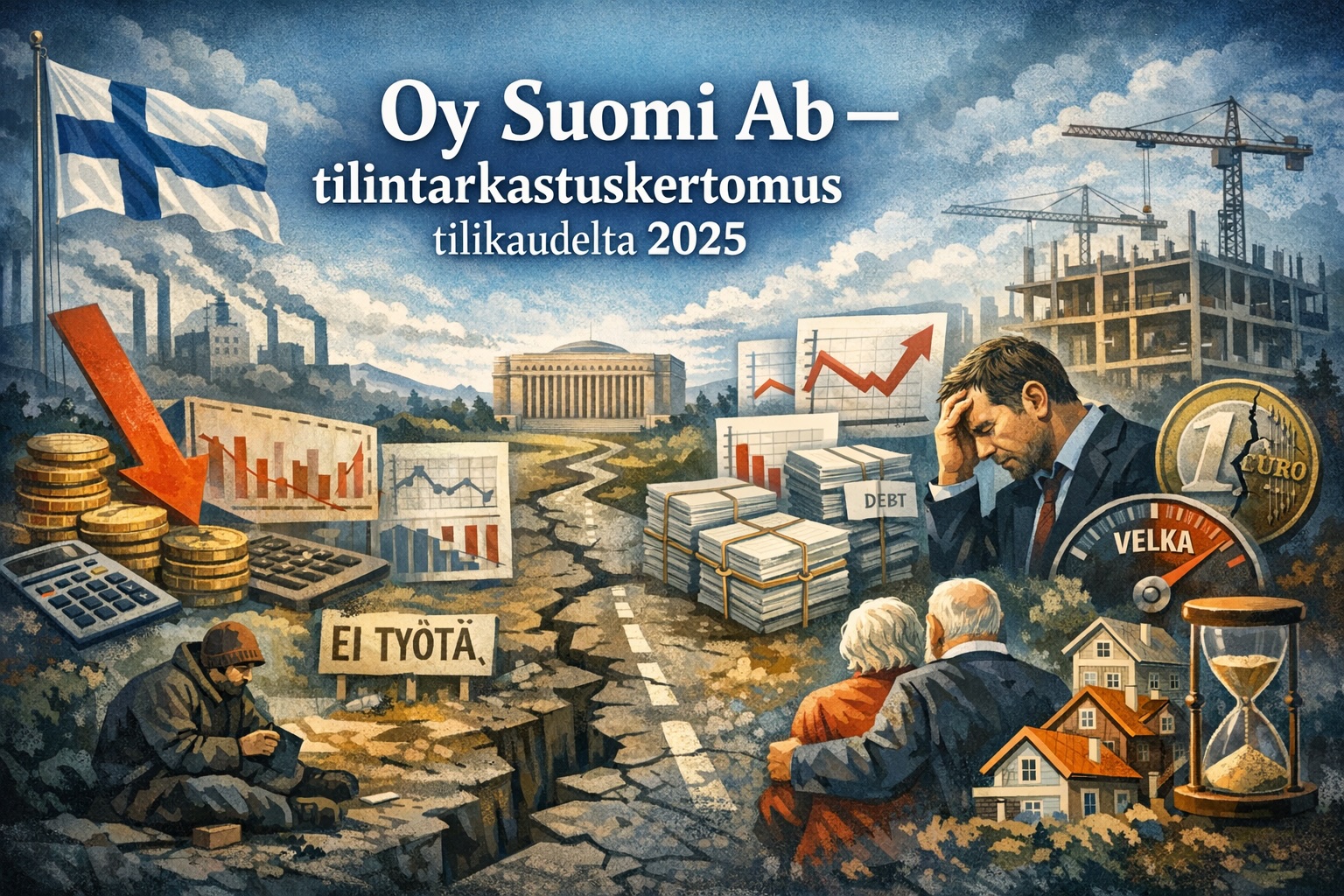
Finland Inc: Financial Statements, Auditor's Report, and Analyst Assessment
13 February 2026 | Oy Suomi Finland Ab
When narrative and facts don't align: Finland's economy examined as a publicly listed company
Introduction: Why This Analysis?
Think of Finland as a publicly listed company. Not as a metaphor, but as an analytical framework.
A listed company has an income statement, a balance sheet, a cash flow statement, management, a board of directors, shareholders, and an auditor. It has forecasts that either materialise or don't. It has competitors. It has an R&D pipeline that either produces innovation or withers. It has personnel who are either productively employed or not.
All of these elements exist in a national economy too. The difference is how they are discussed.
The management of a listed company cannot tell investors that "recovery has begun" when revenue is falling, staff are being laid off, and the balance sheet is deteriorating. Investors read numbers, not rhetoric. Financial market regulators intervene when forecasts are misleading.
In Finland's public discourse, no such oversight exists — so this article can serve that purpose.
This article examines Finland's economy from three perspectives:
- Auditor's Report — what an auditor would record
- Analyst Assessment — what an investment analyst would recommend
- Special Reviews — the property market, the energy paradox, and the impact of AI
All figures are based on public data from Statistics Finland, the Ministry of Economic Affairs and Employment (TEM), the Ministry of Finance (VM), the Finnish Association of Real Estate Agents (KVKL), Fingrid, and Nord Pool as of February 2026. Nothing is fabricated. Everything is verifiable and can be found at this link.
Our framing analysis shows that no Finnish media outlet presents these figures in one place. This article does.
Financial Summary
In plain terms: Finland is a company that loses 49 million euros per day and has done so for 18 consecutive years. Of its workforce, 351,500 people are without work, and for 92 per cent of them, no positions exist. New business registrations are down by a quarter compared to a year ago. Old businesses are dying at a record pace.
The company's largest asset, its housing stock, is losing value every month. In real terms, the decline is already 20–25 per cent from the peak. Property time-on-market continues to lengthen, meaning the price floor has not been found. In Lahti, Jyväskylä, Tampere, and Vantaa, unemployment stands at 15–18 per cent and properties sit on the market for months. A person whose home will not sell cannot relocate for work. A mobility lock feeds unemployment, which feeds the mobility lock.
At the same time, the company produces more electricity than it consumes, yet pays double the price for it. In January 2026, the spot price of electricity was up 122 per cent year-on-year. In February, close to triple. This does not show up in the inflation figure, but it shows up in electricity bills: 200–300 euros per month extra — hitting precisely the people with the least financial buffer.
Meanwhile, something is happening in the background that no one speaks about openly: AI is replacing knowledge work at an exponential rate. The AI models released in February 2026 are near-AGI level and already code nearly all of their own successors. Our three-exponentials model shows that 200,000–225,000 knowledge-work jobs face exposure over the next three years — faster than we estimated as recently as January.
The official forecast promises that everything will turn around. The data tells a different story. A consumer confidence reading of -41.8 tells us the citizens already know, even if no one is telling them.
CEO's Review
New Year's Address by President of the Republic Alexander Stubb, 1 January 2026
The CEO of Finland Inc opened 2026 with a review whose core message was familiar: "We have nothing to worry about. We will manage. And this year, we will manage even better."
The CEO presented three strategic objectives for the year: peace, growth, and caring. He stated that the company is "by nearly all international metrics, one of the best in the world." He highlighted the company's strengths: education, security, supply security, data networks, quantum technology, and critical minerals.
On the economy, the CEO said he was "concerned about the state of public finances." He praised the parliamentary consensus on a debt brake and stated that growth is "the foundation of the welfare society." He acknowledged that cuts alone are not enough, nor does increasing expenditure lead to salvation. Structural reforms are "always difficult."
He mentioned AI and technology as opportunities but made no reference whatsoever to their labour market impact. He spoke of growth but did not yet know about January's -28.4 per cent collapse in business registrations. He spoke of caring and acknowledged that not everyone is doing well — "there are financial difficulties, there is unemployment, there is insecurity" — but did not quantify any of these.
Auditor's note: The CEO's review follows the same template as the previous year's. In the 2025 address, the message was identical: "We have nothing to worry about. We will manage." At that time, there were approximately 290,000 unemployed. Now there are 351,500. The message did not change, even though the income statement did.
In a listed company, the CEO's review is read against the income statement. If the review speaks of "growth" and "managing" while revenue stagnates, staff are being laid off at record pace, and the balance sheet deteriorates, investors draw their own conclusions.
The consumer confidence reading of -41.8 tells us that Finland Inc's "shareholders" have already drawn theirs.
Part I: Auditor's Report for the Financial Year 2025
Auditor's Opinion: QUALIFIED (conditional)
We have audited the financial statements of Finland Inc for the period 1 January – 31 December 2025. We are unable to issue an unqualified opinion.
1. Structural Imbalance Between Revenue and Expenditure
| Item | Figure | Change |
|---|---|---|
| Revenue (tax income) | EUR 83.8 bn | +2.6% |
| National debt | EUR 242.4 bn | +10.3% (+EUR 18 bn) |
| Daily debt financing requirement | EUR 49 m | — |
| Duration of deficit | 18 consecutive years | — |
The company finances its operating expenses with debt at a rate of 49 million euros per day. This cannot be called investment, because investment carries an expected return. This is the financing of running costs.
In a listed company, this would prompt an immediate question: why does operating cash flow not cover operations? The answer: expenditure structurally exceeds revenue, and management has not corrected the situation in 18 years.
2. Human Resources: Critical Observation
| Metric | Figure |
|---|---|
| Unutilised workforce (TEM) | 351,500 persons (13.0%) |
| Long-term unemployed (over 12 months) | 39.2% of unutilised |
| Over 55 years old | 34.1% of unutilised |
| Youth unemployment (15–24 years) | 22.9% |
| Tightness ratio | 0.08 |
| Open positions | 29,320 |
A tightness ratio of 0.08 means that for every open position, there are 12 unemployed people. This is not a matching problem. This is a demand collapse.
No listed company would explain "talent shortages" to its investors if 92 per cent of open positions go unfilled relative to supply. The company's workforce strategy lacks both a redeployment programme for older workers and an onboarding pipeline for younger ones.
3. R&D: Burning the Pipeline from Both Ends
| Metric | Figure |
|---|---|
| New businesses (January 2026) | -28.4% |
| Bankruptcies (2025) | 3,906 (record in 27 years) |
| Lost person-work-years | 14,300 |
| Share of growth-oriented companies | 6% (record low) |
| Open positions vs. 2021 peak | -53% |
This is the single most alarming finding of the audit: business registrations collapsed by -28.4% in January 2026, and this was not reported in Finnish media.
In listed-company terms: the company is burning its R&D pipeline from both ends. Nothing new is being created; the old is dying. This is not "creative destruction," because creative destruction requires that something new emerges to replace the old. Destruction alone is just destruction.
4. Balance Sheet: Erosion of Assets
| Item | Status |
|---|---|
| Older apartment blocks | -1.7% YoY |
| Helsinki metro area studios from peak | -20% |
| Eastern Finland, housing wealth 2016→ | -EUR 28,700 / household |
| Building permits | -11% |
| Real prices from peak (nationwide) | -20% |
| Municipal debt | +17.8% |
The company's most significant balance sheet item, the housing stock, is declining in value. Management speaks of "recovery" citing a +10.7% increase in transaction volumes, but omits the fact that volume remains -16.8% below the five-year average.
In a listed company, this would be recorded as an impairment of assets. Value is evaporating from Finland Inc's balance sheet, and management is framing it positively.
5. Going Concern Uncertainty
| Metric | Figure |
|---|---|
| Debt ratio | 86.6% of GDP |
| VM forecast 2030 | 96+% |
| Inflation | 0.2% |
| 10-year bond rate | 3.25% |
| Real interest rate | ~+3.0% |
| Dependency ratio | 61.7 |
Debt dynamics in a zero-inflation environment are mathematically merciless. When inflation is 0.2 per cent and the nominal interest rate is 3.25 per cent, debt does not "melt away" — it grows in real terms. Every borrowed euro is more expensive than it looks on paper.
We do not recommend removing the going concern qualification. The company is able to service its debt in the short term, but the pace of indebtedness combined with zero inflation, a shrinking business sector, and a rising dependency ratio creates a dynamic that is not sustainable over the medium term.
6. Credibility of Management Forecasts
| Forecast | Forecaster | Forecast | Actual | Variance |
|---|---|---|---|---|
| Unemployment | VM | 8.8% | 10.7–13.0% | +2–4 pp |
| Unemployment | Labore | 8.5% | 10.7–13.0% | +2–5 pp |
| GDP growth | VM | 0.6% | ~0.2% | -0.4 pp |
A systematic guidance miss — four inconsistencies out of six claims. In a listed company, repeated forecast failures lead to a loss of confidence and a "management credibility discount": the next forecast is not believed either, which weakens the company's ability to raise capital on favourable terms.
Part II: Special Review — Property Market
Four Cities, One Story
| Lahti | Jyväskylä | Tampere | Vantaa | |
|---|---|---|---|---|
| TEM unemployment | 17.9% | 16.5% | 16.2% | 14.9% |
| Change YoY | +2.0 pp | +1.1 pp | +2.1 pp | +1.4 pp |
| Price per m² (€/m²) | ~1,607 | ~1,700 | ~2,912 | ~2,607 |
| Time on market (2025) | 113 days | 105 days | 248 days | 180 days |
| Prices YoY | -11.3% | declining | -2.0% | -5.9% |
These figures together tell a story that no one is telling as a whole.
The Mechanism: Unemployment → Mobility Lock → Price Correction
Phase 1: Unemployment freezes demand. When a city has 16–18 per cent unemployment, a significant share of potential buyers lacks purchasing power — but more importantly, the uncertainty effect kicks in: even those who have jobs do not dare make the largest investment of their lives when the risk of redundancy feels real.
Phase 2: Time on market lengthens. KVKL CEO Viljamaa states directly in the January 2026 review: a turn towards rising prices would require that time on market first shortens and supply contracts. Neither is happening. In Tampere, time on market is 248 days — over 8 months. That is an exceptional figure for a major growth city.
Phase 3: Mobility lock. When a property will not sell, a person cannot relocate for work. When a person does not relocate, the matching problem deepens. When the matching problem deepens, unemployment remains high. The cycle feeds itself.
Phase 4: Price correction. In real terms, it has already happened: nationwide, -20 per cent from the 2021 peak; in Helsinki, -25 per cent. Real housing prices have returned to early-2000s levels. The question is whether a corresponding decline will come in nominal prices — and the answer depends on whether time on market turns around.
It is not turning around. In January 2026, time on market lengthened again.
City-by-City Situation
Tampere is the darkest case in the data. Time on market 248 days, unemployment up 2.1 percentage points, prices down 15 per cent from peak. Tampere's mayor speaks optimistically about population growth, but that is a supply argument, not a demand one.
Lahti already has low price levels (EUR 1,607/m²), but the decline accelerated: city centre prices fell -11.3 per cent year-on-year. Unemployment at 17.9 per cent is the highest of these four. The price floor has not been found. The Indoor Group / Asko bankruptcy in February 2026 darkens the picture further.
Jyväskylä competes with Tampere for the same talent — and loses. Central Finland is one of the least developed regions.
Vantaa is the weakest link in the capital region. Prices -5.9 per cent YoY, time on market 180 days. Heavy new construction in the early 2020s created oversupply that is pushing down the prices of older properties.
Auditor's Addendum
The property portfolio across these four cities would require an impairment write-down. An accountant cannot carry 2021 peak values on the balance sheet when market value has declined by 15–25 per cent in real terms and nominal declines continue as a trend.
The number of apartment blocks listed for sale exceeds 19,000, a record. Total residential transactions in January 2026 came to 3,483 — down 7.6 per cent from the previous year and -16.8 per cent below the five-year average.
Part III: Special Review — The Energy Paradox
A Net Exporter Paying Double the Price
| Metric | Figure |
|---|---|
| Electricity production | 15,216 MW |
| Electricity consumption | 13,081 MW |
| Net status | Exporter (+2,135 MW) |
| Spot price January 2025 | 6.63 c/kWh |
| Spot price January 2026 | 14.7 c/kWh |
| Change YoY | +122% |
| February 2026 forecast | 19.05 c/kWh (~3x last year) |
| Wind power range | 0–7,400 MW |
Figures from Friday 13 February 2026
Finland produces more electricity than it consumes. Yet January's spot price was up 122 per cent year-on-year. In early February, prices exceeding 80 c/kWh were observed — levels on par with the energy crisis.
Why does a net exporter pay peak prices?
Three reasons, all of them structural:
Marginal pricing. On the Nord Pool electricity market, the price is set by the most expensive form of generation required. When wind drops out and frost drives consumption to its peak, the last megawatt is produced by expensive reserve capacity — and all electricity is priced accordingly. Wind and nuclear producers receive the marginal price, not their cost price. Profit leaks through the market mechanism.
Weather dependence. Ice forming on wind turbine blades knocked hundreds of megawatts of production offline at precisely the most critical moments. On paper, capacity is sufficient — in reality, it is not, when it is needed most.
Interconnectors. Electricity in Sweden's price zones is many times cheaper, but transmission capacity is insufficient. Finland is an "electricity island."
The Invisible Tax: Devouring Purchasing Power
Official inflation is 0.2 per cent. Let us look at what happens inside a household:
| January 2025 | January 2026 | Difference | |
|---|---|---|---|
| Electricity bill (2,500 kWh) | EUR 166 | EUR 368 | +EUR 202 |
| February forecast | ~EUR 149 | ~EUR 476 | +EUR 327 |
This is 200–300 euros per month in additional costs for a household — costs that do not fully appear in the inflation figure, because electricity is only one component of the CPI and the cheap summer months weight down the annual average.
Whose wallet does this come from? Precisely those who are already under pressure. Electrically heated detached houses are typically located outside urban centres — exactly where unemployment is highest, property values have fallen the most, and mobility is hardest. The energy price spike hits regressively: it strikes hardest those who have the least buffer.
Auditor's Additional Note
The company has invested significantly in renewable energy infrastructure and achieved a production surplus. The auditor notes, however, that the marginal pricing mechanism prevents the benefit of this surplus from reaching the company's employees and customers. The production surplus transfers as export revenue to neighbouring companies, but peak-hour import dependence drives up costs at the most critical times.
The return on investment does not materialise in the company's own results — it leaks through marginal pricing into the market.
Finland built a wind farm but forgot to build walls around it.
Part IV: Special Review — The Silent Disruption
AI and the Disappearance of Work
In January 2026, Amazon laid off 16,000 employees. The Pirkanmaa wellbeing services county launched the largest redundancy negotiations in Finnish history, affecting 18,000 employees. Neither said the word "AI" out loud.
On 5 February 2026, Anthropic released Opus 4.6 and Codex 5.3. These models are near-AGI level. Both Anthropic and OpenAI have stated that AI already codes nearly all of its own new versions. This is not a prediction about the future — this happened last week.
Our Silent Disruption analysis from January predicted the arrival of AI's three exponentials. The data shows that development has accelerated since our analysis was published. The speed has roughly doubled.
Updated Three-Exponentials Model
| Original estimate 2029 | Updated estimate 2028 | |
|---|---|---|
| Adoption breadth | 85% | 85% |
| Internal depth | 65% | 70% |
| Capability | 85% | 90% |
| Effective impact | 47% | 54% |
The product of three exponentials — what share of knowledge work is exposed to AI impact:
- 2025: 0.38 × 0.15 × 0.30 = 1.7%
- 2026: 0.55 × 0.25 × 0.50 = 6.9%
- 2027: 0.70 × 0.45 × 0.70 = 22%
- 2028: 0.85 × 0.70 × 0.90 = 54%
Finland has approximately 1.5 million knowledge-work jobs. If 54 per cent of them are exposed to significant AI impact by 2028 and 35–40 per cent of this materialises as actual job losses, we are talking about 280,000–320,000 jobs.
When accounting for 30 per cent re-employment, the net addition to the unemployed is 200,000–225,000 people — faster than we previously estimated.
Why the Silence
The answer is the same as with TEM's employment forecasts: social stability.
Consider what would happen if the government said out loud: "AI will replace over 200,000 jobs within the next three years. We do not know what will happen to these people."
The political pressure would be immediate. That is why the talk is of "process development" and "customer orientation." The rhetorical formula is identical from Seattle to Tampere. It is a global script: human labour is being replaced by machines, and this is concealed behind euphemisms.
Updated Triple Pressure
| Pressure factor | Original impact 2027 | Updated impact |
|---|---|---|
| Direct cost of unemployment | +EUR 4.8 bn/year | +EUR 6–8 bn/year (AI unemployment) |
| Pension expenditure growth | +EUR 6.5 bn/year | +EUR 6.5 bn/year |
| Tax base erosion | -EUR 1.4 bn/year | -EUR 2.5–3.5 bn/year |
| Total | EUR 12.8 bn/year | EUR 15–18 bn/year |
This equals 18–21 per cent of the state budget — without a single new policy decision.
Part V: Analyst Assessment
Recommendation: UNDERWEIGHT
Fundamental Analysis
Revenue: Weak (+2.6%). No organic growth engine. Exports -5.1%, imports -9.6%, trade balance EUR 2.6 billion in deficit.
Profitability: Negative. Losses of ~EUR 49 m/day. Consumer confidence: "Finland now" -41.8, 12-month outlook -16.0. Crisis-level pessimism by international comparison.
Balance sheet: Deteriorating. Assets (housing) declining, debt rising. The Maastricht 60% threshold clearly exceeded (86.6%). Municipal debt +17.8%.
The only structural strength: Energy infrastructure. The production surplus is a genuine strategic advantage, but marginal pricing prevents the benefit from materialising — and this would require regulatory intervention that management has not undertaken.
Management Credibility Assessment
Systematically over-optimistic forecasts:
- VM: unemployment 8.8% → actual 10–13%
- Labore: 8.5% → even further off
- GDP growth: 0.6% → actual ~0.2%
Management communication is contradictory. The government blames its predecessors ("18 years"). The opposition blames the government. Neither presents a credible plan for correcting the structural deficit.
In a listed company, repeated guidance misses lead to a management credibility discount → more expensive capital → weaker ability to invest → weaker growth. A spiral.
Special note: Management makes no mention of AI's labour market impact in the company's strategy or forecasts. Like a 1990s company that would not mention the internet — or like Nokia, which refused to believe in touchscreens, and everyone knows how that ended. This is either ignorance or deliberate silence, and both erode credibility.
Risk Matrix
Short term (0–12 months):
Rising unemployment weakens tax revenue, increases social expenditure → negative spiral. The collapse in business registrations (-28.4%) foreshadows a weakening of hiring capacity with a 6–12 month lag. Energy price spikes consume household purchasing power at the worst possible time.
Medium term (1–5 years):
Debt dynamics in zero inflation. Debt/GDP exceeds 100% before the end of the decade → a fresh reaction from credit rating agencies is likely. AI's labour market impact materialises: 200,000+ knowledge-work jobs exposed. Real housing price decline continues; a nominal correction of 10–20 per cent is probable, particularly in high-unemployment cities.
Structural horizon (5–15 years):
Dependency ratio 61.7%, share of population aged 65+ at 23.6%, share aged 0–14 at 14.6%. Net immigration of +18,262 is insufficient. The labour force reserve shrinks every year. Without a dramatic productivity leap or significantly higher immigration, the tax base narrows.
Overall Assessment
This is a company whose net asset value is slowly declining, whose earnings growth is negative, whose management issues repeated profit warnings after the fact, whose only competitive advantage (energy) fails to generate returns due to a regulatory failure, and which has not identified its greatest business risk (AI) in its strategy.
Recommendation: UNDERWEIGHT. Do not sell in a panic, because the company has genuine intellectual capital, infrastructure, and institutional strength — but given current management credibility and the structural trajectory, this is not a position to increase.
Part VI: Two Spirals That No One Is Drawing
The core of this analysis lies in what happens when all of the above factors are placed on the same page. No Finnish media outlet does this. Not Yle, not Helsingin Sanomat, not Kauppalehti. Each reports on its own sector, and the whole picture vanishes.
Spiral 1: The Freezing of the Real Economy
Business deaths (-28.4%) → unemployment rises (13–17.9%) → properties do not sell (113–248 days) → mobility lock → matching problem deepens → unemployment becomes structural → tax revenue falls → debt ratio rises
Spiral 2: The Erosion of Purchasing Power
Energy spot price +122% → household disposable income falls → consumer confidence remains at rock bottom (-41.8) → purchase intentions remain at record lows → housing market does not recover → price correction continues → balance sheet values fall → negative wealth effect → consumption contracts further
And in the background:
Spiral 3: AI's Labour Market Impact
AI replaces knowledge work exponentially → 200,000+ jobs exposed → traditional solutions (retraining) cannot keep up → structural unemployment rises → tax base narrows → the triple pressure on public finances accelerates
These three spirals feed one another. Not one of them can be stopped by a single policy measure.
In Closing: Why the Silence
Because social stability demands it.
Consider what would happen if the Ministry of Finance published a forecast: "Unemployment will rise to 16–17 per cent by 2028. Real housing prices have fallen by a quarter. Our energy infrastructure does not benefit our citizens. AI will eliminate hundreds of thousands of jobs. We do not know how to solve this."
The political pressure would be immediate. The media would demand action. Citizens would ask why the government is doing nothing. The opposition would demand resignations. Markets would react. Confidence would collapse.
That is why forecasts are built to show light at the end of the tunnel. There is always a turning point coming: next year, the day after tomorrow, any moment now. This is not a conspiracy — it is the built-in logic of the system. Institutions cannot produce hopelessness, because their function is to maintain stability.
Reality does not care about the needs of institutions.
Official inflation is 0.2 per cent. A household in Lahti pays 200 euros more for electricity in January, loses 11 per cent of its home's value, and reads in the newspaper that "recovery has begun." The consumer confidence reading of -41.8 on the "Finland now" index tells us that citizens know the truth, even if no one is telling them.
The five mechanisms analysed here — the income statement deficit, the freezing of the property market, the energy paradox, the AI disruption, and the lack of credibility in management forecasts — are not five separate problems. They are one problem viewed from five angles.
That problem is: Finland Inc's business model was built for a world that no longer exists.
This analysis is based on public data from Statistics Finland, the Ministry of Economic Affairs and Employment (TEM), the Ministry of Finance (VM), the Bank of Finland, the Finnish Association of Real Estate Agents (KVKL), Fingrid, Nord Pool, Nasdaq Commodities, and Anthropic. Calculations are based on Okun's law (coefficient 0.35), a labour market net flow model, and a three-exponentials product model. Property data: KVKL Price Monitoring Service, Statistics Finland. Energy data: Nord Pool, Fingrid, Helen. AI estimates are the authors' own.
All figures are public and verifiable.