
The Silent Disruption No One Is Talking About
Why official economic forecasts are built on mathematics that hasn't been invented yet — and what the data actually says
A Forecast That Requires a Miracle
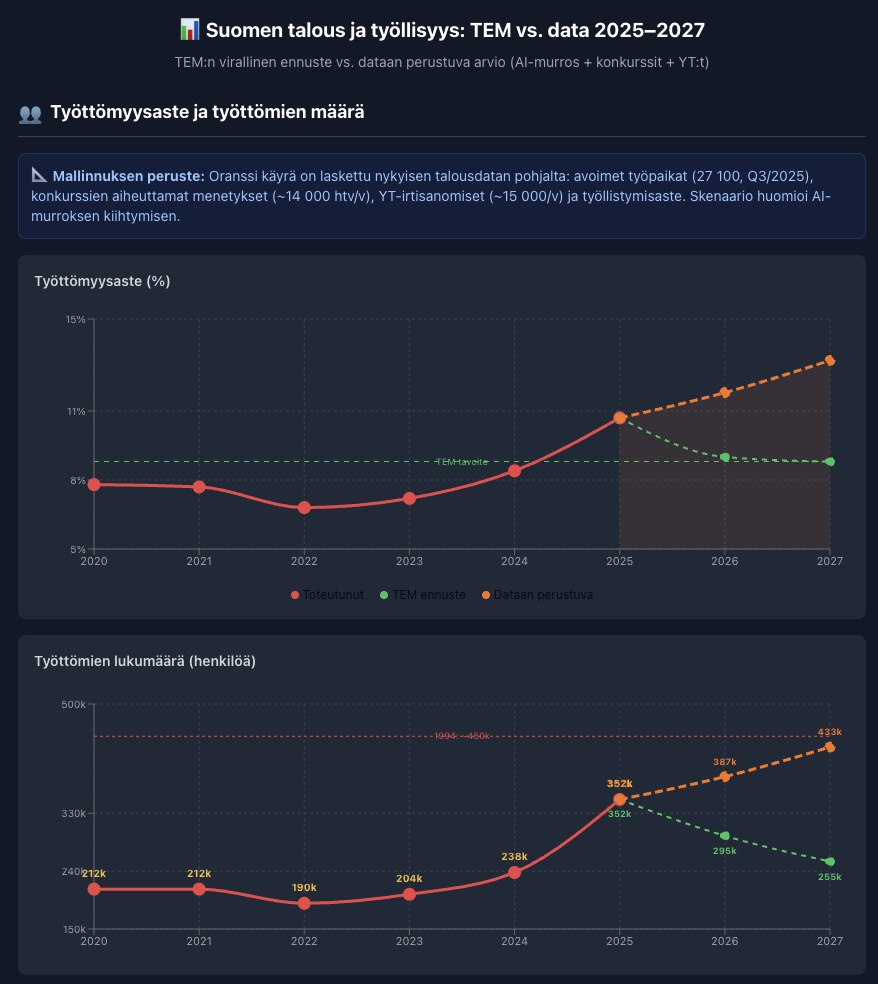
The Ministry of Economic Affairs and Employment (TEM) forecasts that Finland's unemployment rate will drop to 8.8 per cent by 2027. Currently it stands at 10.7 per cent, with 351,500 people out of work. For TEM's forecast to materialise, nearly 100,000 people would need to find employment within two years.
This sounds hopeful. It is also mathematically impossible.
In economics, Okun's Law describes the relationship between unemployment and economic growth. According to this principle, a 1.9 percentage point drop in unemployment — from 10.7 to 8.8 per cent — would require approximately 6.8 per cent cumulative GDP growth over two years. That means an average annual growth rate of 3.4 per cent.
The Bank of Finland's forecast for the same period is 2.1 per cent. The Ministry of Finance's estimate is in the same range. Finland's average annual GDP growth over the past 17 years has been 0.4 per cent. The last time Finland grew at over three per cent annually was during the Nokia boom, between 1995 and 1999.
TEM's employment forecast and every other institution's GDP forecasts are in direct contradiction with each other. Both cannot be true. One is wrong — and based on the data, it is TEM's employment forecast.
Why does a ministry publish a forecast whose fulfilment would require economic growth Finland has not seen in a quarter of a century?
The answer is: social stability.
This Is the Truth No One Can Say Out Loud — But I'll Say It Anyway
Imagine what would happen if TEM published this forecast: "Unemployment will remain above 10 per cent for the next five years. A structural transformation has begun, and there is no going back."
(The above is the truth being suppressed. And will be, for a long time yet.)
In any case, the political pressure would be immediate if the truth were told. The media would demand action. Citizens would ask why the government is doing nothing. The opposition would demand resignations. Markets would react. Confidence would collapse.
That is why forecasts are constructed to show light at the end of the tunnel. There is always a turning point on the horizon: next year, the day after tomorrow, any moment now. This is not a conspiracy — it is the built-in logic of the system: institutions cannot produce hopelessness, because their function is to maintain stability.
Reality does not care about what institutions need.
In January 2026, redundancy negotiations are rolling on like a steam train without brakes: the Pirkanmaa wellbeing services county (18,000 employees within scope), Telia, Posti, Helen, Foodora, Toyota. In 2025, there were 3,906 bankruptcies — a record in 27 years. 14,300 person-years of work were lost. Open job vacancies have collapsed by 53 per cent from their 2021 peak.
Where are the signs of a turnaround? There are none.
Icebreaker contracts and defence industry growth are often cited as glimmers of hope. They are real, but the scale is wrong. Even if defence exports grew from €2.6 billion to €10 billion by 2030, this would employ thousands of people. There are 351,500 unemployed. The mathematics does not add up.
Two Worlds, Same Rhetoric
In January 2026, Amazon announced it would lay off 16,000 employees. On 28 January, the Pirkanmaa wellbeing services county launched the largest redundancy negotiations in Finnish history, covering 18,000 employees.
Amazon CEO Andy Jassy spoke of "layers of bureaucracy" and "increasing organisational agility." Pirha's management spoke of "harmonising operations" and "streamlining administration."
Neither said the word out loud that connects both: artificial intelligence.
Amazon is investing $125 billion in data centres and has stated it uses generative AI to replace administrative work. Pirha is deploying an AI assistant that produces summaries of patient records, but this was not mentioned in the redundancy announcement. Next in line are doctors, whose diagnostic work will soon be performed by AI, leaving physicians at the primary care level with little more than writing prescriptions. It is already a statistical fact that AI can produce categorically higher-quality diagnoses than any human doctor.
Why the rhetoric and euphemisms?
Because telling the truth would be politically, legally, and socially impossible. "We are laying you off because a machine does your job more cheaply" is a sentence no one can say out loud. Instead, they speak of "developing processes," "customer-centricity," and "responding to future needs."
The rhetorical formula is identical from Seattle to Tampere. It is a global script, repeated in every country, every industry, every organisation. The words change; the meaning stays the same: human labour is being replaced by machines, and this is concealed behind euphemisms.
Exponential Blindness
The human mind is built for linear thinking. On the savannah, there were no exponential threats. If a lion approached, it approached at a steady speed — not accelerating. That is why our brains cannot intuitively process growth that doubles at regular intervals.
This is one reason why the impact of AI is systematically underestimated.
The share of companies using AI in Finland has doubled in two years: from 15 per cent to 38 per cent. Between 25 and 30 per cent of the code produced by Microsoft and Google is already written by AI. According to Bloomberg, 40 per cent of working hours are automatable with current technology — not future technology, but what already exists.
The nature of exponential growth is that most of the change happens at the very end. If a process doubles every year and is currently at 5 per cent, it looks slow — but in three years it will be at 40 per cent. In five years, over 100 per cent: everywhere.
This means that all forecasts based on current data and linear extrapolation are wrong. They underestimate both the speed and the scope of the change. Once generative AI reaches critical mass, even today's "realistic" forecasts will be headed for the scrapheap.
The Product of Three Exponentials
AI's impact on the labour market is not a single exponential — it is the product of three.
The first is adoption breadth: how many companies use AI. In 2025, the figure is 38 per cent. By 2029, it is estimated at 85 per cent.
The second is internal depth: how extensively AI is used within the companies that have adopted it. In 2025, an average of 15 per cent of processes. By 2029, an estimated 65 per cent.
The third is capability: how much of any given task AI can perform. In 2025, approximately 30 per cent. By 2029, an estimated 85 per cent.
The effective impact is the product of these three figures:
- 2025: 0.38 × 0.15 × 0.30 = 1.7%
- 2029: 0.85 × 0.65 × 0.85 = 47%
This means that AI's effective impact on knowledge work grows from 1.7 per cent to 47 per cent in four years. Finland has approximately 1.5 million knowledge-work positions. If 47 per cent of them are exposed to significant AI impact and 35–40 per cent of that materialises as actual job losses, we are talking about 240,000–280,000 jobs.
Factoring in a 30 per cent re-employment rate, the net addition to the unemployment rolls is 170,000–200,000 people by 2029.
This would push the unemployment rate to 16–17 per cent — the level of the 1990s depression.
The Numbers No One Wants to Hear
Let us look at what the statistics actually say:
There are currently 351,500 unemployed. In 2022, the figure was 190,000. That is an increase of 161,500 people — 85 per cent — in three years.
In 2025, there were 3,906 bankruptcies. A 27-year record. 14,300 person-years of work were lost.
In the third quarter of 2025, there were 27,100 open vacancies. The 2021 peak was 57,900. That is a 53 per cent decline.
In 2025, an estimated 13,500–16,000 people were laid off or placed under threat of redundancy through co-determination negotiations. In January 2026, the wave continues: Pirha, Telia, Posti, Helen, Foodora, Toyota.
These are not random cyclical fluctuations. This is a trend with no slowdown in sight.
Mathematical Impossibility
TEM's forecast of unemployment falling to 8.8 per cent by 2027 would require the number of unemployed to decrease from 351,500 to approximately 255,000. That would mean 96,500 people finding employment in two years.
Consider the labour market flow model:
New unemployed entering the system each year total approximately 40,000–50,000: bankruptcies account for roughly 14,000 person-years lost, redundancy negotiations for approximately 10,000–15,000, and normal turnover for the rest.
Approximately 25,000–30,000 find employment each year: there are roughly 27,000 vacancies per quarter, of which 65 per cent are filled, and of those, 30–40 per cent go to the unemployed.
The net flow is therefore +10,000–20,000 additional unemployed per year — not the -50,000 that TEM's forecast would require.
For TEM's forecast to materialise, the number of open vacancies would need to double OR bankruptcies and layoffs would need to collapse. Neither is in sight.
Triple Pressure
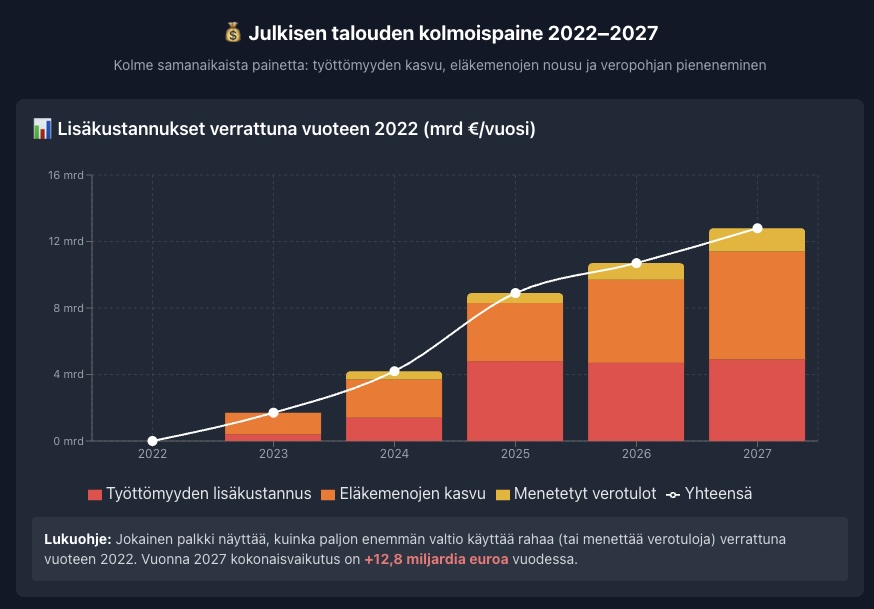
Rising unemployment is not the only problem. Finland's public finances are being squeezed simultaneously by three forces.
The first is the direct cost of unemployment. A single unemployed person costs the state an average of €30,000 per year: unemployment benefits, housing allowances, and lost tax revenue. With 161,500 more unemployed than in 2022, the additional cost is €4.8 billion per year.
The second is rising pension expenditure. The baby boomer generation is retiring, and pension spending has risen from €34.5 billion (2022) to an estimated €41 billion (2027). An increase of €6.5 billion per year.
The third is the shrinking tax base. The number of employed has fallen from its 2023 peak (2,628,000) to an estimated 2,550,000 in 2027. Each employed person generates an average of €20,000 in tax revenue for the state. The decline means a €1.4 billion annual loss.
Combined, this triple pressure creates €12.8 billion in additional annual strain on public finances in 2027 — compared to 2022. This equals 15 per cent of the state budget.
The dependency ratio — the number of dependants per hundred employed — has risen from 66 (2022) to an estimated 78 (2027). For every hundred employed people, there are now 12 more dependants than five years ago.
Not a Cycle — a Disruption
It is tempting to think this is simply a deeper recession, one that will pass like those before it. It is not.
Recessions are cyclical: demand collapses, production adjusts, eventually growth returns and employment follows. Recovery from the 1990s depression took a decade, but it happened — because the nature of work did not change. The same jobs returned when the economy recovered.
What is changing now is the nature of work itself. AI does not reduce demand — it eliminates the need for supply: it makes human labour unnecessary. When a machine does the same work more cheaply and better, the work does not return when the cycle turns. It is gone permanently.
Traditional solutions do not work. Retraining takes years; AI's capabilities grow in months. By the time a person qualifies for a new profession, AI is already there. Historically, the emergence of new industries has compensated for the decline of old ones — but now the change is so rapid and so broad that compensation cannot keep pace.
Preparedness Begins with Understanding
This analysis is not intended to frighten. It is intended to prepare.
False hope is worse than a hard truth, because it prevents preparation. Those who believe the official forecasts do not prepare. They do not save. They do not retrain. They do not question — and when reality hits, it hits the unprepared.
The official forecasts are not internally consistent. TEM's employment forecast and the GDP forecasts are in contradiction. The statistics tell an entirely different story from the rhetoric. Euphemisms are concealing a transformation that is already underway.
The change is not coming. It is already here, and it is accelerating.
Society must ultimately confront the questions it has been avoiding: How is income distributed when there is not enough work for everyone? What is a person's value and purpose when machines do everything we once considered human labour? How do you build a society where meaning does not depend on paid employment?
These are not philosophical questions for future seminars. They are practical questions that demand answers now — before 170,000 newly unemployed people are asking them in the streets.
The author has analysed public data from Statistics Finland, TEM, the Bank of Finland, the Pellervo Economic Research Institute (PTT), and the Ministry of Finance. Calculations are based on Okun's Law (coefficient 0.35) and a labour market net flow model. The forecasts presented in this article are the author's own estimates, based on public data.