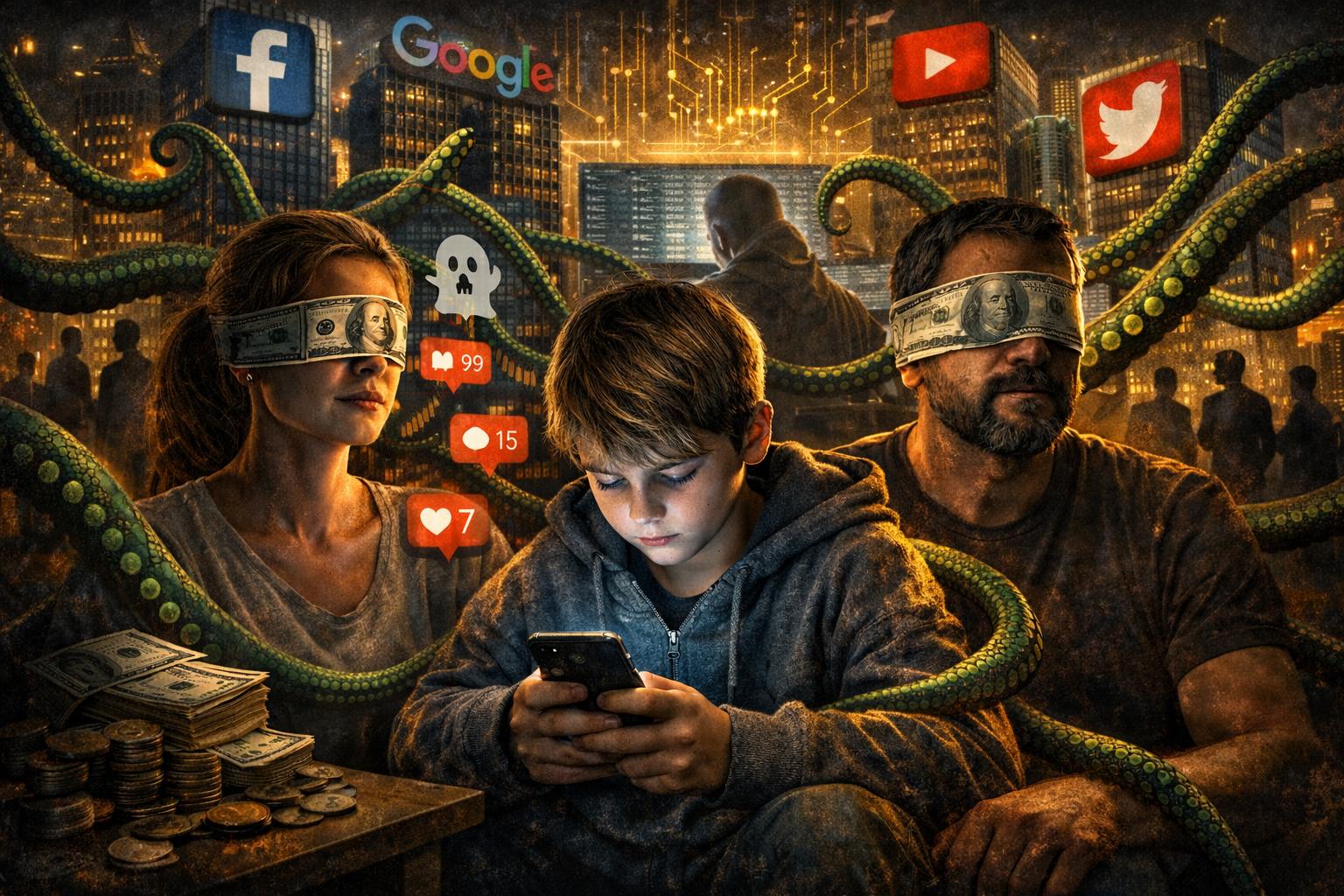
Monetisation Logic and Children's Developing Brains
How the money-making machine exploits what is not yet fully formed — and why presence is the only counterforce
This article brings together neuroscience, education, and a spiritual perspective on a phenomenon that is reshaping an entire generation from the inside out.
Introduction
This article addresses a phenomenon that touches every family, every school, and every community: how the monetisation logic of digital platforms targets the developing brains of children and young people, how it reshapes their perception of reality, and how it ultimately affects the very structures of society.
Understanding this phenomenon requires examination on three levels. The first is neurobiological: what is happening developmentally in a child's brain and how monetisation logic exploits this stage of development. The second is social: how the logic taught by the algorithm transfers into children's everyday lives, peer culture, and family dynamics. The third is ethical and spiritual: what this reveals about our values as a society and what it demands of us as adults.
These levels cannot be examined in isolation, because it is precisely their combined effect that makes this phenomenon so difficult to recognise and so dangerous to ignore.
PART I: THE NEUROBIOLOGICAL FOUNDATION
The prefrontal cortex: a gatekeeper that does not yet exist
The human prefrontal cortex is the last region of the brain to mature. It is responsible for impulse control, decision-making, emotional regulation, and the ability to assess long-term consequences. This brain region develops in stages throughout adolescence and does not reach full maturity until the age of 21–25.
In practical terms, this means that a child or adolescent facing temptation is not capable of the same deliberation as an adult. They are not weak or careless. They simply do not yet possess the neurobiological structure that makes mature decision-making possible.
At the same time, the adolescent brain's reward system (the limbic system, particularly the nucleus accumbens) is highly active. This creates a developmental imbalance: the system that detects rewards is running at full speed while the system that applies the brakes is still under construction. A young person experiences rewards more intensely than an adult yet is less capable of resisting them.
This imbalance is not a defect. It is a normal developmental stage that serves learning, social development, and the journey toward independence. It becomes a problem only when external systems begin to deliberately exploit this vulnerability.
A study published in Nature Communications (Crone & Konijn 2018) demonstrates that adolescent brain development involves significant structural changes particularly in regions associated with social understanding: the medial prefrontal cortex, the superior temporal cortex, and the temporoparietal junction. These are precisely the areas most sensitive to environmental influence.
Dopamine: the currency used to programme the brain
All digital monetisation logic is ultimately built on a single neurobiological mechanism: the dopamine cycle. Dopamine is not so much a "pleasure hormone" as a neurotransmitter of anticipation and motivation. It does not tell the brain "this feels good" but rather "this is worth pursuing again."
Understanding this distinction is critical. Monetisation logic does not sell a child a product. It sells the anticipation of a product. It builds an anticipation–reward–repeat loop in the brain that operates on the same principle as gambling addiction.
B.F. Skinner's variable reinforcement principle, described as early as 1938, lies at the heart of this: when a reward comes at random intervals, behaviour is reinforced more effectively than with a predictable reward. Loot boxes, random prizes, and spinning wheels exploit precisely this mechanism. In a child's brain, where the prefrontal brake is absent, this loop embeds itself especially deep.
Disrupted dopamine regulation broadly affects impulse control, decision-making, and reward processing in digital environments. These environments are designed to deliver rapid rewards, which promotes impulsive behaviour and makes it harder to concentrate on tasks that require sustained effort.
PART II: THE MECHANISMS OF MONETISATION
Dark patterns: exploitation by design
So-called "dark patterns" — manipulative design patterns — are deliberate interface choices that steer users into doing things they would not otherwise do. For children, these are particularly problematic because a child does not recognise them as manipulation.
Research has identified several manipulative patterns tied to the monetisation of children:
Time pressure. Limited-time offers create artificial urgency. A child's brain, not yet capable of assessing long-term consequences, reacts to this more strongly than an adult's brain. "Buy now or lose it forever" is a message that bypasses deliberation entirely.
Emotional guilt. In some games designed for children, a character begins to cry or look sad if the child refuses to make a purchase. A child whose social cognition regions are at a sensitive developmental stage experiences this as genuinely distressing.
Currency obfuscation. In-game currencies (Robux, V-Bucks) blur the connection to real money. A child whose abstract thinking is still developing does not grasp that 1,000 Robux represents real money from the family's account.
Social pressure. Games where success within a friend group requires purchases exploit the particular sensitivity of adolescents to peer evaluation. The social cognition regions of the adolescent brain are at this stage especially responsive to the opinions of peers.
The gateway model in gaming. Free-to-play games draw players in at no cost, then deliberately slow progression to a point where paying feels like the only option. This is known as the freemium model.
Compliance, not critical thinking
These mechanisms reveal the deepest problem within the system: monetisation logic does not aim to raise critical thinkers. It aims to raise compliant consumers. The entire business model rests on the user never pausing to ask "do I actually need this?" but instead reacting automatically to whatever the algorithm serves up.
For a child, this is especially significant. Critical thinking is a prefrontal cortex function that develops slowly. It requires the ability to pause, evaluate, question, and make deliberate choices. Monetisation logic bypasses this process entirely by directing its message straight at the reward system, which responds quickly and automatically. The child is not being raised into a person who thinks. The child is being raised into a person who reacts.
This is about something larger than individual games or apps. Society has permitted the development of business models in which children's immaturity is not a problem — it is a resource. The immaturity of the prefrontal cortex is not something to be protected. It is something to be exploited. The child is not safeguarded. The child is monetised.
In a recent study (CHI 2025), 22 children were interviewed about their experiences with game monetisation. All 22 were accustomed to microtransactions, and a large part of their gaming experience was shaped around these monetisation practices. Roblox in particular — where over 39.7 million children under 13 play daily for an average of 130 minutes — emerged as a platform where users themselves can create monetisation structures without adequate oversight.
PART III: FOUR LENSES THROUGH WHICH A CHILD SEES THE WORLD
The impact of monetisation logic does not end when the screen goes dark. It reshapes the way a child interprets reality, themselves, and other people. The following four phenomena illustrate how the logic taught by the algorithm transfers into a child's everyday thinking and behaviour.
1. Appearance as performance metric
A child does not learn this from a single video or a single advert. They learn it from thousands of micro-interactions with the algorithm. They see the correlation: a certain appearance attracts more attention. The prefrontal cortex is not mature enough to evaluate this correlation critically; the reward system is fully prepared to respond to it. The child draws a conclusion that is neurobiologically logical: my worth is determined by how I look. The algorithm never says this directly. It shows it through results.
2. Drama as currency
The algorithm has trained the child's brain to associate conflict with attention. This is not a conscious choice. It is a learned association that has taken root in the reward system. Calm interaction does not activate the dopamine cycle the way drama does. In schools, this is clearly visible: a child who generates drama gets attention. A child who is calm becomes invisible. Children begin producing drama in real life as well, because they have learned what generates social currency. The gossip and conflicts in schools follow the same logic as viral social media content.
3. Worth as visibility
This may be the most dangerous distortion. The social cognition regions of a child's brain are especially sensitive to peer information during adolescence. The temporoparietal junction and medial prefrontal cortex are actively processing the question "what do others think of me?" The algorithm gives this question a numerical answer: likes, view counts, followers. Brain regions that would normally develop to navigate complex social dynamics instead learn simplified metric-based logic. This logic transfers into peer relationships as well: who is popular, who is talked about, whose presence is considered "valuable." These questions begin to follow the same logic as the platform's algorithms.
4. Attention as a substitute for connection
Genuine connection requires prefrontal cortex functions: the ability to tolerate uncertainty, to wait, to be vulnerable without immediate reward. Seeking attention bypasses all of these requirements. It is fast, measurable, and produces an immediate dopamine response. A child whose prefrontal cortex is still developing naturally gravitates toward whatever delivers the reward faster. This manifests in friendships in a way that resembles the logic of a content creator more than the logic of friendship.
This does not mean children are shallow. It means they have also been taught — non-verbally — what the world is like. They have skilfully learned the game they were given to play. They are incredibly adaptive beings who have adjusted to their environment the way children always do. The problem is not the children. The problem is the game.
PART IV: SOCIETAL MANIFESTATIONS
The erosion of attention
A large longitudinal study from the Karolinska Institute (Nivins et al. 2025) followed over 8,300 children from age nine over a four-year period. The results were clear: heavy social media use was associated with a gradual decline in attention. No comparable association was found with watching television or playing video games. It was specifically the constant notifications and messages of social media that appeared to affect the ability to concentrate.
In a study by NTU Singapore and Research Network (2025), 68 per cent of 13–25-year-olds reported that social media weakened their ability to focus. Many described difficulty reading or watching anything longer than one minute.
Social media usage time increases dramatically at precisely the critical developmental stage: the average daily use for 9-year-olds is around 30 minutes; by age 13, it is already 2.5 hours — even though the minimum age for most platforms is 13.
Declining impulse control
Research shows that heavy social media use is associated with reduced cognitive flexibility, planning ability, and inhibitory control in young people. Social media addiction is linked to increased impulsivity and impaired decision-making — precisely the functions the prefrontal cortex is responsible for.
This creates a vicious cycle: a platform designed to deliver continuous small rewards weakens the very brain regions that would help a child resist those rewards. The system undermines the very capacity that would protect the child from the system itself.
Structural changes in brain development
A longitudinal study (PMC, Becht et al.) showed that adolescents who used social media heavily experienced faster thinning of the prefrontal cortex compared to those who used it sparingly. Although cortical thinning is a normal part of maturation, accelerated maturation is linked in research to depression and impaired impulse control. Negative environmental conditions appear to accelerate brain maturation in ways that are not optimal.
The mental health crisis
The constant pursuit of external validation (likes, follower counts, comments) is associated with lowered self-esteem. This creates a compulsive cycle in which social media is used ever more to alleviate the distress it itself causes.
In one study, 93.8 per cent of young respondents reported experiencing at least one of the following: depression, anxiety, lowered self-esteem, body image issues, sleep problems, social isolation, or emotional difficulties. These are not separate problems. They are different manifestations of the same phenomenon.
Financial exploitation
In-game purchases are estimated to generate over 74.4 billion dollars annually. In the United Kingdom, a report by the Safer Internet Centre showed that 70 per cent of young gamers had made in-game purchases, with 31 per cent making them at least weekly. As early as 2019, parliamentary hearings heard accounts of children who had accumulated debts of over a thousand pounds through games. Epic Games was forced to pay half a billion dollars in settlement for its use of manipulative design patterns in Fortnite.
PART V: THE TRIANGLE THAT CLOSES AROUND THE CHILD
Absence, algorithm, and peer culture
At the core of this phenomenon lies a chain of three forces, each reinforcing the other:
A: Absence creates a vacuum. The vacuum does not arise only when an adult is physically gone. It also arises when an adult is physically present but not truly there. Research uses the term "technoference" to describe a situation where a parent's phone use disrupts interaction with the child. Physical proximity without emotional availability can be more harmful to a child than clear absence, because it creates an experience of repeated rejection.
B: The algorithm fills the vacuum. The algorithm does not rest. It does not tire. It does not go to work. It is always available, always ready to offer the child what the child craves: visibility, attention, reward, and the feeling of being noticed. It does this in a way designed to keep the child engaged as long as possible, because every second is monetisable.
C: Peer culture normalises the logic. Eventually, children teach each other what the algorithm has taught them. At this point, the logic no longer needs the algorithm. It has transferred from person to person and become culture. This is perhaps the most frightening stage: when manipulation has been successfully recast as "normal," it no longer looks like manipulation. It just looks like the way things are.
A child does not experience this chain as a threat. They experience it as the world. It is the only world they know. The child has not ended up in the wrong world. For them, this is the only world that exists. They cannot compare their experience to something they have never had. A child grows up in a world where they may never experience what it feels like to be seen without performing, loved without earning attention, or valued without being visible.
Therein lies the true depth of this phenomenon.
PART VI: THE DISTORTION OF REALITY WITHIN THE FAMILY
A collision neither side understands
The scene repeats itself in hundreds of thousands of homes every evening: a parent says "put the phone away now." The child reacts intensely. The parent interprets: defiance, disobedience, ingratitude. The child experiences: something essential being taken away, insecurity, disconnection from the world where their social existence takes place.
Both are right within their own experienced reality. Neither is wrong. They are living in different realities.
The parent remembers a childhood where the connection to friends was severed each evening, and that was not a threat. The child lives in a world where the connection to friends is continuous, and its interruption feels like social death — because the algorithm does not wait. Conversations continue without you. Content is created without you. Someone else gets the attention that could have been yours.
The root cause and its surface expression look different. The parent sees a child who is defiant, impatient, constantly seeking attention, unable to tolerate boredom, and who reacts intensely to even small disappointments. In reality, the child's reward system has been calibrated to an environment where rewards come quickly, are intense, and are random. Ordinary everyday life does not activate this calibrated system sufficiently. The child is not being defiant. They are experiencing a neurological deficit that feels inside them like hunger or thirst.
This is like training a child to breathe underwater and then wondering why they cannot breathe in air.
The parent's own blind spot
At this point, we must speak plainly.
Parents are not immune to monetisation logic. The adult prefrontal cortex is more mature, but it is not immune. The dopamine cycle operates in adults too. The variable reinforcement mechanism of social media affects adults more mildly — but it affects them still.
A meta-analysis (Zhang et al. 2025, JMIR) shows that parents' own technology use in their child's presence significantly disrupts the quality of the parent-child relationship. Parents who use their phone in their child's presence report feeling less connected to their child and evaluate their own parenting more negatively. The child, in turn, experiences rejection.
Longitudinal studies show that a parent's phone dependency predicts a child's phone dependency through social learning: a child imitates what a parent models, not what a parent says. Here lies a contradiction that erodes the family's credibility from within: a parent says "put the phone away" while holding a phone.
The vicious cycle
A parent's absence increases the child's reliance on the digital world. The child's increased screen time increases the parent's frustration. Frustration leads to harsher limits — or alternatively, to giving up. Both responses increase the child's sense of insecurity.
Research is direct: a poor parent-child relationship can lead to increased use of internet devices by the child as an escape from conflict and emotional distress. The child does not flee to the screen because the screen is so good. They flee because something is missing.
The deeper reasons for inaction
Why do parents not intervene enough? Not because they do not care. The reasons run deeper.
Lack of knowledge. Most parents do not understand the developmental timeline of the prefrontal cortex or the neurobiological mechanisms of monetisation logic. They see the behaviour, not the structural realities of the brain beneath it. Without this understanding, limits feel arbitrary — to the parent themselves as much as to the child.
Exhaustion. A digital device is the most effective babysitter ever invented. A tired parent chooses short-term peace. This is not laziness. It is the survival strategy of an overloaded nervous system. Research shows that parents with mental health challenges such as anxiety or depression monitor their children's screen time less, because they have fewer psychological resources to set boundaries.
Their own addiction. Many parents are themselves dependent on the same system they are trying to restrict for their child. They check their phone dozens of times a day. They scroll in bed at night. They feel anxious when the phone is out of reach. They do not recognise this as addiction because it is normal. Everyone does it. The same peer culture that normalises the child's behaviour normalises the adult's behaviour too.
Cultural pressure. A parent who significantly restricts their child's screen time is forced to justify themselves. Other children play. Other children are on TikTok. "Do you want your child to be left out?" This pressure is real, and dismissing it is not fair.
Intergenerational transmission
Research uses the term "intergenerational transmission" to describe the mechanism by which a parent's behavioural patterns transfer to the child. A parent's screen dependency predicts a child's screen dependency. A parent's poor self-regulation predicts a child's poor self-regulation. A parent's inability to be present predicts a child's inability to be present.
This is not about assigning blame. It is about acknowledging reality. Blame locks us in place; truth sets us free.
PART VII: THE STATE OF REGULATION AND ITS LIMITS
Regulation remains fragmented, though movement is visible. Belgium, Finland, and the Netherlands have classified purchasable loot boxes as gambling and sought to restrict them. The European Commission has launched investigations into potential Digital Services Act violations by gaming platforms, with possible penalties of up to six per cent of a company's global revenue. In the United States, in 2025 the state of Utah sued Snapchat, alleging the platform had designed features that hook children.
The regulatory debate, however, is often technical and legalistic. It focuses on the question "is this gambling or not?" rather than asking the deeper question: is it ethical to design systems that deliberately exploit children's neurobiological immaturity for financial gain?
Parental responsibility is real, but it is not sufficient on its own. Systems designed to circumvent even adult judgement are overwhelming for children. Legislation must set limits on how monetisation logic may be directed at developing brains.
PART VIII: A DEEPER EXAMINATION
A question of values
This issue touches something deeper than the maturation timeline of brain regions. It is fundamentally a question of values. This is like selling alcohol to a child and then defending it by saying the child walked into the shop on their own. Yes, the child walked in on their own — because they do not yet have the brain structures that would help them understand why they should not.
The spiritual dimension: the breaking of connection
The deepest effects of monetisation logic cannot be explained by neuroscience alone. Neuroscience describes the mechanism. It tells us how. It does not tell us why this mechanism exists or why it targets precisely those structures that hold human relationships together.
From a biblical perspective, a pattern is recognisable here: the attack always targets connection. The first lie was not about information but about trust: "Yea, hath God said?" (Gen. 3:1, KJV). The goal was to break the connection between God and humanity. The same logic repeats itself within families: monetisation logic does not attack the family directly. It creates conditions in which connection breaks down gradually, imperceptibly, so that no one can point to the exact moment it happened.
The lies this system sows are subtle:
"Your worth depends on how others react to you." This is the direct opposite of what God says: you are valuable because you exist, because you were created.
"You are alone unless someone is watching." This is the opposite of what Psalm 139 teaches: "Thou hast known me before I was formed in my mother's womb."
"If you are not visible, you are not significant." This is the opposite of what Jesus taught: "Thy Father which seeth in secret shall reward thee openly" (Matt. 6:6, KJV).
These lies do not come to a child as a single grand announcement. They come as thousands of microscopic messages, algorithmic choices, and peer reactions, all reinforcing the same logic. They do not look like lies. They look like "just the way the world works." That is precisely where their power lies. The most effective lie is one that does not look like a lie but like reality.
In the biblical context, Jesus spoke directly about protecting children: "But whoso shall offend one of these little ones which believe in me, it were better for him that a millstone were hanged about his neck, and that he were drowned in the depth of the sea" (Matt. 18:6, KJV). These words do not apply only to individuals. They apply to systems, structures, and choices that place profit above a child's wellbeing.
PART IX: WHAT WE CAN DO
Presence as a counterforce
The chain breaks at the point where someone chooses to be present. Not perfectly. Not every moment. Not without their own struggles. But consciously, honestly, with grace toward themselves — and yet without giving up.
Research confirms this: a secure attachment relationship acts as a buffer against phone dependency. A parent's presence does not merely reduce screen time. It changes what the child's reward system learns to long for. A child who regularly experiences genuine presence receives an alternative reward model for their brain: connection that is slow but deep, unpredictable but safe, unassuming but real.
Mindful parenting has been shown in research to buffer the negative effects of harsh parenting on the parent-child relationship. Perfection is not required. Awareness is.
Practical steps
Awareness is the beginning. A neurobiological understanding of prefrontal cortex development gives parents and educators a rationale that is not moralising but biological: "I am not restricting you because I do not trust you. I am restricting you because your brain is still under construction — and that is not your fault."
Talking with children. Children are capable of understanding that their brains are being manipulated, provided it is explained in age-appropriate terms. This is not fearmongering. It is empowerment. Researchers recommend developing interactive educational tools to teach children to recognise manipulative monetisation practices.
Structural boundaries. Age verification, screen time limits, and locking in-game purchases are not punishments. They are acts of love that stand in for the biological brake the child does not yet have.
Offering alternatives. Brains that do not receive healthy rewards seek unhealthy ones. Play, physical activity, creativity, genuine human relationships, and time in nature offer the reward system what it needs — without manipulative structures.
The parent's own honesty. The greatest security for a child is not a perfect parent. It is a parent who recognises their own brokenness and chooses growth. A child who sees a parent honestly wrestling with the same challenge receives a model that no algorithm can offer: a model of how a person faces truth, acknowledges weakness, and chooses differently.
IN CLOSING: WHOSE GAME IS THIS
The problem is not the children. It is not even the algorithms. The problem is that children have been given a game whose rules were written by someone who does not have their best interests at heart. The author of monetisation logic is not interested in the development of a child's prefrontal cortex. They are interested in the quarterly report.
Neuroscience and spiritual understanding say the same thing in different languages. Neuroscience says: the system exploits an immature structure. Spiritual understanding says: someone is sowing lies where truth has not yet had time to take root.
The answer to both is the same: light where there is darkness. Truth where there are lies. Presence where there is emptiness.
A child's brain is not a marketplace. It is sacred ground where a human being is being formed. All of us bear responsibility for the kind of environment we build around that formation.
Science tells us that the prefrontal cortex matures slowly. Monetisation logic says that slowness is an opportunity. Love says that slowness is something to be protected.
"Lay not up for yourselves treasures upon earth, where moth and rust doth corrupt, and where thieves break through and steal: But lay up for yourselves treasures in heaven." (Matt. 6:19–20, KJV)
A child's brain is shaped by what it is offered as treasure.
The question put to us is: what are we offering?
REFLECTION QUESTIONS FOR PARENTS AND THOSE WHO WORK WITH CHILDREN
The following questions are not accusations. They are mirrors — meant for pausing, not performing. You can return to them in your own time, alone or together with another adult.
My own relationship with the screen
-
When was the last time I spent half an hour with my child without either of us touching a phone? What did that feel like?
-
If my child were to describe my phone use, what would they say? What have they perhaps already learned from what I model?
-
Do I recognise in myself the same dopamine loop I am concerned about in my child? How does it show up in my daily life?
Looking behind the child's behaviour
-
Have I been interpreting my child's behaviour as defiance when it may in fact be a neurological deficit caused by a brain calibrated to excessively rapid rewards?
-
Does my child know why I limit their screen time, or do they experience my limits as arbitrary exercise of power?
-
In what ways does my child seek attention? Does it resemble genuine longing for connection, or does it more closely follow the logic of a content creator — where the most important thing is to be seen?
Connection and safety
-
Is there room for boredom in my home? Or do I fill every silence with entertainment because I, too, tolerate emptiness poorly?
-
Does my child feel valuable even when they are not performing, when no one is watching, and when they are not visible?
-
Can I be present for my child even when they react intensely to a boundary, or do I withdraw or harden at precisely the moment they most need safety?
The bigger picture
-
What kind of world am I normalising through my silent consent — by not intervening, not asking, not being present?
-
What do I want my child's brain to learn to long for: the rapid rewards of algorithms, or the slow, genuine connection of human beings?
-
If monetisation logic is teaching my child that their worth depends on the reactions of others, who is teaching them otherwise? And am I teaching it with words — or with my life?
This article is based on research from: Nature Communications (Crone & Konijn 2018), Karolinska Institute (Nivins et al. 2025), NCBI/NIH (U.S. Surgeon General's Advisory), Springer Nature (Digital Media, Cognition, and Brain Development in Adolescence), PMC (Longitudinal associations between social media use and structural brain development), CHI 2025 (Children's experiences of game monetization), Michigan Medicine, NTU Singapore & Research Network (2025), JMIR (Zhang et al. 2025, meta-analysis on parental technoference), Journal of Pediatrics (parental phubbing), Frontiers in Psychology (harsh parenting, mindful parenting), Wiley (intergenerational transmission of internet addiction), ScienceDirect (screen exposure and social-emotional development meta-analysis), BMC Pediatrics (2025).
Sami & Heini Minkkinen, 2026