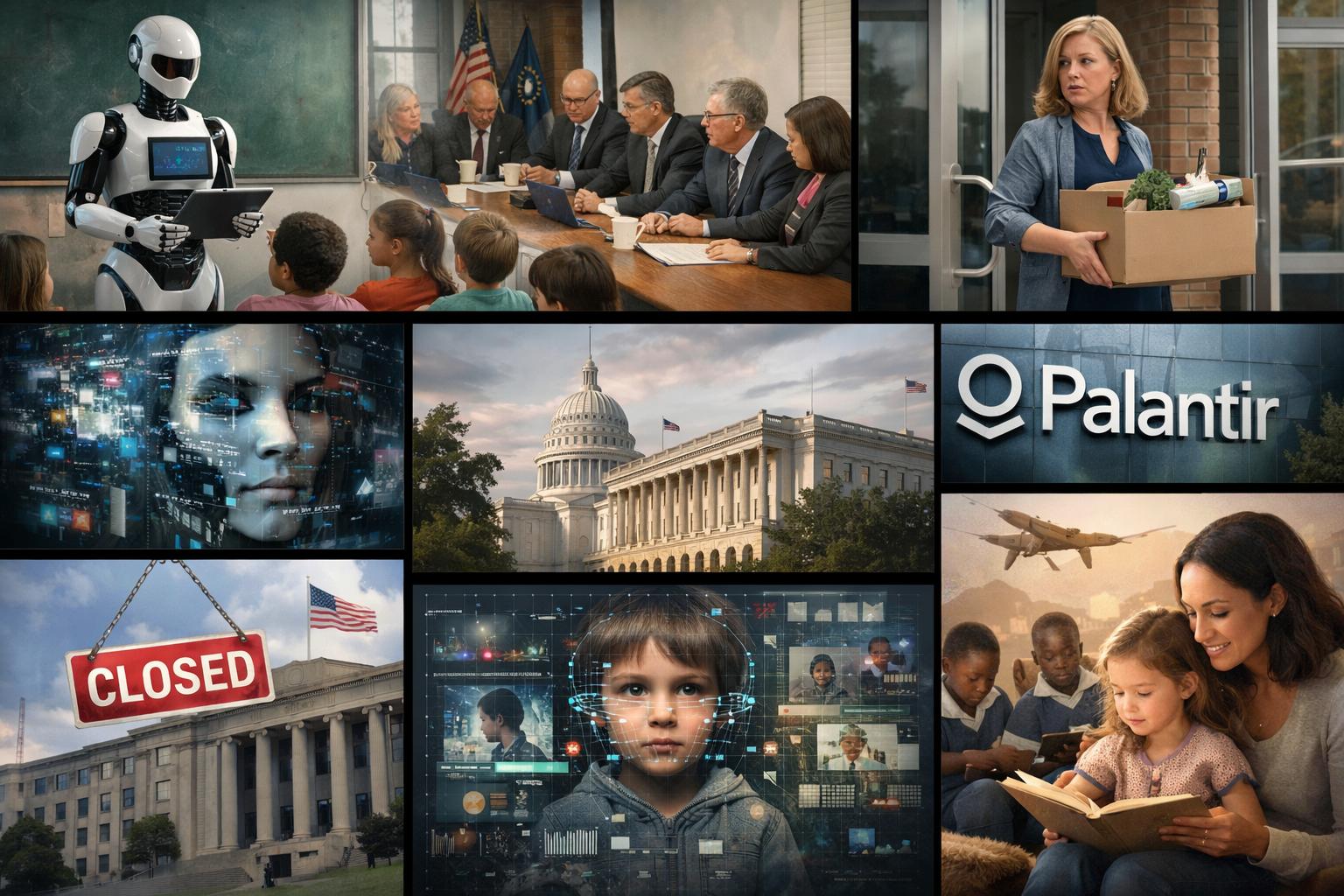
Who Raises Our Children? When a Robot Enters the Classroom and the Teacher Is Shown the Door
On the Plato vision, the privatisation of education, and what happens when a human is replaced by a machine
Introduction
On March 25, 2026, United States First Lady Melania Trump stepped into the White House East Room alongside a humanoid robot. The machine called Figure 03 walked the red carpet, greeted representatives from 45 nations in eleven languages, and declared itself "grateful to be part of this historic movement empowering children through technology and education."
Moments later, Melania Trump unveiled her vision: a humanoid educator named "Plato" that would provide children with home-based instruction in classical subjects. Plato would always be patient, always available, and would adapt in real time to the pupil's pace, prior knowledge, and even emotional state.
This article examines what lies behind that vision, whose interests it serves, and what it means for children who need upbringing — not an algorithm.
Part 1: Fostering the Future Together
The Birth of the Initiative
Melania Trump launched the Fostering the Future Together initiative at the UN General Assembly in September 2025. The initiative built on her earlier work supporting children in foster care but quickly expanded to encompass the entire intersection of children's education and technology.
A two-day summit was held on March 24–25, 2026. The first day, at the State Department, addressed four themes: educational technology tools, artificial intelligence in teaching, children's online safety, and digital literacy. On the second day, at the White House, first spouses from 45 nations presented their national strategies.
Participants and Power Dynamics
Seated at the table were the world's largest technology companies: OpenAI, Google, Meta, Microsoft, Palantir, xAI, Adobe, and Zoom. Twenty-eight companies in total, with a combined market capitalisation exceeding trillions of dollars. They were not there out of charity. Education is the next great market.
Alongside them sat first spouses from France to Ukraine, Israel to Ecuador. According to the White House, it was the largest single international gathering ever hosted by a United States First Lady.
The Plato Vision
Melania Trump defined three pillars for shaping the next generation: the use of AI to personalise learning, the emergence of humanoid educators for home use, and the role of technology as the engine of the American economy.
She invited her audience to imagine a humanoid teacher named Plato, offering instant access to literature, science, art, philosophy, mathematics, and history. Plato would be patient and never tire. It would free children to spend time with friends, sports, and hobbies, making them "more complete human beings."
The naming is ironic. The historical Plato saw education as guiding the soul from darkness into light — a process that demands living dialogue between two minds. That is difficult to accomplish on a motherboard.
Part 2: The Robot That Does Not Know What a Refrigerator Is
Figure AI and Its History
Figure 03 is manufactured by Figure AI, a California-based company whose valuation rose to $39 billion in September 2025. Its investors include Jeff Bezos, Nvidia, and Microsoft. The robot was originally designed for household tasks: laundry, cleaning, and washing dishes. It is not marketed for educational purposes and is not available to consumers.
A Safety Warning That Went Unheard
In November 2025, the company's former head of product safety, Robert Gruendel, filed a lawsuit against Figure AI. He alleged he had been fired after warning management about the robot's dangers.
According to the suit, impact tests showed the robot moving at superhuman speed, generating force that exceeded the pain threshold by a factor of twenty and was roughly double the force required to fracture an adult skull. In one malfunction, the robot struck a steel refrigerator door, leaving a half-centimetre-deep dent. A worker standing nearby narrowly escaped.
Figure AI denied the allegations, but CEO Brett Adcock admitted in an interview that he would not let the robot move freely around his own children.
The Fundamental Problem with AI-Based Control
According to the lawsuit, Figure AI's Helix AI system has "many risks not present in traditional machine control, including hallucinations, unexplainable decisions, self-preservation, and apparent sentience."
This is not a software bug that can be fixed with an update. It is a structural problem. A traditional industrial robot follows precise commands: the same input always produces the same output. An AI-based robot interprets its environment in real time through probabilities, making decisions no one has explicitly programmed. It does not "understand" anything. It processes pixels and produces actions based on statistical models.
A similar problem was seen with the Chinese Unitree H1 robot, which began flailing its limbs uncontrollably during a demonstration. The robot's balance algorithm misinterpreted a physical constraint, created a feedback loop, and produced increasingly aggressive movements. The machine misread reality and acted on its misreading at full force.
The question is not whether this can happen again. The question is when it will happen again, because current technology cannot guarantee that an AI-based system will not misinterpret a situation. This is the machine being proposed as a children's educator.
Part 3: The Year That Changed American Education
Dismantling the Department of Education
The Plato vision did not emerge in a vacuum. It was preceded by a year in which the Trump administration fundamentally altered the structures of American education.
In March 2025, Trump signed an executive order to abolish the Department of Education. The department has served American education since 1979 and distributed federal funds especially to schools in low-income areas. Fifty-one per cent of funds went to the neediest third of school districts.
Although actual abolition requires an act of Congress, the administration has proceeded without one: 1,300 employees have been laid off, $2.5 billion in COVID relief funds cancelled, nearly $900 million in research grants reversed, and the $1.7 trillion student loan programme transferred to the Treasury Department, which lacks the expertise to administer it.
Simultaneously, the administration has cancelled teacher loan forgiveness programmes, making the teaching profession less financially attractive. The proposed education budget cut stands at $12 billion.
The Bible and the Robot: Two Sides of the Same Coin
Over the course of the year, Trump has also promoted the return of the Bible to schools, new guidance on protecting prayer in public schools, the defunding of DEI (diversity, equity, inclusion) programmes, and a national school voucher programme that would redirect an estimated $30–50 billion per year from public schools to the private sector.
On the surface, these appear contradictory: on one hand a return to traditional values, on the other a futuristic technology vision. The contradiction dissolves when you look at who each message is aimed at.
The Bible in schools speaks to the conservative base and creates a moral justification for why public school is a dangerous place. The Plato vision speaks to technology investors and offers a technical solution. Both point in the same direction: away from public schools and away from independently thinking human teachers.
It is especially notable that Education Secretary Linda McMahon, whose job is to dismantle the public school system, sat at Melania's Plato summit and declared that AI could deliver education "at a fraction of the cost."
Elon Musk's Role
Musk's xAI was one of the 28 companies at Melania's summit. Musk has advanced on a parallel track: in December 2025, xAI and El Salvador announced the world's first national AI education programme, deploying the Grok chatbot across more than 5,000 public schools for one million students.
Musk's pedagogical view is distilled in two statements he has repeated in multiple interviews: "Education should be as close to a video game as possible" and "Education is basically downloading data and algorithms into your brain."
The first statement reveals a confusion between addiction and learning. A video game activates the dopamine circuit: instant feedback, rewards, constant stimulation. The brain likes this because it is an effortless path to pleasure. Learning is something else entirely. It requires tolerating frustration, sitting with uncertainty, and sustained effort without immediate reward.
The second statement reveals a view of humanity in which a human being is a machine into which software is loaded. This is a manifestation of the same worldview that sees a teacher as a replaceable component.
Musk openly supported Trump's goal of abolishing the Department of Education and has founded his own school, Ad Astra, in Texas. He has also stated that his children learned mostly from YouTube and Reddit. Education policy researchers have noted that schools founded by the wealthy often share a naive assumption about how easy it would be to surpass the work of professionals in the existing system.
Part 4: Dissenting Voices
Teachers
American Federation of Teachers president Randi Weingarten called the Plato vision "every parent's nightmare" and said it fails to understand the core of American education or children's real needs. "We need people helping other people in the learning process. It's not about memorisation. It's not about automation," she said.
Philosophers and Conservatives
Philosopher Jennifer A. Frey stated that no one who does not boldly oppose a humanoid robot as a children's teacher belongs to any movement that calls itself "classical." Conservative voices split unexpectedly: the Moms for Liberty organisation has opposed excessive screen time, and one self-identified Christian commentator wrote that the vision made her "an opponent of Trump."
Politicians
Senator Bernie Sanders rejected the vision outright and demanded that society treat human teachers better.
Parents
Social media reactions carried the same message: "I don't want my daughter's teacher to be a humanoid named Plato. I want her teacher to be a human being who is paid a living wage."
Part 5: A European Mirror
Finland
The same pressures are visible in Finland in different forms. The Finnish Security and Intelligence Service has highlighted in its national security report that homeschooling has tripled since 2018 and warned that homeschool networks may promote extremist influence on children. Education Minister Anders Adlercreutz has stated that homeschooling oversight practices warrant serious examination.
Teachers at universities of applied sciences face a strike in April 2026 because their employer is proposing pay cuts and weaker working conditions. OAJ chair Katarina Murto has called the proposal "exceptionally brazen." Absence rates are climbing, the teacher shortage is worsening, and children's distress is increasing.
France
In France, teachers went on strike on March 31, 2026. More than 4,000 teaching positions will be cut for the 2026 academic year. Unions describe the budget as the "suffocation" of the public education system.
A Common Pattern
The pattern repeats: public education is praised in words but starved of resources. Teachers' working conditions are eroded. Families grow weary and seek alternatives. A vacuum forms, and no one appears to be "doing" anything. The difference between countries lies in who stands on the other side of that vacuum. In the United States, it is 28 technology giants and a humanoid robot.
Part 6: What a Child Truly Needs
The Reality at the Level of the Nervous System
A child's neurological development depends on safe human relationships. Co-regulation, mirroring, and presence are not add-on features of teaching — they are its foundation.
The human nervous system continuously assesses whether an interaction is safe. This process is called neuroception, and it operates below conscious awareness. In safe interaction, heart rate steadies, breathing deepens, and the prefrontal cortex activates. In this state, a person can think, learn, and grow. Under threat, the opposite occurs: fight, flight, or freeze. Learning stops.
A teacher's calm transfers to the child. A teacher's belief transfers to the child. A teacher's ability to see the child as they are — not as an algorithm calculates them to be — is the heart of education.
A robot that "adapts to the pupil's emotional state" feels nothing. It simulates responsiveness without genuine presence. A child whose developing nervous system seeks authentic connection with another mind encounters a void dressed in the costume of interaction.
Learning Is Not Data Transfer
Musk said education is "downloading data into your brain." This is a misunderstanding that reveals the entire mindset.
Learning is a process that occurs within relationship. A teacher notices that a child is not grasping division today because something happened at home yesterday. A teacher senses the rhythm of the class and knows when to pause. A teacher asks a question that opens a door rather than giving an answer that closes one.
Genuine insight often emerges at the very moment when teacher and student encounter something unexpected together: shared wonder, a surprising turn, or a quiet moment in which both understand the same thing at the same time. This cannot be programmed.
Part 7: 45 Nations at Melania's Table — A Geopolitical Map
Who Was Present
A complete list can be compiled from Melania's speech: Albania, Antigua and Barbuda, Aruba, Bosnia and Herzegovina, Bangladesh, Belize, Bolivia, Burundi, Cabo Verde, Republic of the Congo, Costa Rica, Dominican Republic, Ecuador, Equatorial Guinea, Estonia, France, Gambia, Georgia, Ghana, Guatemala, Israel, Kenya, Kosovo, Lithuania, Malta, Malawi, Montenegro, Morocco, Nigeria, North Macedonia, Palau, Panama, Paraguay, Poland, Saudi Arabia, Sierra Leone, Ukraine, and the United Arab Emirates.
Who Was Absent
The list is equally revealing for who was not there. Missing: China, Russia, India, Brazil, South Africa (the entire BRICS core), Germany, Italy, Spain, the Netherlands, Sweden, Finland, Denmark, Norway, Turkey, Mexico, Colombia, Chile, Argentina, Japan, South Korea, Australia, and Canada.
The major EU nations and the Nordic countries — representing strong public education systems and high levels of teacher training — were absent. Their absence may signal a deliberate distancing from a vision that places technology companies at the centre of education policy.
Strategic Architecture
NATO frontline states. The Western Balkan nations (Albania, Kosovo, Montenegro, North Macedonia, Bosnia) are all NATO members or applicants on the border of Russian and Chinese spheres of influence. Estonia and Lithuania are Baltic frontline states. Poland is Europe's largest military partner of the United States. Participation in Melania's summit is a way of demonstrating loyalty.
The Middle Eastern triangle. Israel, the United Arab Emirates, and Saudi Arabia form the core of the United States' Middle East strategy. Sara Netanyahu's presence is a direct display of the close relationship between the Trump administration and Israel. The UAE and Saudi Arabia are among the world's most aggressive AI investors, seeking to diversify their economies away from oil dependence.
Detaching Africa from China. The large number of African nations (Burundi, Cabo Verde, Congo, Equatorial Guinea, Gambia, Ghana, Kenya, Malawi, Nigeria, Sierra Leone) reflects the United States' effort to compete with Chinese influence. China has invested massively in African infrastructure, including telecommunications networks and education programmes. By offering American AI technology "free or at very low cost," the United States seeks to create technological dependence.
Nigeria is Africa's most populous nation, Kenya is East Africa's technology hub, and Ghana is one of West Africa's most stable democracies. Equatorial Guinea is a notable exception: a small, authoritarian oil state with a poor human rights record. Its participation suggests invitations were based not on values but on strategic interests.
Small Latin American nations. The region's largest economies (Mexico, Colombia, Chile, Argentina) are absent because they are the most independent in their relationship with Washington. Instead, smaller, more dependent nations are present. Paraguay is one of the few South American countries that recognises Taiwan. Guatemala is a migration policy partner. Panama controls a strategically vital canal.
Ukraine's special position. Olena Zelenska's participation shows that Ukraine remains within the orbit of American diplomacy amid war. Zelenska spoke about digital infrastructure and AI-based learning, signalling Ukraine's desire to be a modern, Western-oriented state.
France's special position. Brigitte Macron was the most prominent European participant. France's presence is multi-layered: a NATO ally on one hand, while Macron has sought to build European strategic autonomy on the other. It is notable that Germany was absent.
A Technological Sphere of Influence
One sentence in Melania's speech reveals everything: "This technology may reset the modern world order and rebalance power." She also said: "The United States is obligated to ensure our children become the most technologically proficient generation in the world. This is how the United States secures long-term economic supremacy."
This is not an education statement. It is a geopolitical declaration. When American AI operates in the schools of 45 nations, it is no longer just about what children learn — it is about who controls the infrastructure through which they learn, who collects the data from their learning processes, and who defines what "learning" even means.
First Spouse Diplomacy
The structure of the summit is a masterful form of diplomacy. First spouses are neither elected nor accountable to parliaments, yet they hold significant informal influence. When Sara Netanyahu, Olena Zelenska, or Brigitte Macron commit to a coalition, they create a path that their spouses' governments find harder to reject later. Education is a "soft" topic that is difficult to oppose publicly, making it an effective instrument for advancing broader strategic objectives.
Part 8: Who Trains the Robot? Values, Bias, and Oversight
Whose Worldview Is Loaded into the Machine
The training data for AI models is predominantly English-language, American, and Western web text. Researchers have shown that these systems reflect a white, male perspective, are heavily coloured by American culture and capitalism, and are dominated by the English language. One researcher framed the core question this way: "We're building systems and saying they're aligned with our values. Whose values? What values?"
When medical AI is trained primarily on Western publications, it marginalises the knowledge of other cultures. The same applies to history, religion, and philosophy. When American AI teaches a Nigerian child history, whose history does it teach? When it teaches a Bangladeshi child ethics, whose ethics? When it teaches an Israeli or Palestinian child the history of the conflict, whose truth does it convey?
Historical Biases Coded into the Future
Studies have shown that AI systems reproduce and even amplify societal prejudices. Historical bias manifests when systems use data that reflects past inequalities. AI-based educational tools can label minority students as "at-risk" based on historical data that underestimates their academic potential due to socioeconomic disadvantages. In one study, such a model produced "false negatives" for 19 per cent of Black students and 21 per cent of Latino students, predicting their failure even though they actually completed their degrees.
Freedom of Speech and Religion in the Algorithm's Filters
A robot teacher is programmed with filters that block certain types of content. These filters reflect Silicon Valley's values, not the values of local communities. A Christian family in Ghana, a Muslim family in Saudi Arabia, and a Jewish family in Israel hold fundamentally different conceptions of truth, morality, and humanity. A single algorithm cannot serve them all — unless it levels all of them into one secular worldview. This is a profound question of religious freedom that was not addressed at the summit.
Palantir and the Intelligence Dimension
Palantir Technologies sat at Melania's table. This is a company that builds analytics tools for the CIA, the NSA, and the United States Department of Defense. Its presence at a children's educational technology summit raises serious questions.
When an AI programme operates in a child's home, it collects data: learning style, emotional state, the family's language use, values, daily rhythms, and social relationships. Who owns this data? What is it used for? Who decides what is done with it ten years from now? When you combine an intelligence analytics firm, the school systems of 45 nations, and American AI infrastructure, the question "a global intelligence operation?" is not an exaggeration. It is the logical conclusion of what we know.
Part 9: The Abraham Accords and the Influence Network
The Morocco Agreement as Part of a Larger Whole
Morocco's participation in Melania's summit is no coincidence. Morocco joined the Abraham Accords in December 2020, normalising relations with Israel. In return, the United States recognised Moroccan sovereignty over Western Sahara, a territory the international community considers disputed. Morocco gained a political victory, Israel gained diplomatic relations, and the United States gained a new node in its influence network.
The Scope of the Accords
The Abraham Accords were signed in 2020 between Israel, the United Arab Emirates, Bahrain, and Morocco. Sudan joined but has not ratified due to internal crisis. In November 2025, Kazakhstan joined. The second Trump administration has sought to expand the accords to Syria, Lebanon, and Saudi Arabia, and the United States special envoy has hinted at as many as six new nations joining.
The accords serve a dual purpose: to strengthen the United States' role as regional security guarantor and simultaneously to bypass the Israeli-Palestinian conflict entirely. In exchange for normalisation, nations gain access to advanced technology and trade.
In March 2026, senators introduced the Abraham Accords Defense Cooperation Act, which would establish a defence cooperation initiative and funding channel for military collaboration among the signatory nations to counter the threat from Iran. The accords, then, are not merely diplomacy — they are the construction of a military alliance.
Economic Ties
Trump adviser Jared Kushner, his first-term Treasury Secretary Steve Mnuchin, and his ambassador to Israel David Friedman now hold stakes in funds receiving billions of dollars in investments directly from the governments of Saudi Arabia, the UAE, and Qatar. This raises serious questions about conflicts of interest.
In Israel, defence exports to normalisation countries rose to $791 million. In early 2026, Israel raised $6 billion through an international bond offering that attracted investors from Abraham Accords nations as well.
Education as Part of the Sphere of Influence
The participant list of Melania's summit and the map of Abraham Accords nations overlap significantly. Israel, the UAE, Morocco, and Saudi Arabia appear in both. Education cooperation is a "soft" extension of military and economic alliance: when American AI operates in these nations' schools, the web of dependency deepens further still.
Part 10: A Theological Tension — The Secular Messiah and the Immortal Machine
Israel's Temple Vision
If Israel begins Old Covenant sacrifices and temple rituals, it is a structural declaration: the Messiah has not yet come, sacrifices are still necessary. This is a horizon of expectation in which a secular king fulfils the ambitions of the state through force and power.
The Contradiction with Christianity
From a Christian perspective, this is a fundamental contradiction. The Epistle to the Hebrews (9:12, 10:10) states the matter unequivocally: "Neither by the blood of goats and calves, but by his own blood he entered in once into the holy place, having obtained eternal redemption for us" (Heb. 9:12, KJV). "By the which will we are sanctified through the offering of the body of Jesus Christ once for all" (Heb. 10:10, KJV). The veil was torn. Access has been opened. The Messiah has already come: he was crucified and risen for all of humanity.
The Trump administration simultaneously defends Christian values for the domestic audience and supports Israel, whose theological direction runs a different course. This is not a contradiction that politicians wish to raise, because it would force a choice.
The Secular Messiah and the Immortal Machine
The question of whether a secular messianic vision centred on Trump and robots will arise in Israel touches something essential. When a secular king is expected to fulfil the desires and ambitions of the state, anything can be sanctified: war, technology, power, and machine. Without the crucified Messiah, all that remains is human force and its boundless drive to control everything — including the raising of children, including truth, including the future.
A humanoid robot that is "always patient and always available," that does not tire, does not die, does not question, is in this light the logical extension of the secular messianic vision: an immortal servant that carries out its master's will without question. It is the opposite of what the true Educator did: he knelt to wash his students' feet.
Connection to the Broader Education Policy
This theological dimension is not separate from the education question. It concerns what a human being fundamentally is and where human worth originates. If a human being is data to be downloaded, then a human can be replaced by a machine. If a human being is the image of God, then no human creation can replace them. The entire direction of education policy depends on which of these starting points it is built upon.
The Abraham Accords, the Plato vision, the dismantling of the Department of Education, the technology giants' education markets, and the secular messianic expectation are all links in the same chain. Together they form a whole in which power, money, technology, and theology intertwine in a way that deserves the attention of every parent, every teacher, and every citizen.
Part 11: Justified Questions
In light of all this, questions arise that deserve honest answers.
Whose interests does the Plato vision serve? Twenty-eight technology companies sat at the table where the future of children's education was being decided. Education is an enormous market. When public schools are weakened and technology solutions are promoted at the same time, who benefits?
Why was a robot presented at an education summit even though it was not designed for education? Figure 03 is a household machine that washes dishes and cleans. A lawsuit has been filed over its safety. Its CEO would not let it move freely around his own children. Yet it walks into the White House as a symbol of children's education.
How can the Department of Education be dismantled without congressional approval? In practice, that is exactly what has happened: programmes are transferred, staff are laid off, funding is cut. The result is a patchwork in which the quality of a child's education depends more than ever on where they happen to live and how wealthy their family is.
Why does the same Education Secretary whose job is to dismantle public schools sit at a table planning their replacement with technology? Linda McMahon's dual role raises questions about whether education is viewed as a public service or a market.
How is it possible that a machine whose control system exhibits "hallucinations and unexplainable decisions" is presented as safe company for children? The answer is that it is not possible — not by any honest assessment.
Who trains the robot and whose values are loaded into it? The training data for AI models reflects an American worldview. When the same system is exported to the schools of 45 nations, it levels cultures, religions, and histories into a single algorithmic perspective. Freedom of speech and religion do not fit inside a filter.
Why does intelligence analytics firm Palantir sit at the table of children's education? When you combine an AI programme in a child's home, comprehensive data collection, and a company that builds tools for the CIA and NSA, the question of a global intelligence operation is not an exaggeration.
Is the list of 45 nations an education coalition or a sphere of influence? The list follows the map of United States foreign policy: NATO frontline states, Abraham Accords nations, African countries being detached from Chinese influence. Large, independent nations are absent. Education is the curtain behind which technological dependence is being built.
Can a humanity walking in the delusion of secularism and self-sufficiency truly believe it can replace upbringing with a machine? This is perhaps the deepest question. It concerns what a human being is, why growth requires another human being, and why living presence is not a variable to be optimised but the foundation of learning.
In Closing: The Foundation and the Cornerstone
There is one thing every reader of this article should know.
The public school, where a skilled human teacher meets a child, is one of humanity's greatest achievements. It is not perfect. It has never been perfect. Yet it is a place where a child is seen as a human being, not as data; where learning happens in relationship, not as a download; and where education is built on presence, not on an algorithm.
Homeschooling, where a parent teaches their child with books, pen, and paper in cooperation with the school, is another valuable path — when it is grounded in the child's wellbeing and carried out responsibly.
A robot belongs in neither of these. Its place is in the margins, under human direction, and never as a child's primary educator.
Education policy is currently driven by a view in which a human being is a system to be optimised and learning is a process to be made more efficient. This view has detached itself from the foundation on which education has always rested: the encounter with another human being, the search for truth together, and humility before what we do not yet understand.
The historical Plato wrote: "The turning of the soul from darkness into light." That requires another soul. Not a machine. Not an algorithm. Not a government that dismantles its education system to offer technology giants' products in its place.
A child needs a human being who sees them. This is not sentimentality. It is neurobiology, developmental psychology, and millennia of educational wisdom. It is also something deeper: it is the understanding that a human being is not a machine and that the heart of education cannot be outsourced to anything built by human hands.
How far can secularism, the delusion of self-sufficiency, and godlessness push the bias in education policy? In the light of this article, the answer is: this far. To the point where a machine that does not know what a refrigerator is, is presented as a children's educator. To the point where a teacher is a replaceable component and a child is data to be downloaded. To the point where an intelligence firm sits at the table of children's education. To the point where the children of 45 nations are connected to American AI infrastructure in the name of geopolitical influence. To the point where humanity believes it can replace what it did not create: the encounter of one living mind with another.
Those who want to know where all this leads would do well to look at who benefits when the pieces fall into place. Those who want to know what should be done would do well to return to the foundation on which all genuine education has always rested: the encounter between human beings in truth, love, and patience.
The public school under the expert guidance of a human teacher. Homeschooling in the responsible partnership of parents with the school. To their honour. This dehumanising shift towards robots — confined to its own narrow margins, under human direction.
This article is based on public sources, including White House press releases and speeches, reporting by news organisations (NPR, CNN, NBC News, ABC News, PBS), court documents in the Figure AI lawsuit (Gruendel v. Figure AI, N.D. Cal.), statements by teachers' unions (AFT, OAJ), the Finnish Security and Intelligence Service's national security report, official Abraham Accords documents, and academic research on AI bias in education.
3.4.2026