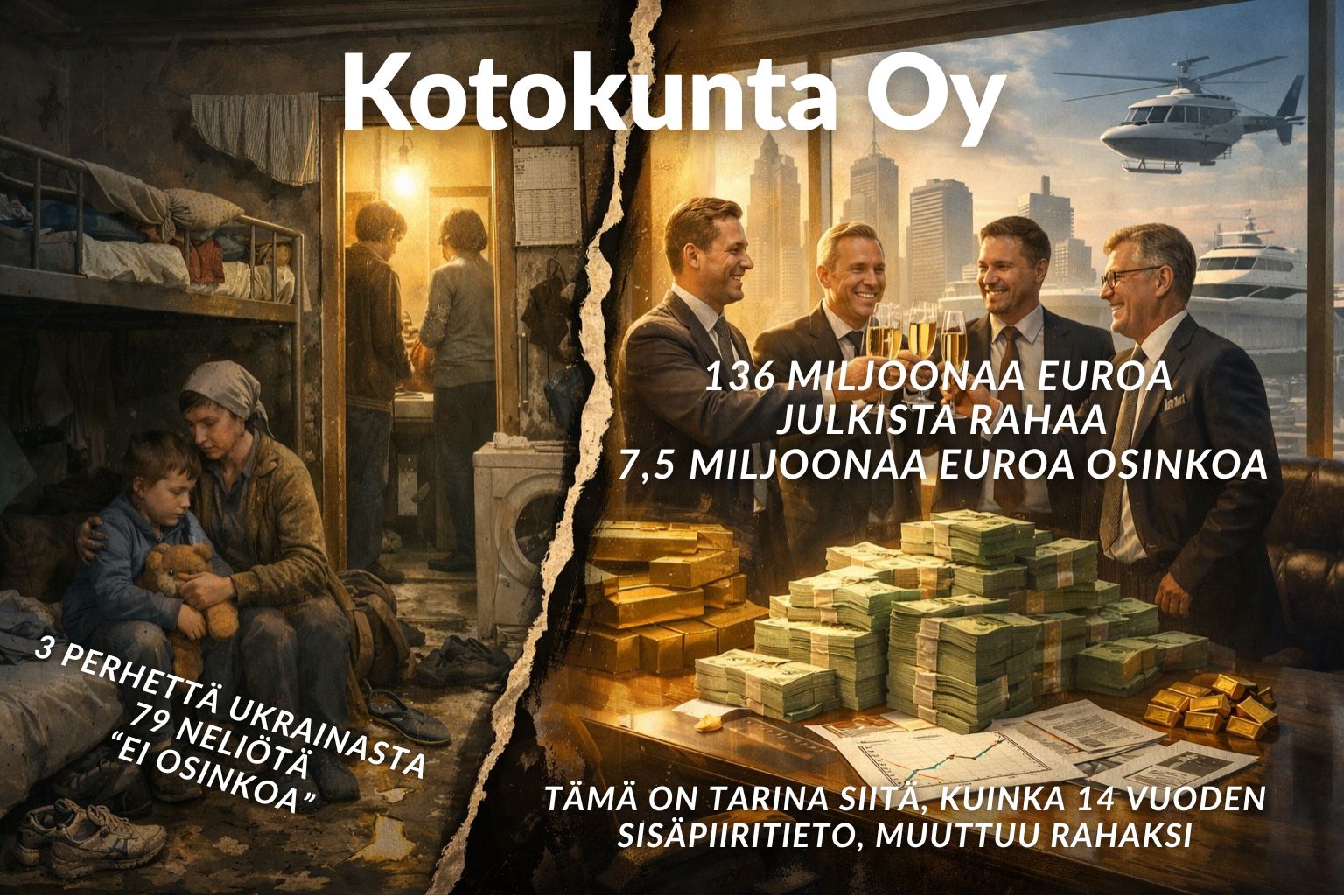
Kotokunta
The story of a company that landed a contract before it existed
It is time to stop virtue signalling and stop lying to ourselves that we are good people doing good things. We accept exploitation, human trafficking, and stand by watching as human dignity is trampled to fuel a business worth hundreds of millions.
18.2.2026 | Oy Suomi Finland Ab
In the autumn of 2015, over 30,000 asylum seekers arrived in Finland. A normal year brings 3,000–4,000. The number of reception centres surged from 18 to over 200. The Finnish Immigration Service needed places immediately. Yesterday. Hours ago.
On 11 November 2015, Lari Christensen registered a company called Kotouma Oy.
That same day, the Finnish Immigration Service awarded Kotouma a contract for a reception centre in Pyhtää.
That same day.
Christensen had been preparing the premises before the company was even registered. Within weeks, Kotouma expanded to Hotel Tallukka in Vääksy — roughly 500 places — and to an unaccompanied minors' unit in Kivistö, Vantaa. All direct procurement. No competitive tendering.
This is how a story began that ends with €136 million flowing into five people's pockets.
A company that slept for six years
Kotokunta Oy was registered on 22 June 2016. The acute phase of the refugee crisis was over. Asylum applications had dropped to 5,600 per year. Reception centres were closing.
Kotokunta slept.
| Year | Revenue | Employees | Profit |
|---|---|---|---|
| 2021 | €3,000 | 1 | −€2,000 |
One employee. Three thousand euros in revenue. Minus two thousand euros in profit. A company that does nothing. But does not shut down either.
In 2021, Kotouma was merged into Kotokunta. Everything — relationships, experience, knowledge, and contracts — was transferred into a single company.
And then came Ukraine.
From three thousand euros to 136 million
In February 2022, Russia invaded Ukraine. Tens of thousands of people sought temporary protection in Finland. Reception centres were needed again. Immediately. Yesterday. Hours ago.
And Kotokunta was ready.
| Year | Revenue | Employees | Profit | Margin |
|---|---|---|---|---|
| 2021 | €3,000 | 1 | −€2,000 | — |
| 2022 | €12.5 million | 90 | €857,000 | 6.9% |
| 2023 | €92.3 million | 277 | €9.0 million | 9.8% |
| 2024 | €136.1 million | 497 | €15.7 million | 11.5% |
From three thousand to 136 million. In three years. From one employee to nearly five hundred.
This is not a startup story. This is not an entrepreneurial miracle. This is a machine that was built in 2015, put to sleep for six years, and woken up when the next crisis window opened.
Five owners shared €7.5 million in dividends in a single year. From public funds. From asylum services.
Five owners, three common denominators
Kotokunta is a five-person company. No holding structures. No venture capitalists. Five owner-managers, all actively involved in operations.
Their backgrounds tell you everything.
Lari Christensen: the first entrepreneur of the crisis
Founded Kotouma at the peak of the refugee crisis. Landed a contract the same day. Expanded to three locations within weeks. He had no prior experience in reception operations, but he had "10 years of experience in financial administration and HR services."
Christensen runs a network of companies: Christensen Holding Oy, Asumarahasto Oy, HKJ-Invest Oy, North of Sixty Oy, and NICHE-3 Oy. Asumarahasto — literally "Housing Fund" — is a property company whose very name points to housing services.
Janne Autio: 14 years in the public sector, then the private sector
This is the heart of the story.
Janne Autio served as the director of the Kotka municipal reception centre from approximately 2008 to 2022. Fourteen years. In the public sector. Under the coordination of the Finnish Immigration Service.
During that time, Autio established and refined what is known as the "dispersed housing model" — asylum seekers live in ordinary apartments instead of institutions. He built this model on the taxpayers' payroll, with public sector resources, over the course of 14 years.
Then he moved to Kotokunta. As co-owner and chief operating officer. And he took his model with him.
Kotokunta offered the dispersed housing model in competitive tenders. It won. 15 out of 16 contracts in the first round.
The company's CEO, Juhani Pälve, told Yle: "It surprised even us that we won every contract we bid on."
Surprised? A company whose chief operating officer spent 14 years developing the winning model in the public sector and brought it with him to the private sector won every tender. Truly surprised?
Matias Pälve: sitting on two chairs at once
Matias Pälve is the Director of Service Production for the Western Uusimaa wellbeing services county. A public office. He oversees the delivery of public social and health services.
At the same time, he has been a board member of Kotokunta Oy since October 2024 — confirmed by the Finnish Trade Register extract from the Finnish Patent and Registration Office. His public tax records for 2024 show capital income of €108,842: a sum consistent with dividends from a significant ownership stake.
A public sector executive simultaneously sits on the board of a company — a company that receives €136 million per year in public contracts. Both roles active. Simultaneously.
The Attendo connection: three out of five
Juhani Pälve, Matias Pälve, and Jari Lampinen all worked at Attendo — Finland's largest private care company. Attendo is a company whose core competence is generating profit from publicly funded services. Three of Kotokunta's five owners learned this craft at Attendo and brought it to a new market.
The National Audit Office: Immigration Service procurements were unlawful
The National Audit Office of Finland (VTV) published a report in 2023 titled "Long-term government service procurements." In it, the VTV examined the procurement practices of the Finnish Immigration Service and found them partly illegal.
In the VTV's own words: the Immigration Service had carried out reception centre procurements "partly through direct procurement in violation of the Procurement Act" — and before 2022, practically all reception centres had been established without competitive tendering.
Before 2022, only "a few reception centres" had been established through competitive tendering. All others were direct procurements: contracts awarded without open competition.
The Yle MOT investigation in 2024 added detail: The Immigration Service spent approximately €900 million on non-tendered direct procurements. €670 million in 2022–2023 alone.
€900 million. Without competitive tendering. And when tendering was finally introduced in 2022, one company won nearly everything — because its key personnel had themselves designed the model on which the tendering was based.
The Red Cross: the former monopoly
Before Kotokunta, the market was dominated by the Finnish Red Cross. At the start of 2016, the Red Cross operated 109 reception centres out of approximately 146–227. That too was a monopoly, that too without competitive tendering.
The Red Cross operated on a cost reimbursement model. The Immigration Service paid the Red Cross an administrative fee of 5–8 per cent of the budget. Yle described it as "risk-free business." A guaranteed profit margin, no competition, no pressure for efficiency.
When competitive tendering began, the Red Cross started losing. Kotokunta won. The Red Cross initiated redundancy negotiations in several districts.
The market structure did not change. One monopoly replaced another. The Red Cross's risk-free 5–8 per cent margin was replaced by Kotokunta's 11.5 per cent margin and €7.5 million in dividends.
Nobody asked
This is where the story becomes staggering.
€136 million. One company. Five owners. €7.5 million in dividends. Growth from €3,000 to €136 million in three years. Procurement practices declared unlawful by the state's own auditor. A revolving door from public to private. A dual role in public office and private ownership.
And in Parliament: zero written questions.
Not one. No member of Parliament has ever asked a single question about Kotokunta Oy.
The Finnish Competition and Consumer Authority (KKV) has published no investigation into market concentration in reception centre services, even though the unlawful practices identified by the National Audit Office fall directly within the KKV's mandate.
Helsingin Sanomat, Kauppalehti, and Talouselämä have published no identifiable investigative journalism on Kotokunta's market position.
€136 million in public funds. And silence.
What does this mean?
We are not claiming that anyone has broken the law. The Immigration Service's direct procurements were unlawful according to the National Audit Office, but that is the Immigration Service's problem, not Kotokunta's. Kotokunta's owners have made lawful business decisions. They founded a company, built expertise, and won competitive tenders.
But.
When a company's chief operating officer developed the winning model over 14 years in the public sector and brought it with him to the private sector, this is not fair competition. It is a structural advantage that no tendering process can level. No competitor can overturn 14 years of insider knowledge with a bid calculation.
When a company's co-owner simultaneously holds a senior public sector position with a €12,000 monthly salary, this is not merely a conflict of interest. It is a system in which the public and private sectors are so intertwined that no boundary remains.
When a company lies dormant for six years with a single employee and rises to €136 million in three years when the next crisis strikes, that is not entrepreneurship. That is a standby position. Someone knew the next crisis would come. Someone kept the engine running. Someone waited.
And when all of this happens in a market where the state's own auditor has declared the procurement practices unlawful and nobody — not Parliament, not the competition authority, not the mainstream media — asks a single question, this is no longer the story of a single company. It is the story of a system. A system that generates profit for the few, services for the many, and oversight for no one.
One number
A family that fled Ukraine lives in a Kotokunta-arranged apartment in Valkeakoski. According to an investigation by Yle Novosti, residents reported eight people living in 79 square metres. Three families sharing one bathroom.
Kotokunta Oy's owners shared €7.5 million in dividends.
Both figures are public. Both are true. And both are part of the same story.
Timeline
| Date | Event |
|---|---|
| Autumn 2015 | Over 30,000 asylum seekers arrive in Finland |
| 11 Nov 2015 | Lari Christensen founds Kotouma Oy |
| 11 Nov 2015 | The Immigration Service awards the Pyhtää reception centre contract — effectively the same day |
| Nov–Dec 2015 | Kotouma expands to Vääksy and Vantaa, through direct procurement |
| 22 Jun 2016 | Kotokunta Oy is registered |
| 2016–2021 | Kotokunta is effectively dormant |
| 2021 | Kotouma merges into Kotokunta. 1 employee. €3,000 revenue. |
| 24 Feb 2022 | Russia invades Ukraine |
| 2022 | The Immigration Service launches a Dynamic Purchasing System (DPS) |
| Autumn 2022 | Kotokunta wins 15/16 contracts in the first round |
| 2023 | The National Audit Office declares Immigration Service procurements partly unlawful |
| 2024 | Yle MOT: €900 million in non-tendered direct procurements |
| 2024 | Kotokunta: €136.1 million revenue, €15.7 million profit, €7.5 million in dividends |
| 2025 | Parliamentary questions about Kotokunta: 0 |
All information is based on public sources: Finnish Trade Register (PRH), Business Information System (YTJ), Asiakastieto, TED procurement notices, National Audit Office report 12/2023, Yle MOT, Yle Novosti, Iltalehti, government procurement data (tutkihankintoja.fi), parliamentary records.
This article is part of the Visio Suomi project.
Next instalment: Consultant Nation — who controls public procurement and at what cost.