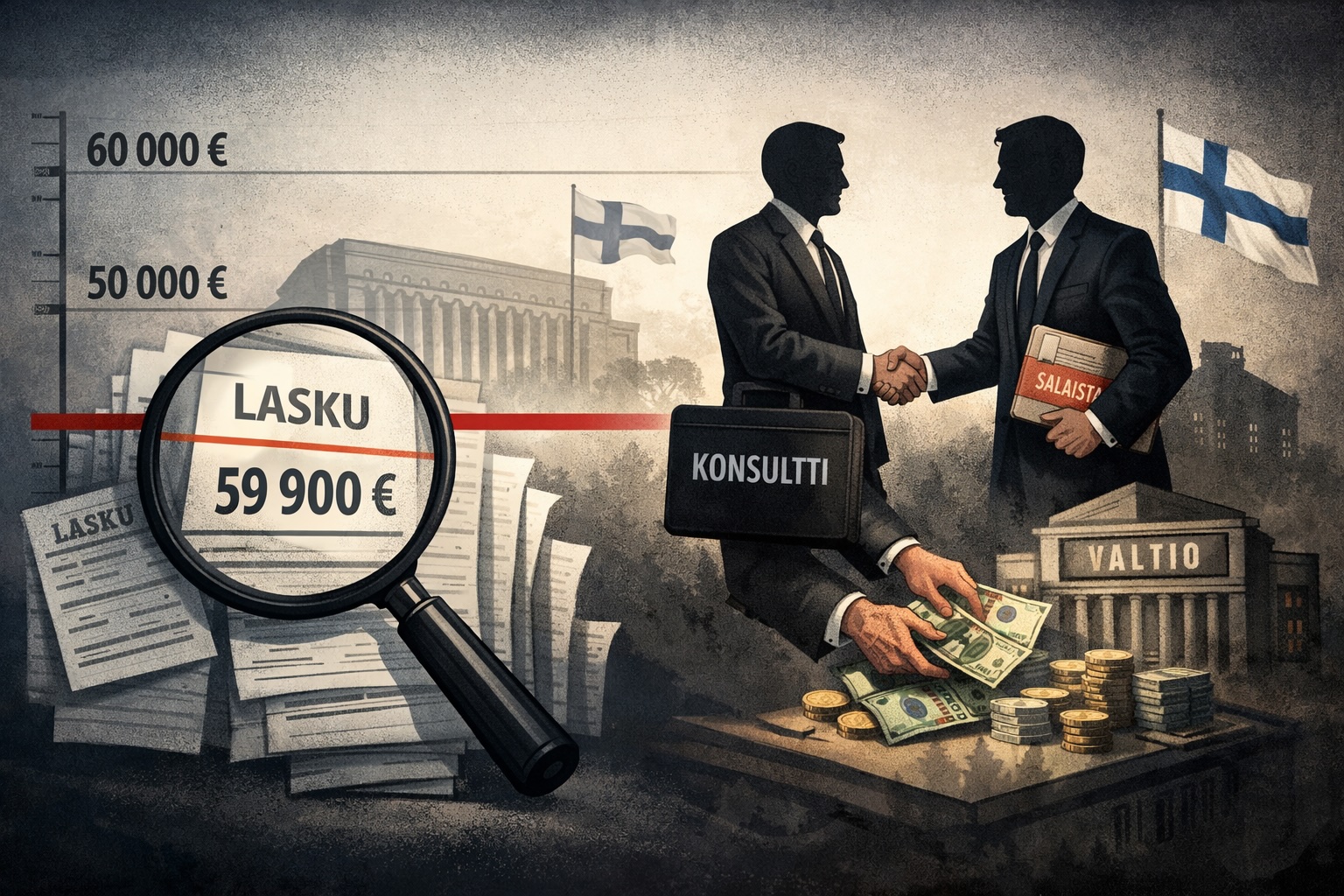
Just Under the Limit
How consultants dodge competitive bidding with your money
18.2.2026 | Oy Suomi Finland Ab
Imagine you are renovating your home. Any renovation over €10,000 requires three quotes. Your plumber knows this. So he bills you €9,900. The next year, another €9,900. And the next. Different rooms, but always €9,900. You pay. Nobody asks questions.
Now replace the plumber with Gartner — the world's largest IT consulting firm. Replace €10,000 with €60,000. That is the threshold above which public procurement must go through competitive bidding. And replace your home with the Finnish state.
With your tax money.
The rule is simple
The Public Procurement Act states: when a public purchase exceeds €60,000, it must be put out to open tender. Competitive bidding means multiple companies get to submit offers and the best bid wins. It is the taxpayer's safeguard. It ensures that your mate does not get the job simply because he is your mate.
But what if the purchase comes to €59,900? Then no competitive bidding is required. A civil servant can buy from whoever they like. No comparison. No transparency. No competition.
The question is: how many consulting purchases land just under that threshold?
We went through every government invoice from 2019 to 2025. 17.3 million invoices. €74 billion. And we counted: how many times did a single consulting firm's invoices to the same agency, in the same year, fall between €55,000 and €59,999?
The answer is alarming — and revealing.
Gartner Finland Oy: same pattern, different agency, year after year
Gartner is the world's largest IT research and consulting firm. It advises companies and governments on technology decisions. Gartner sells expert services to the Finnish state. And Gartner's invoices look like this:
| Year | Agency | Total billed | Invoices |
|---|---|---|---|
| 2019 | National Land Survey | €59,840 | 1 |
| 2020 | National Land Survey | €59,900 | 1 |
| 2020 | THL | €59,840 | 1 |
| 2024 | Natural Resources Institute | €59,800 | 3 |
| 2019 | Traficom | €56,000 | 1 |
59,840. 59,900. 59,840. 59,800. Four different agencies. Multiple years. Every amount so close to the €60,000 threshold that it cannot be coincidence — yet far enough away that it never crosses it.
Gartner does not send a single invoice for €59,900. That would be too obvious. Instead, the engagement is sized as a whole to land just under the limit. Sometimes it is split across several invoices. But at year's end, the total is always the same: just under €60,000.
Futurice Oy: six units, same strategy
Futurice is a Finnish technology consultancy. Their billing to the public sector follows the same logic:
| Year | Unit | Total billed | Invoices |
|---|---|---|---|
| 2019 | Urban Environment, Helsinki | €59,415 | 6 |
| 2020 | Urban Environment, Helsinki | €59,950 | 3 |
| 2022 | Traficom | €59,376 | 1 |
| 2025 | Traficom | €59,500 | 2 |
| 2023 | Health & Social Services, Helsinki | €57,225 | 6 |
| 2019 | Finnish Transport Infrastructure Agency | €57,005 | 5 |
Six different units. Six times landing in the €55,000–€60,000 range. €59,415 to Urban Environment across six invoices — that is precise arithmetic. The following year, €59,950 across three invoices. Fifty euros short. Coincidence? Of course not.
KPMG Oy Ab: four consecutive years at the Ministry of Justice
KPMG is one of the world's four largest audit and consulting firms. The Ministry of Justice is a regular client. And the invoices tell a story:
| Year | Unit | Total billed |
|---|---|---|
| Year 1 | Ministry of Justice | €56,831 |
| Year 2 | Ministry of Justice | €57,488 |
| Year 3 | Ministry of Justice | €59,040 |
| Year 4 | Ministry of Justice | €59,300 |
56,831. 57,488. 59,040. 59,300. Four consecutive years. Same ministry. Same consulting firm. The amount climbs toward the threshold year by year like a thermometer — but never exceeds it.
KPMG's invoices appear in the €55,000–€60,000 range a total of 13 times, across 9 different units, over 7 years.
Deloitte — Prime Minister's Office and Stara, same price
Deloitte is another of the Big Four. Their pattern:
| Year | Unit | Total billed | Invoices |
|---|---|---|---|
| 2020 | Prime Minister's Office | €59,500 | 1 |
| 2025 | Stara (Helsinki) | €59,500 | 2 |
Same amount. €59,500. Two different units, five years apart. Deloitte's invoices appear in the €55,000–€60,000 range 8 times, across 7 different units.
HAUS Finnish Institute of Public Management Ltd: the state's own organisation
This is where the story turns absurd.
HAUS Finnish Institute of Public Management Ltd is the state's own training and development organisation. It was established to serve public administration. It is part of the system.
HAUS's invoices appear in the €55,000–€60,000 range 14 times, across 12 different units. More than any private consulting firm.
The state's own organisation circumvents the state's own competitive bidding threshold more systematically than the private sector. The system is gaming itself.
The big picture: the pattern worsens every year
Individual cases could be coincidence. The overall picture cannot.
We calculated the annual billing for every supplier-agency pair. Then we compared: how many pairs land in the €55,000–€59,999 range, versus those in the €60,000–€64,999 range?
If the competitive bidding threshold has no effect on purchasing behaviour, these numbers should be roughly equal. If the threshold does have an effect — if engagements are deliberately sized to stay under it — there should be more below the line than above it.
The results:
| Year | Purchases €55–60k | Purchases €60–65k | Below vs. above threshold |
|---|---|---|---|
| 2019 | 2,073 | 2,129 | Equal — normal |
| 2020 | 1,996 | 2,089 | Equal — normal |
| 2021 | 2,241 | 1,917 | 17% more below threshold |
| 2022 | 2,122 | 2,130 | Equal |
| 2023 | 3,102 | 2,735 | 13% more below threshold |
| 2024 | 3,228 | 2,868 | 13% more below threshold |
| 2025 | 2,712 | 2,210 | 23% more below threshold |
In 2019, things were normal: roughly equal numbers on both sides of the threshold. In 2025, there are 23 per cent more purchases just below the threshold than just above it. That means the pricing of hundreds of engagements has shifted over five years. Awareness of the threshold has spread. And an increasing number of engagements are being sized to stay under it.
This is not coincidence. Coincidence does not grow every year.
What does this mean?
Let us speak plainly.
When a consulting firm prices an engagement at €59,800, there is one consequence: no competitive tender takes place. No one else gets to bid. No one compares prices. No one asks whether someone else could have done the same work for less — or better. The civil servant buys from whoever (read: their regular contact) they choose, and the taxpayer pays.
It means that the competitive bidding threshold — the taxpayer's most important safeguard in public procurement — is not working. Not because the threshold is set at the wrong level, but because the consulting industry and the buyers have learned to circumvent it.
With the pattern worsening every year, this is not a matter of a few careless civil servants. It is a practice that is spreading. A silent agreement between buyer and seller: you keep the price under the limit, I won't ask why.
We are not claiming that the law has been broken. The procurement threshold is a threshold, not a violation if you stay below it — but the purpose of the law is to protect competition and the taxpayer's interest. When the same consulting firm sells to the same agency year after year, always just under the limit, the purpose of the law is defeated. The letter is fulfilled. The spirit dies.
One question
This data is public. Every figure comes from the state's own invoice data, openly available at tutkihankintoja.fi. Anyone can verify every number.
The data has been public for years, but it has never been examined from this angle.
We ask only one question: why?
Why has no one — not the National Audit Office, not Parliament, not a single ministry — ever counted how many public purchases land just below the competitive bidding threshold? The answer is short: no one looked, because no one asked.
Now we are asking.
This article is part of the Visio Suomi project, which combines Finland's open government data sources into a comprehensive picture of the state of the nation. All data is public and verifiable.