You can find our previous article on homeschooling and the Finnish Security and Intelligence Service's (SUPO) statements here.
From Fear to Connection: What Really Lies Behind the Homeschool Debate
The Headlines Tell a Story
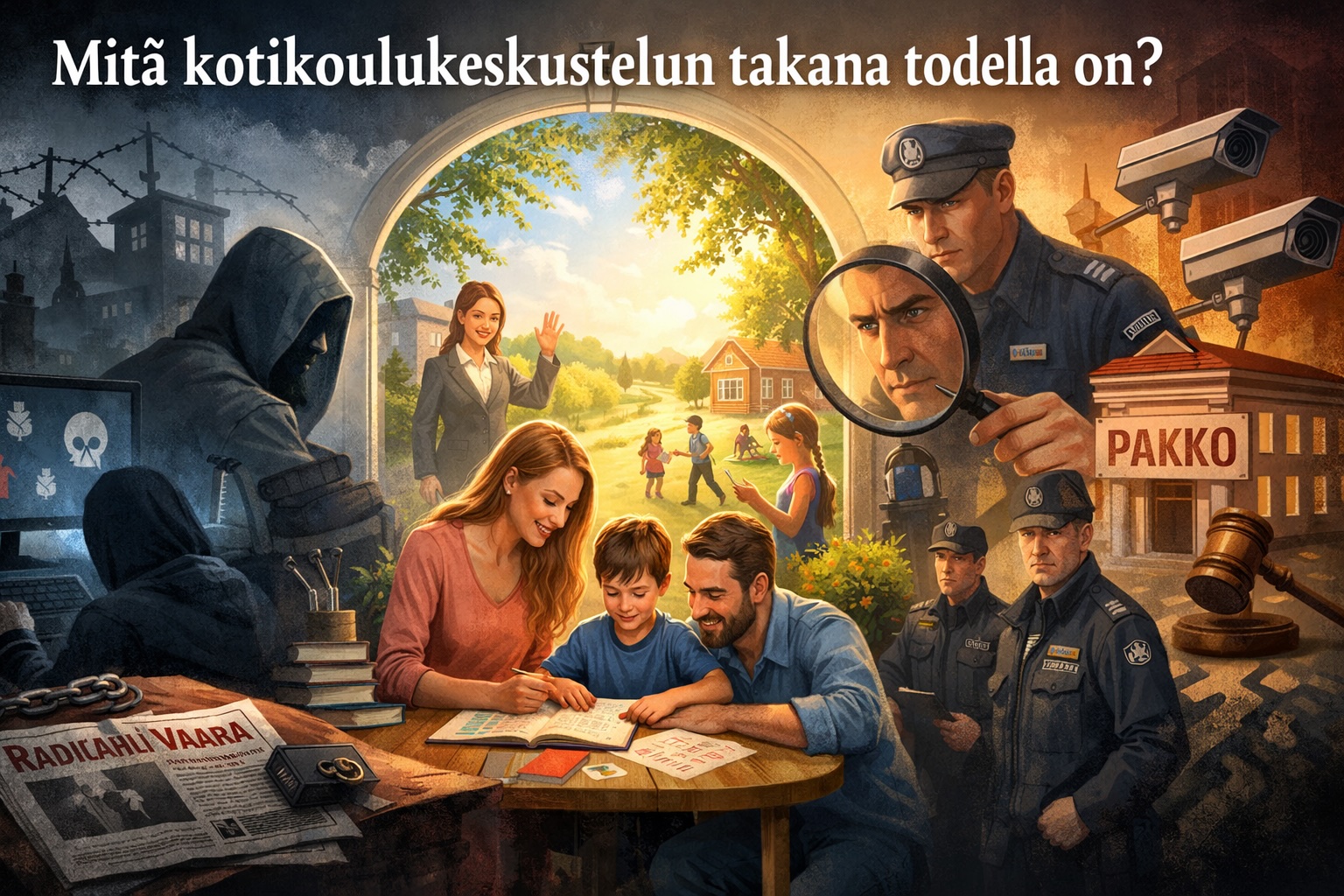
"SUPO warns about homeschools." "Extremist influence." "Homeschoolers secretly attend radical religious schools." "Something alarming is happening in people's homes." "Finland needs compulsory schooling to prevent child radicalisation."
These headlines were written to provoke fear. They work. A reader encountering them for the first time pictures a clandestine network where children are being radicalised in dark rooms. The image is powerful, frightening, and deliberate.
But it is not true. It is a frame constructed to serve a predetermined conclusion, not to describe reality.
The reality is this: Finland has approximately 950 children in home education. That is 0.16 per cent of all primary school pupils. SUPO's own chief admits he does not know exactly what is being taught in homeschools. He admits that radicalisation happens primarily online. The only concrete example of a far-right homeschool in Finland is a single family that moved from Sweden to the Åland Islands, whose affiliations were reported by a Swedish activist organisation.
This is the foundation on which a compulsory schooling debate is being built — one that affects every Finnish family.
How did we get here? What really lies behind these headlines? What do you find when you dig deeper than the fear?
Fear: Are Children Being Radicalised in Homeschools?
What is feared?
SUPO specialist researcher Anna Santaholma states that behind homeschools there is "often fundamentalist and ultra-conservative thinking." SUPO chief Juha Martelius says compulsory schooling would increase Finland's security, because then the state would know what children are being taught.
The fear is that homeschools are raising children against society.
What does this fear conceal?
No one has presented evidence that Finnish homeschooling has produced a single radicalised young person. Not one. Finland's only far-right terrorism investigation concerns the Kankaanpää men, who were radicalised online — not in a homeschool. SUPO's own analysis states that radicalisation happens on the internet and social media, regardless of where a young person lives.
The fear is not based on evidence. It is based on a theoretical possibility that has not materialised.
What is the opposite of fear?
Trust. Trust that the vast majority of parents make choices for the good of their children. Trust that among those 950 families there are mothers and fathers who lie awake at night thinking about how their child can learn best. Trust that freedom need not be taken from everyone because a few could, in theory, misuse it.
Trust is not naivety. It is the choice to see the good in a person first and to address problems in a targeted way when they actually arise.
Despair: The State Cannot Oversee This
What is feared?
SUPO states that it is extremely difficult for authorities to monitor what is taught in home education. Adlercreutz worries that practices vary from one municipality to another. Santaholma states there is a gap in the legislation.
The despair is that the system cannot control the situation.
What does this despair conceal?
The state has not even tried to build a functioning model of cooperation with homeschool families. It has not asked families why they chose homeschooling. It has not offered support, resources, or partnership. It has left the relationship between families and municipalities unattended, and then wondered why oversight does not work.
Behind the despair there is not an impossible problem. There is a neglected opportunity.
What is the opposite of despair?
Hope. Hope is born from the recognition that the problem is solvable. If the state built a cooperation model where homeschooling and public schooling operated side by side, oversight would happen naturally: family and school would share the same core curriculum, the child's progress would be tracked together, and support would be available in both directions.
The solution does not require compulsory schooling. It requires building a relationship. A relationship in which neither party stands above the other, but both stand around the child.
Distrust: Parents Don't Know What's Best for Their Child
What is feared?
SDP's Tytti Tuppurainen sums up the attitude in one sentence: "This is not about parental preference — it is about children's futures." Left Alliance's Minja Koskela demands compulsory schooling. SUPO's review states that home education "increases societal segregation."
Behind this lies the assumption that parents who choose homeschooling do so to their child's detriment, or out of their own ideological interest.
What does this distrust conceal?
The real reasons families choose homeschooling. Martelius himself acknowledges that families who opt for home education often have well-founded reasons related to their child's health or wellbeing. This is the one point in the article where reality is given a voice — but it is passed over in a single sentence on the way to the compulsory schooling debate.
Those reasons include school bullying that the school failed to address. Special needs that went unmet. Mental health problems that worsened in the school environment. Family convictions that conflict with ideological content in the curriculum. The child's own desire to learn in a way that works for them.
These are not parental "preferences." These are a child's needs that parents are trying to meet because the system could not.
What is the opposite of distrust?
Respect. Respect for the reality that parents know their children. They know when their child is not sleeping, when she cries in the morning, when he has stopped talking after the school day. This knowledge is valuable. Dismissing it as "preference" is cruel.
Respect also means that when a parent makes a difficult decision to protect their child, society does not automatically question their motives.
It should ask: what can we do so this family gets the support it needs?
Dishonesty: When Words Do Not Match Reality
What is said?
"Radical religious homeschools." "Fundamentalist thinking." "Anti-societal attitudes." "Radicalisation." "Security threat."
What is left unsaid?
How many such homeschools have been found in Finland? Not a single named case has been presented publicly. How many children have been radicalised in a homeschool? Not a single documented case exists. What does "fundamentalist" mean in this context? It has not been defined. What does "ultra-conservative" mean? It has not been delineated. Where is the line between "conviction" and "radicalisation"? It has not been drawn.
The words are large. The evidence is non-existent. This discrepancy is dishonesty, not security policy.
What is the opposite of dishonesty?
Truth. The truth in this case is simple: Finland has 950 children in home education. The vast majority of them are in ordinary families where parents carry their responsibility. A small number may be in situations that require attention. Identifying those situations does not require stripping everyone of their freedom. It requires precision, honesty, and targeted action.
Truth also demands acknowledging that public school is not without problems. The bullying problem remains unsolved. Special education resources are insufficient. The youth mental health crisis is real. Ideological content has entered the curriculum that conflicts with the convictions of many families. These are the reasons families choose homeschooling, and they will not be solved by forcing families back into the problem.
Connection: The Way Forward
The story the headlines have built is this: homeschooling is a threat, the family is a suspect, the state knows better, the solution is compulsion.
The real story is this: a child needs safety, a family is doing its best, the school needs resources, the state needs humility.
Connection is born when no one stands against anyone, but everyone stands for the child. In practice, it looks like this:
-
The state acknowledges that choosing homeschool is most often a response to the shortcomings of public school, not an ideological statement. Every child who transfers to homeschooling is feedback to be received with gratitude, not suspicion.
-
The Ministry of Education builds a cooperation model where homeschool families receive support in implementing the curriculum: materials, guidance, a connection with their local school. Homeschooling is part of the education system, not outside it.
-
The municipality monitors every child's progress, whether in school or homeschool — not as surveillance but as care. The monitoring is the same for all, because every child is equally valuable.
-
The family has the freedom to teach according to its values within the framework of the curriculum. That freedom is not a threat. It is a sign that Finland is a country that trusts its people.
-
The school addresses its own shortcomings: bullying is dealt with for real, special needs are met, mental health services are available, a safe learning environment is protected. When the school is safe, families have no need to flee from it.
-
SUPO directs its efforts at real threats, not at 950 families. Radical Islamist unauthorised schools can be investigated and addressed without branding all homeschools as a threat. Targeted action is more effective and more just than generalisation.
The Story We Have Not Yet Told
The headlines have told a story of fear. That story is easy to tell, because fear sells, clicks follow, and political points are scored.
There is another story waiting to be told. It is the story of a mother who keeps her child in homeschool because the school could not keep him safe. It is the story of a father teaching his son mathematics at the kitchen table because in the classroom no one had time to notice him. It is the story of a child who learns to read at her own pace and rediscovers the joy of learning that school had taken away.
These stories are real. There are hundreds of them. No headlines are written about them, because they do not fit the fear-driven frame.
If we want to find connection, we must tell these stories too. Not to defend homeschooling against school, but to show that both are needed. A tree needs both roots and branches. A child needs both home and society. These do not have to be in opposition. They can stand together — when neither needs to fear the other.
The Solution Is Not Compulsion. The Solution Is Connection.
Compulsory schooling answers the question: how do we control people? Cooperation answers the question: how do we serve children?
The first question produces control. The second produces trust. Control keeps people in place. Trust helps them grow.
Finland is built on trust. That trust is earned anew every day — not by demanding it, but by being worthy of it. The school earns families' trust by being safe, fair, and shaped by the child. The family earns the state's trust by carrying its responsibility and doing its best. The state earns its citizens' trust by respecting their freedom, listening to their concerns, and serving their children.
Here is the blue-and-white future from which no one is excluded: a country where the root is healthy and the branches hold, where school and home do not compete for the child but carry her together, where freedom is not a threat but a testament to the strength of civilisation.
That future is not born of fear. It is born of connection. It is born when we stop sawing at the branches and begin watering the roots.