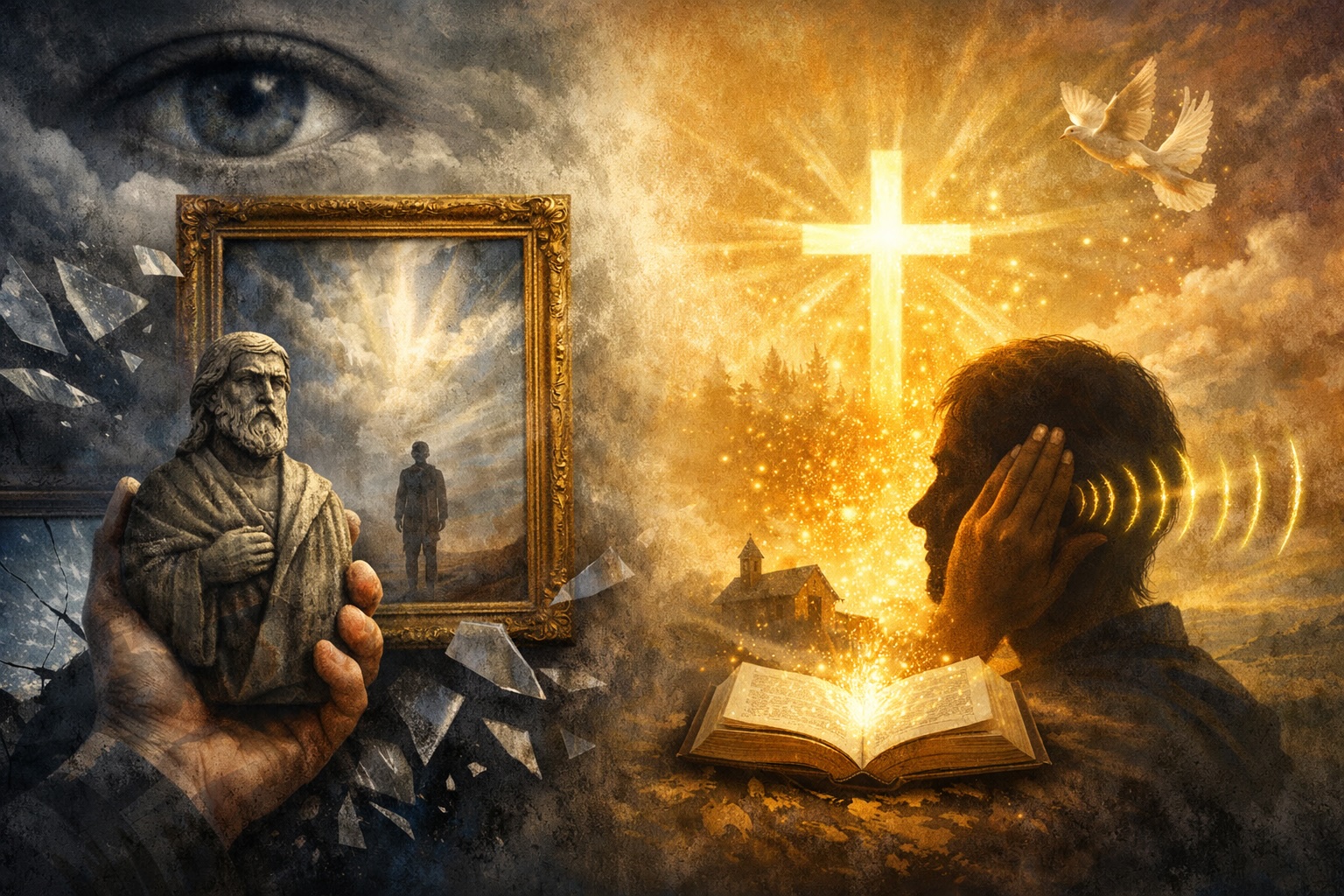
The Eye Takes, the Ear Receives
The Limits of Seeing and the Freedom of Hearing
The Image That Freezes
If God were visible, the human mind would make its first natural move: it would frame. The eye cannot gaze upon the infinite, so it crops. It takes the portion of the whole it is able to process and says: "This is God."
This is where the image is born. Not yet in a sinister sense, but as an inevitable consequence of how human perception works. The eye frames. The mind interprets. Memory stores. Now God has become something a person can "possess," carry in the mind, and recall at will. This is already the beginning of distance. What was living has become recorded. What was present has become remembered.
The image begins to live a life of its own. It no longer changes, even though God Himself is living and moving. The person returns to the image again and again, but the image has stopped. It is a frozen moment — the person's own framing, immortalised.
The Turning Point No One Notices
Here something subtle but decisive takes place: the person begins to worship the image instead of God. Not consciously, but because the image is easier. It does not surprise. It does not challenge. It says nothing new. It is safe, manageable, and predictable. A visible god that obeys its bearer. The living God is frightening, for He is free. The image is comforting, for it is captive.
A person who has worshipped their own image long enough begins to notice that the image increasingly resembles the worshipper. The person projects onto it their own desires, fears, values, and prejudices. "God wants what I want." "God hates what I hate." "God is on my side."
The image is now a mirror. The person bows before it, but sees only themselves. They call it prayer, but it is monologue. They call it faith, but it is self-affirmation.
This is the deepest form of idolatry — not a bronze statue in a temple, but one's own self exalted as sacred. It is so subtle that the person does not notice it. They believe they are worshipping God sincerely, even as they worship their own conception of God.
The Eye Takes, the Ear Receives
Looking is an active act in which the viewer decides where to look, how to frame, and what to interpret. Listening is a different kind of act. In it, a person makes themselves vulnerable. They do not control what they hear. They can close their eyes, but the ears remain open. Listening demands a vulnerability that looking does not. This is why faith comes by hearing (Rom. 10:17). Not by seeing. For hearing breaks the illusion of control that seeing constructs.
The Word That Lives
When God speaks, He does not give an image of Himself. He gives a word. A word cannot be framed in the same way as an image. A word lives, moves, shifts meaning within context, and resonates differently at different moments. The same verse in the Bible can speak to a person in an entirely different way twenty years apart, because the word is living (Heb. 4:12).
An image can be hung on a wall. A word cannot.
Words Carry the Soul
When a person speaks to another, they do not merely transfer information. They reveal something of what they are. Words carry with them the essence of their sender — not just their thoughts. This is why the same words from different lips feel different. This is why we recognise the difference between sincere and pretentious speech, even when the words are identical.
Jesus said: "For out of the abundance of the heart the mouth speaketh" (Matt. 12:34, KJV). Words are not separate from the soul. They are the soul's overflow — the point where the inner becomes visible, or more precisely, audible.
This is why words always contain either truth or falsehood. Not merely factual truth or falsehood, but existential: does the person speak from their true being, or do they pretend to be something else? Is the word aligned with the soul or at odds with it?
A lie, then, is not merely a false statement. It is the fracturing of the soul — the moment a person severs their words from truth. This is why lying exhausts and leaves a person uneasy, until, prolonged long enough, the heart hardens. Truth sets free, even when it is difficult.
Being Seen Without Eyes
Being seen without eyes is a paradox that dismantles the entire logic of modern culture. The world says that to be seen, you must show. Show yourself, your achievements, your life. Make an image of yourself and put it on display.
This is the logic of the golden calf applied to the person themselves: make yourself visible and you will be worshipped. Social media is a temple where everyone is both priest and idol.
True seeing happens differently. It happens when another person listens — not with their eyes but with their presence. It happens when someone receives your words not to judge but to understand. It happens when silence between two people is not emptiness but space where truth can breathe. This kind of seeing does not require eyes. It requires ears. It requires a heart. It requires the courage to be present without the need to control, resolve, or perform.
God's invisibility is not a deficiency but a protection. He shields us from the slavery of the image so that we may learn to be seen in a way that needs no image — through the word, through silence, and through presence.
Philip's Request
"Philip saith unto him, Lord, shew us the Father, and it sufficeth us."
(John 14:8, KJV)
Philip had walked with Jesus. Heard His words. Been present at miracles. Yet he demands: "Shew us, and it sufficeth us." Everything seen and heard was not enough, because the eyes cried louder than the ears.
Jesus' answer stops us in our tracks. He showed nothing. Instead He said: "He that hath seen me hath seen the Father." You have already received everything, but you do not recognise it, because you are still searching with the wrong sense and for the wrong things. Then He adds something decisive: "The words that I speak unto you I speak not of myself" (John 14:10, KJV). He directs back to words. Not to an image. To words that come from the Father, that carry the Father's soul, that are the very connection Philip seeks with his eyes.
"Shew us, that it may suffice" is humanity's oldest prayer and oldest trap. It promises satisfaction but produces only deeper hunger. Every image gives birth to the need for the next image. It is an endless cycle, for the eye never says enough.
Being heard does not breed more hunger. It fills, because in it a person receives what no image can give: connection. Not an image of the other, but the other's presence. Even in silence we receive abundantly — all things and more. Therein lies the open secret of the gospel. Its power and its wisdom.
If what we see
does not match what we hear?
If we hear something
for which we have no image?
When another listens,
not with their eyes but with their presence,
the image ceases to matter.
When someone receives your words,
not to judge but to understand,
you forget that seeing could ever matter.
When silence between two people
is not emptiness but space
where truth can breathe,
the rhythm of breath is shared —
a code of Love.
"He that hath ears to hear, let him hear."
(Matt. 11:15, KJV)
Faith Before Seeing
"If thou wouldest believe, thou shouldest see." Not "If thou shouldest see, thou wouldest believe." The world says: show me, and I will believe. Jesus says the opposite: believe, and you will see. Faith comes first. Seeing is the fruit of faith, not its prerequisite. Once again — hearing before looking.
Faith is found where no one tries to see faith but simply listens. A mustard seed does not know it is a mustard seed. It does not know what will grow from it. It is small and unaware of its own power. Faith is exactly like that. A person who does not know whether they believe enough, yet still turns toward God to listen. Does not see, yet still yearns. That yearning itself is already proof of the mustard seed.
The Temple That Is a Person
"LORD, I have loved the habitation of thy house, and the place where thine honour dwelleth."
(Ps. 26:8, KJV)
The gift of faith settles within us — He Himself. This is why anger cannot hear God, nor the self, nor the neighbour, because it is not of the Lord's working. Glory justifies, and His influence within us exposes the darkness we voluntarily relinquish when we see its true face.
God's house is the person. The Psalm speaks of the temple, but Paul takes it to its conclusion: "Know ye not that ye are the temple of God, and that the Spirit of God dwelleth in you?" (1 Cor. 3:16, KJV). Glory does not dwell in a building. It dwells in a person. Invisibly — not as an image but as presence.
Anger is deafness. It is not merely an emotion; it is a state in which hearing ceases. An angry person cannot hear another, cannot hear themselves, cannot hear God. All three connections sever in the same instant, because they are ultimately the same connection. This is why Jesus equated anger with murder (Matt. 5:21–22) — not because anger is an equally grave act, but because it produces the same severance. It shuts the temple doors from the inside.
The Glory That Reveals
Glory does not compel. It reveals. Darkness persists as long as it is permitted to masquerade as something else — as righteous anger, healthy self-preservation, or justified bitterness. It disguises itself. The presence of glory strips away this mask — not by force, but simply by being what it is: Truth. Light does not need to fight darkness. It simply ignites, and darkness ceases to exist.
This is why renunciation is voluntary. Not because God grants freedom of choice as a matter of principle, but because seeing truth itself gives birth to the desire to let go. A person does not renounce darkness because they are commanded to, but because they finally see what it is. Love by compulsion is not love, but an insight grown in love is more powerful than any commandment.
The Threshold That Suffices
"For a day in thy courts is better than a thousand. I had rather be a doorkeeper in the house of my God, than to dwell in the tents of wickedness."
(Ps. 84:10, KJV)
This is the quiet humility of hearing. The world's threat of rejection cannot drive you to settle in the rooms it offers. Better to remain in the open under the shelter of His hand than indebted in gratitude to the blind who refuse to hear.
The Psalm speaks of the threshold. Not the inner chamber, not the seat of honour, but the threshold. The lowest place in God's house. It is a place without status, without visibility, without rank. The doorkeeper on the threshold is the one nobody notices. Yet the psalmist says it suffices. One day in that place is better than a thousand elsewhere.
Why? Because from there, you can hear. From there, what takes place within carries outward. The one who stands at the threshold does not own the house, but they are near it. They are close. That suffices.
The world offers rooms. Security, status, and belonging — but not being heard. In the world, everything is conditional: be grateful, be indebted, do not question. Settling into the world's rooms costs you your hearing, for they set the terms of what may be said and what must be silenced.
Blindness that stems not from inability but from will is the kind that demands silence around it — not God's silence but enforced silence. It demands that others, too, stop hearing, because hearing the Truth nearby is a threat to the one who has chosen not to hear. This is why the world's rooms always carry an unspoken rule: do not speak of what you truly hear.
In the open there is no such rule. In the open there is no roof, but there is a hand. No walls, but lasting shelter. It is a bare, vulnerable place, but there one may hear freely and speak freely. At the threshold and in the open, His hand suffices. It does not withdraw — it is heard in a way that runs deeper than seeing.
The Soul That Yearns
"My soul longeth, yea, even fainteth for the courts of the LORD: my heart and my flesh crieth out for the living God."
(Ps. 84:2, KJV)
When He works in us and we turn toward Him, we hear what the noise of the world tried to drown out with its clamour.
The soul yearns — not for seeing but for hearing. That word "yearns" is bodily; it is not a thought about God but a pull toward God. Heart and flesh cry out — not only the mind. This is important, because it means that turning does not begin with a decision. It begins with a longing that runs deeper than the will. God awakens the longing before a person has time to decide anything. The noise of the world and the fixation on surfaces tried to cover it. It cannot destroy — only conceal. The longing is and remains there all along. Noise does not remove it; it only makes hearing harder. Spectacle pleases the eye for a moment but does not satisfy.
Turning toward God, then, is not discovering something new. It is hearing what has always been, beneath the surface. Understanding, for the first time, what it means to be heard — in the dwelling place of lasting peace and rest.
Grace That Opens the Ears
"We have thought of thy lovingkindness, O God, in the midst of thy temple."
(Ps. 48:9, KJV)
The Holy Spirit does not bring new information — He gives the ability to hear. The same God who appeared as Judge now appears as Liberator. Nothing changed in God, but everything changed in the listener who ceased gazing at vanity.
The Holy Spirit within us allows us to hear, for the first time, grace instead of mercilessness — grace that does not condemn but sets free. Instead of demanding, condemning God, ourselves, and one another — imagining we are making progress — we wander toward images in which the opposite of Love has hidden itself.
Demanding follows the logic of seeing: show, prove, justify. Grace follows the logic of hearing: come as you are, the door is open. A person who demands and condemns God, themselves, and others believes they are advancing, but only drifts toward images. Every sanctuary built by human hands is an image — an attempt to confine the holy to a single place. The true sanctuary is where grace comes from, and it does not close.
The Door That Does Not Close
"Lift up your hands in the sanctuary, and bless the LORD."
(Ps. 134:2, KJV)
The holy is not the creature's creation — it is grace that does not shut its door, even when the creature keeps opening and peering endlessly through neighbouring doors.
We knock everywhere except at the door of the living God. We listen and gaze at the void in idols, but not at our Creator. We try every visible door, build our own rooms and call them home. All the while, that one door stands open — where He waits for us to grow weary of searching in the wrong direction.
This is not weakness in God but the nature of Love. Love does not shut the door, because shutting would follow the logic of the image: framing, controlling, conditioning. Grace is infinite precisely because it operates not by image but by word. It calls. Again and again. Regardless of how many neighbouring doors a person has already opened.
When we hear the living God, we have acknowledged and accepted that He is greater than any one of us. Until then, we try to see — and what is heard becomes distorted, and the voice of Truth falls silent.
The Banqueting House and the Solemn Assemblies
"He brought me to the banqueting house, and his banner over me was love."
(Song of Sol. 2:4, KJV)
Jesus is our wine and our living bread — the needs of the body are met once the most important thing comes first.
"I will gather them that are sorrowful for the solemn assembly, who are of thee, to whom the reproach of it was a burden."
(Zeph. 3:18, KJV)
Jesus did not promise the peaks of worldly success and popularity — that shallow leaven. The faithful remnant experiences much of what their Lord experienced, knowing that we are on the way to true riches and the eternity of glory in Heaven.
The Sufficiency of Faith
"Jesus saith unto her, Said I not unto thee, that, if thou wouldest believe, thou shouldest see the glory of God?"
(John 11:40, KJV)
The measure of a mustard seed would suffice. Can even that be found?
"And she said, The glory is departed from Israel: for the ark of God is taken."
(1 Sam. 4:22, KJV)
What, in the end, is the ark? Our safe harbour? What is true and lasting cannot be stolen from us, because it is not ours but given to us. The glory is not ours but the Lord's. From Him we receive grace and forgiveness.
"Until I went into the sanctuary of God; then understood I their end."
(Ps. 73:17, KJV)
This does not mean that God's mysteries could ever belong to a person, but in weakness His power and wisdom are made visible as needed.
"He that hath ears to hear, let him hear."