
A Brutality Society Cannot Bear
What an animal cruelty case reveals about our society
Last month, a severe case of animal cruelty was uncovered in a private residence. A person of considerable standing had killed a puppy approximately 20 weeks old in an exceptionally brutal manner: the puppy was killed by being torn apart. Each limb was severed separately, the internal organs ripped out, and finally the skull was crushed.
The puppy had suffered significantly before death. Its stress hormone levels had been at their peak. Every torn body part showed evidence that the puppy had been conscious of what was happening until the very last moment.
The breeder received a five-month custodial sentence for aggravated animal welfare crime¹. In addition, a lengthy ban on keeping animals was imposed. Neighbours told the media they were deeply shocked and that the incident had taken them by surprise, as the convicted individual held a highly respected position in society.
The perpetrator's lawyer attempted to justify the act by claiming that the puppy had clear birth defects and that its quality of life would have been worse than that of other comparable puppies. Furthermore, the perpetrator stated in a social media post that the act was for the best of all, as the experience felt good and empowering.
The judge dismissed this defence immediately: "Causing suffering constitutes animal cruelty regardless of the justification. An animal has the right to live and to die naturally without human-inflicted brutality."
A second case that never made the news
That same week, a routine medical procedure was performed at Tampere University Hospital. A twenty-week-old human foetus was killed using the same method as the puppy: limbs severed one by one, internal organs ripped out, and finally the skull crushed.
Neuroscientific research demonstrates that a 20-week-old human foetus perceives pain at least as intensely as a puppy²,³. Its nervous system is more developed, its reactions to stimuli stronger⁴. Stress hormones surge, the heart rate accelerates, and as a conscious being it attempts to evade the threatening instruments until the very end⁵.
The physician who performed the procedure received no punishment. He received compensation for his work. No one was condemned on social media. The neighbours were not shocked. The media did not report on the event. The act was legal and socially accepted.
The only difference between these two cases is this: in the first, the victim was a dog. In the second, a human being.
Surgical abortions account for less than one per cent of all abortions performed annually in Finland⁶. The vast majority of abortions are carried out medically, but every single surgical procedure is identical to animal cruelty — except the law protects the animal, not the human.
The image below shows a foetus at 20 weeks.
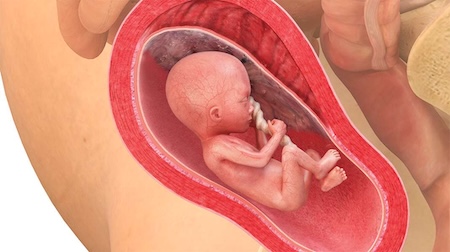
(Image from: https://www.vau.fi/raskaus/Raskausviikot/viikko-20/)
The D&E method
The D&E method described above is fortunately rare in Finland, but for abortions beyond 12 weeks that cannot be carried out medically, the D&E method is also used. Of abortions beyond 12 weeks, 2–4% are surgical according to statistics. The medications administered to the mother do not affect the foetus in a way that would relieve pain or ensure the foetus is dead before the procedure.
The global scale of abortion
Worldwide, approximately 200,000 abortions are performed every day, amounting to nearly 73 million abortions per year⁴¹. This figure exceeds the combined death toll of wars, natural disasters, and epidemics⁴². For perspective: this number is equivalent to the Second World War repeated every year in abortions alone. This is not a random development but a systematic ideological project that has transformed the concept of the value of human life in Western society⁴³.
The redefinition of abortion as freedom of choice is an intellectual manipulation that obscures its true nature⁴⁴. When the killing of a foetus began to be called a woman's right to decide over her own body, reality was deliberately blurred⁴⁵. The foetus has been renamed tissue, a cell mass, or a product of pregnancy — language that dehumanises a new human life⁴⁶.
In the eyes of the law: Species determines rights
The Finnish Animal Welfare Act (247/1996) and the Criminal Code (39/1889) define the killing of animals without an acceptable reason as a criminal offence⁷. The penalty may be a fine or imprisonment for up to two years. For aggravated animal welfare offences, the penalty may be up to three years' imprisonment⁸.
Under the law, an animal — even a fish — must not be subjected to unnecessary pain or suffering. An animal must not be killed by a cruel method. The euthanasia of an animal must be carried out as painlessly as possible⁹.
Compare this with the Finnish abortion law. A foetus may be killed up to the 12th week of pregnancy upon request without any justification¹⁰. Up to twenty weeks, authorisation from the National Supervisory Authority for Welfare and Health (Valvira) is required¹¹. Pain relief for the foetus is not mandated. The method is not restricted. The person performing it is not punished.
The law protects a fish, but not a human child.
The paradox of developmental biology
From a developmental biology perspective, the comparison is staggering. A twenty-week-old human foetus is neurologically far more developed than a born 20-week-old puppy¹².
By the 20th week, the human foetal brain already contains all the structures required for pain perception¹³. The thalamus, which transmits pain signals, is functional¹⁴. The brain regions associated with pain perception are more developed than those in most adult mammals¹⁵.
Despite this, the law protects the neurologically less developed being while leaving the more developed one defenceless.
Concrete examples of the disparity in protection
- In Finland, destroying an eagle's nest: fine or imprisonment for up to 2 years
- Disturbing protected species: fine or imprisonment for up to 6 months
- Abusing a dog: up to 2 years' imprisonment
The most striking contradictions are best revealed through international comparison: In California, breaking a sea turtle egg is a federal crime carrying fines of up to $100,000 and one year of imprisonment³⁶. In the same state, abortion is permitted up to the end of pregnancy without restrictions.
In the United States, destroying eagle eggs is a federal crime under the Endangered Species Act. Penalties include fines and imprisonment³⁸. A human foetus has no federal protection at any stage of development.
In Florida, disturbing a sea turtle egg can result in a $15,000 fine and imprisonment³⁹. Each individual egg is counted separately, so destroying a nest of 50 eggs can carry fines of $750,000.
A human foetus has no comparable legal protection — meaning our children would be better safeguarded under animal protection laws.
Animal experiments vs. human experiments: The moral decay of humanity
The contradictions continue when comparing animal experimentation with human embryo research. The Finnish Medical Research Act (488/1999) permits research on human embryos up to 14 days after fertilisation¹⁶. After this, the embryos must be destroyed by law.
At 14 days, we are dealing with a stage of development at which the human already has unique DNA, basic structures are beginning to form, and the neural tube is developing¹⁷. This embryo is a genetically unique human being, possessing all the information necessary to develop into a fully grown person.
Laboratory animals, on the other hand, are subject to strict protective regulations. EU Directive 2010/63/EU requires that all vertebrates be guaranteed anaesthesia for painful procedures⁴⁰. Every application for an animal experimentation licence must be justified in detail: why this particular animal is needed, why alternative methods cannot be used, and how pain minimisation will be ensured.
Research on a fruit fly, whose nervous system comprises approximately 100,000 neurons¹⁸, requires an ethical permit in Finland along with justification for why the animal is needed for the experiment¹⁹. Insect research includes guidelines for minimising their "stress"²⁰.
A human embryo, however — the foundation of a nervous system that will develop 86 billion neurons²¹ — can be researched, manipulated, and destroyed up to 14 days without comparable ethical scrutiny or requirements for minimising suffering.
The Finnish National Advisory Board on Research Ethics grants permits for human embryo research²². Researchers working with fruit flies must apply for separate permits and justify why the flies are needed for their experiments.
In practice, this leads to a situation where a researcher who caused "unnecessary stress" to fruit flies could face disciplinary action, while the same researcher's destruction of a human embryo is accepted and legal. Pain relief for a laboratory rat is required by law, but for a human foetus it is not.
The International Society for Stem Cell Research (ISSCR) recently dropped the 14-day limit from its recommendations²³. The Dutch Health Council recommends extending the 14-day limit to 28 days²⁴. The UK's Human Fertilisation and Embryology Authority (HFEA) has recommended to the government that the time limit on embryo research be extended²⁵. This means that human embryos may soon be researched up to nearly a month of age, while fruit flies continue to enjoy greater protection.
In the depths of social media
Social media reactions reveal the distortion of society's values most clearly. Comments on a video depicting cruelty to a puppy overflow with rage and indignation:
"How can anyone be so cruel?"
"I hope they get the maximum sentence!"
"Animal abusers are the scum of society!"
Reactions to someone sharing their abortion experience are the polar opposite:
"What a brave choice!"
"Your body, your decision!"
"Don't let anyone judge you!"
The same person who condemns the killing of a puppy and preaches about the harms of fishing defends the killing of a human child. The same person who demands maximum punishment for animal cruelty demands a woman's right to kill her child. The same person who would ban the euthanasia of a cat in the name of animal welfare supports the killing of a foetus in the name of "freedom of choice."
The argument for the naturalness of abortion collapses
Some may argue that the difference lies in abortion being "natural" human behaviour, since some animal species do kill their young.
This argument collapses under its own impossibility. If we take animal behaviour as our moral compass, we would also have to accept cannibalism, which occurs in many species²⁶, infanticide — the killing of the young by an alpha male²⁷, incest, paedophilia, and numerous other behavioural patterns that we still, for now, consider condemnable among humans.
Furthermore, the argument contradicts itself: if humans are merely animals and animal behaviour is natural, then why do we prohibit animal cruelty?
In reality, we use the "naturalness" argument selectively — when it supports the conclusion we desire. When it does not, we discard it.
The silent complicity of the medical community
The medical community's stance on this contradiction is deeply troubling. The same physicians who swear the Hippocratic Oath²⁸ perform procedures that would be considered intolerable cruelty in veterinary medicine.
Medical journals discuss in painstaking detail the minimisation of animal pain in laboratory settings²⁹. The same publication may contain an article stating that an animal's anaesthesia must be ensured before any surgical procedure³⁰.
On the very next page, there may be an article on abortion techniques that does not mention a single word about pain relief for the human foetus — even though its nervous system is more developed than that of the laboratory animals in question³¹.
Is a fruit fly truly more valuable than a human being?
What makes some beings worthy of protection and others not? What gives a puppy the right to life but not a human child? Why do we concern ourselves with the stress levels of a fruit fly — which cannot even be measured — while the torture of a human child is of no consequence?
The only logical explanation is that we have decided to define human dignity and worth on the basis of desirability. A puppy is wanted, therefore it is protected. A human child may be unwanted, therefore it is not.
This logic leads to dangerous consequences. If human dignity is based on desirability, what happens to other "unwanted" groups? The disabled? The elderly? Those of a different ethnic background? History shows where this road leads³² — and if we have forgotten, we need only look at how Nazi Germany treated minorities: they were subjected to, among other things, medical experiments and euthanasia.
Pricing a life
Animal welfare organisations raise millions of euros to ensure the wellbeing of animals. People are willing to donate to zoos, animal welfare groups, and wildlife conservation. The abortion industry is a multi-billion-euro business that profits from the destruction of human life³³.
Saving a puppy costs hundreds of euros in donations. Killing a human child generates thousands of euros in profit.
People are willing to spend hundreds of euros on veterinary bills for the family hamster. The birth of a human child is seen as a financial burden to be rid of. Finland's new abortion legislation has made telephone abortions possible — in practice, a single phone call to a doctor suffices and medication for the termination of pregnancy can effectively be prescribed without thorough examination by any doctor.
The double standards of the media
The media responds to cases of animal cruelty with an immediate tone of condemnation. The names of animal abusers are published, and the social backlash against them is presented as a just consequence.
Abortions are never called human cruelty, even though the methods are identical. They are not presented as brutal, even though they are objectively more brutal than any case of animal cruelty. They are not condemned but normalised and even celebrated.
Journalists who write emotion-laden articles about the fate of abandoned dogs seldom write about the fate of human children. Those who interview animal welfare advocates with tears in their eyes never question the workings of the abortion business and organ trade.
The future looks bleak
The situation is worsening. The international research community is constantly pressuring for the expansion of boundaries. Researchers and ethics experts claim that the 14-day limit was originally an "ethical compromise," but that technology has now progressed to the point where the limit should be extended to 28 days³⁴,³⁵.
If these pressures are realised in Finland, human embryos could be researched up to nearly a month of age. Fruit flies would still enjoy better protection than human beings.
This trajectory reveals the depth of society's moral decay. We have created a system in which human dignity is determined by whether a person is "wanted" or not — not by what they are.
The situation of the unborn is the responsibility of us all
Our path is often painful and full of deceptions. We cling to the substitutes the world offers, drowning in everything we believe will bring safety and peace, yet deep within us lives a quiet longing for consistency. A consistency in which all sentient beings receive equal protection from cruelty.
When you see a news story about animal cruelty and feel anger or indignation, ask yourself: why do I not feel the same about the similar treatment of a 20-week-old human being?
When you donate money to animal welfare, ask yourself: do I donate equally to the protection of human life?
When you condemn someone for animal cruelty, ask yourself: do I condemn human cruelty in the same way?
The answers to these questions are deeply personal, but they are also decisive for the future of our society. We are simultaneously building the foundation of values for future generations.
Do we want a society where dignity is determined by species, desirability, or economic utility? Or a society where every sentient being's right to life is equally sacred — including that of human beings?
One quiet truth defeats all loud lies. This longing is not merely a moral obligation. It is a compass given by the Creator, one that can guide even the lost back to the path of truth.
The puppy was given the right to life.
The human child was not.
The choice is ours.
Sources
- Finnish Animal Welfare Act 247/1996, Section 24
- Lozier Institute. (2025). Fact Sheet: A Timeline of the Development of Fetal Pain Sensation. Neurological evidence for fetal pain perception at 17-18 weeks gestation.
- Derbyshire, S.W.G. & Bockmann, J.C. (2020). Reconsidering fetal pain. Journal of Medical Ethics, 46(1), 3-6.
- THL – Finnish Institute for Health and Welfare. (2024). Foetal development in the womb. Terveyskirjasto.
- Bellieni, C.V. & Buonocore, G. (2012). Is fetal pain a real evidence? Journal of Maternal-Fetal and Neonatal Medicine, 25(8), 1203-1208.
- THL – Finnish Institute for Health and Welfare. (2023). Terminations of pregnancy. In Finland, over 99 per cent of pregnancy terminations are carried out medically.
- Finnish Animal Welfare Act 247/1996
- Finnish Criminal Code 39/1889, Chapter 17, Sections 14–15
- Finnish Animal Welfare Act 247/1996, Section 9
- Act on the Termination of Pregnancy 239/1970, amendment 746/2022 (effective 1 September 2023)
- Act on the Termination of Pregnancy 239/1970, Section 6
- Brain Association of Finland. (2025). Brain development from the foetal period to adolescence. Foetal neurological development.
- Kostović, I. & Judaš, M. (2010). The development of the subplate and thalamocortical connections in the human foetal brain. Acta Paediatrica, 99(8), 1119-1127.
- Fitzgerald, M. (2005). The development of nociceptive circuits. Nature Reviews Neuroscience, 6(7), 507-520.
- Lee, S.J. et al. (2005). Fetal Pain: A Systematic Multidisciplinary Review of the Evidence. JAMA, 294(8), 947-954.
- EuroStemCell. (2011). Regulation of stem cell research in Finland. Medical Research Act 1999/488.
- Terveyskirjasto. (2024). Foetal development in the womb. Stages of embryonic development.
- Chiang, A.S. et al. (2011). Three-dimensional reconstruction of brain-wide wiring networks in Drosophila at single-cell resolution. Current Biology, 21(1), 1-11.
- Finnish animal experimentation legislation 564/2013, Section 15
- EU Directive 2010/63/EU, Annex VIII
- Stiles, J. & Jernigan, T.L. (2010). The basics of brain development. Neuropsychology Review, 20(4), 327-348.
- EuroStemCell. (2011). Finnish National Advisory Board on Research Ethics licenses all stem cell projects in Finland.
- Dal News. (2021). Stem cell research community drops 14-day limit on human embryo research. International Society for Stem Cell Research (ISSCR).
- Dutch Health Council. (2023). The 14-day rule in the Dutch Embryo Act. Recommendation to extend to 28 days.
- HFEA. (2024). The HFEA's recommendation to government on extending the time limit on embryo research.
- Hausfater, G. & Hrdy, S.B. (1984). Infanticide: Comparative and Evolutionary Perspectives. Aldine Publishing.
- Packer, C. & Pusey, A.E. (1983). Adaptations of female lions to infanticide by incoming males. The American Naturalist, 121(5), 716-728.
- The Hippocratic Oath. Finnish Medical Association.
- Russell, W.M.S. & Burch, R.L. (1959). The Principles of Humane Experimental Technique. Methuen & Co.
- EU Directive 2010/63/EU, Article 14
- Current Care Guidelines. (2024). Termination of pregnancy. Finnish Medical Society Duodecim.
- Lifton, R.J. (1986). The Nazi Doctors: Medical Killing and the Psychology of Genocide. Basic Books.
- Guttmacher Institute. (2023). Abortion Worldwide 2017: Uneven Progress and Unequal Access.
- Hyun, I. et al. (2016). Should the 14-day rule for embryo research become the 28-day rule? EMBO Molecular Medicine, 8(9), 1024-1026.
- McCully, S. (2022). Extend 14-day human embryo research limit to 28 days. Journal of Medical Ethics, 48(11), 789-795.
- U.S. Department of Justice. (2016). Judge Sends Sea Turtle Egg Smugglers to Prison. Southern District of California.
- Grundgesetz für die Bundesrepublik Deutschland. Art 20a. Staatsziel Tierschutz.
- U.S. Fish and Wildlife Service. Endangered Species Act of 1973, as amended (16 U.S.C. 1531-1544).
- Florida Fish and Wildlife Conservation Commission. Marine Turtle Protection Act (379.2431, Florida Statutes).
- EU Directive 2010/63/EU on the protection of animals used for scientific purposes.
- Guttmacher Institute. Induced Abortion Worldwide: Global and Regional Estimates. Statistical Report, 2022.
- Institute for Health Metrics and Evaluation. Global Burden of Disease Study 2021. University of Washington, 2022.
- Frankowski, B.L. Sexual and Reproductive Health Care for Adolescents. Pediatrics, 113(6), 1730–1736, 2004.
- Tribe, L.H. Abortion: The Clash of Absolutes. W. W. Norton & Company, 1990.
- George, R.P. & Lee, P. The Wrong of Abortion. In A. Cohen & C. Wellman (eds.), Contemporary Debates in Applied Ethics, pp. 13–26. Blackwell, 2004.
- Condic, M.L. When Does Human Life Begin? A Scientific Perspective. Westchester Institute White Paper, 2008.