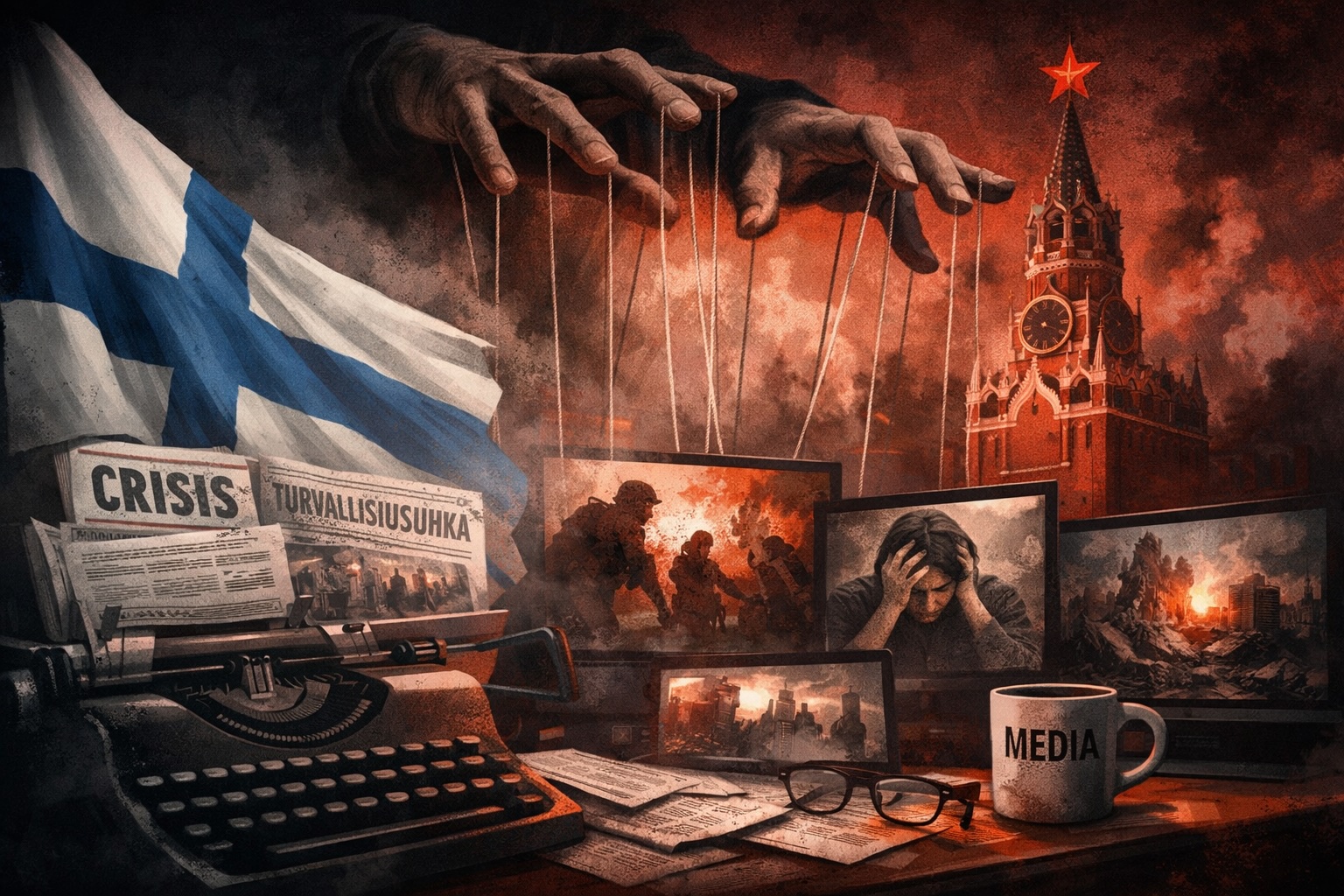
Finnish Media in the Grip of Russian Information Influence
All three documented objectives of Russian information influence are being achieved through Finnish media's own output — without a single Russian troll farm touching a keyboard.
24.03.2026 | yirah.fi
Why does Finnish media produce reporting that benefits Russia and China?
Finnish media is anti-Russian in content. It reports on the war in Ukraine, Hungarian intelligence leaks, warnings from the Finnish Security and Intelligence Service (Supo), and Russia's spring offensive.
Yet the end result is something else entirely.
Yirah.fi's media monitor analysed a total of 5,021 articles over two and a half weeks (9–24 March 2026) from Finland's five largest news outlets: Helsingin Sanomat, Ilta-Sanomat, Iltalehti, MTV Uutiset, and Yle Uutiset. Every day, every week, in every outlet, the same structure repeated: the reader is led toward fatalism, cynicism, and security dependence.
These are precisely the three documented objectives of Russian information influence.
Russia's Playbook
The Finnish Security and Intelligence Service (Supo) states in its 2026 National Security Overview that Russia conducts influence campaigns designed to shape political discourse and public opinion. The RAND Corporation study "The Russian 'Firehose of Falsehood' Propaganda Model" (Paul and Matthews, 2016) distils the core principle: the goal is to make targets act in the propagandist's interest without realising they are doing so. The EU's EUvsDisinfo database has documented over 13,000 Kremlin-aligned disinformation cases since 2015.
There are three objectives:
First: Weakening Western alliances. A November 2024 study by NATO's StratCom Centre of Excellence (Riga) found that Russian actors claim countries would be better off without the EU or NATO. A January 2022 report by the U.S. State Department identifies moral equivalence as Russia's first persistent narrative: presenting there to be no meaningful difference between democracy and dictatorship. Second: Eroding trust in democratic institutions. Carnegie Endowment's Legucka (2020) describes how messaging undermines trust in institutions and political elites. Third: Producing fatalism and cynicism. Peter Pomerantsev put it succinctly: sow widespread doubt about the very possibility of truth until people sleepwalk into apathy.
5,021 Articles, One Direction
The media monitor's two-and-a-half-week analysis revealed five mutually reinforcing trends that repeated every week, every day, in every outlet.
Fatalistic resignation. The Iran war was initially framed as a distant threat (week 11), then as personal fate through mortgage rates and petrol prices (week 12), and finally as an unchangeable reality (Tuesday, 24 March). The reader learned: nothing can be influenced.
Deepening security dependence. Over two weeks, the reader encountered more than 120 distinct threat scenarios. NATO, the Defence Forces, the IEA, and the ECB were consistently presented as trustworthy. Everyday institutions crumbled simultaneously in the news flow: the judiciary was cut, police stations were closed, wellbeing services counties laid off staff, and Kela benefit cuts continued.
Individual preparedness replacing collective action. The daily message: fill your tank early, check your Euribor rate, save for old age. Structural solutions were never presented as an alternative.
Erosion of trust in democratic processes. In week 11, the nuclear weapons debate shifted in five days from a question of values to a technicality of security planning. Demanding parliamentary deliberation was framed as an obstacle. In week 12, the government was in conflict every day over a different issue. On Tuesday, 24 March, a trust survey confirmed: the Defence Forces are the most trusted institution, parliament the least.
Moral simplification. Complex ethical questions were framed as binaries: the West versus Iran, security versus everything else, adaptation versus debt.
These five trends correspond precisely to Russia's three objectives. The direction did not vary from week to week. It deepened.
Six Headlines, One Direction
In February 2026, EVA published its values and attitudes survey "Kiusallinen kaveri" (The Awkward Ally) (2,038 respondents, representative sample). The data contained two parallel realities: 73 per cent considered the United States unstable and unpredictable, while 71 per cent still regarded it as an important trade partner and 55 per cent as a key defender of Western values.
Six outlets reported on the survey, and all chose the same direction: "collapsed," "fading," "shaken," "unreliability is a fact." Not a single one headlined the partnership or the defence of values. EVA's own title, "The Awkward Ally," was more accurate than the headline of any outlet.
A headline equating the United States and China as equally unreliable is a geopolitical act. Lee and Goidel (2022) demonstrated experimentally that framing an alliance in terms of unreliability directly reduces public support for NATO. The U.S. State Department identifies this moral equivalence as Russia's first persistent disinformation narrative.
267 Finnish companies have subsidiaries in the United States, with a combined revenue of 29 billion euros and nearly 40,000 jobs. The Confederation of Finnish Industries (EK) export barometer: 47 per cent of companies expect growth. The United States is a country where a Finnish company can protect its patents in an independent legal system. China is a one-party dictatorship. This distinction appears in none of the six headlines.
Who Sits in the Newsrooms
The Worlds of Journalism Study's Finland wave (2023, Väliverronen, Pöyhtäri, and Villi, University of Jyväskylä) found that 60 per cent of Finnish journalists placed themselves to the left of the political centre. In a Sunnuntaisuomalainen survey (2012), the Greens were the most popular party at 26 per cent, the Finns Party at 2 per cent. At the University of Tampere, 75 per cent of journalism students voted for left-wing or green parties (Westinen et al., Politiikka 1/2016). Yle, Helsingin Sanomat, and Ilta-Sanomat declined to participate in the survey.
The international picture confirms the pattern. In Germany, 82 per cent of journalists who disclosed their leanings supported left-green parties (Dortmund, 2024). In the United States, the share of Republican journalists has fallen from 25.7 per cent (1971) to a low of 3.4 per cent (2022). In Sweden, journalists are to the left of both the public and elected politicians (Asp, 1989–2011). In Britain, 77 per cent identified as left-leaning (Reuters Institute, 2025).
Hassell, Miles, and Morecraft (2023) documented the self-selection mechanism: journalists who do not feel ideologically at home leave. Diversity narrows without any conscious decision. A PNAS-published study across 17 countries (Soroka et al., 2019) demonstrated that people everywhere react more strongly to negative news. The click economy rewards this.
A homogeneous and left-leaning journalist corps, negativity bias, and the click economy explain why individual headlines tilt in a particular direction. They do not explain why five competing outlets arrive at the same outcome week after week — an outcome that corresponds precisely to Russia's documented information influence doctrine.
Historical Context
Finlandisation was neither coincidence nor a structural characteristic. It was active influence. Throughout Finland's entire period of independence, Russia has had a documented interest in influencing Finnish decision-making, media, and public discourse. Pro-Russian individuals have been found in positions where they should not be.
A report published by the Finnish Institute of International Affairs (FIIA) in January 2026, "Russia's Full-Spectrum Influence Activities in Finland in the 2000s" (Saari et al.), makes a decisive observation: features of Finnish political culture — such as a strong drive for consensus and caution in public discourse concerning Russia — have made it difficult to identify indirect forms of influence. This statement comes from a research institute under the Finnish Parliament.
NATO's StratCom Centre of Excellence's November 2024 study documented how old disinformation networks pivot to serve Kremlin objectives without direct coordination. Carnegie Endowment describes how Russia uses "unwitting agents of influence": individuals in positions of power who are not openly pro-Russian but serve the same objectives.
In this context, "negativity bias and the click economy" alone is an insufficient explanation.
Synchronisation
Week 11: all five outlets simultaneously shifted to framing the nuclear weapons debate as a security-policy necessity rather than a question of values. All began covering the Iran war primarily through petrol prices. Week 12: Trump was consistently portrayed across all outlets as unreliable, while the deepening of alliance structures (the JEF meeting, Cold Response, FLF Finland, the NATO test event) received a fraction of the coverage.
A structural explanation is possible: government communications guide the framing, editorial homogeneity produces identical instinctive reactions, negativity bias ensures the same direction. This is a real mechanism.
It is not the only possible explanation. The historical context, Supo's annual warnings, and FIIA's recent report provide no basis for ruling out active influence.
Supo's Priorities
In early March 2026, Supo raised the issue of home schooling and its potential links to radical education in public debate. Finland has fewer than 1,000 home-schooled children. Yirah.fi's analysis showed that the home schooling claim was based on marginal individual cases.
At the same time, Finland's five largest outlets produce over 2,500 articles per week whose framing serves the three objectives of Russian information influence. Not individual articles, but the direction of the entire news flow.
Should Supo be investigating influence targeting the media more closely? Not the content of individual articles, but the connections of the organisations and individuals who decide editorial lines and framing. Who sits in the newsrooms? What networks do they have? Why do five competing outlets arrive at the same outcome week after week?
Fewer than 1,000 home-schooled children, or over 2,500 articles per week whose framing serves a foreign state's information influence objectives. Which is the greater security threat?
What Is Missing from the Media
Over two and a half weeks, 5,021 articles described problems. Solutions journalism was almost entirely absent. The healthcare crisis received marginal attention. The voices of entrepreneurs, the value of trade partnerships, and the concrete benefits of alliances did not feature in headlines. The same gaps repeated every week, in every outlet, identically.
McIntyre and Lough's (2023) systematic review demonstrated that solutions-focused journalism increases reader trust and sense of agency. A SmithGeiger study (2020–21) found that 83 per cent of readers trusted the solutions-focused version of a news story, compared to 55 per cent for the problem-only version.
The systematic absence of solutions produces fatalism. Producing fatalism is Russia's third objective.
Why?
Why does Finland's media apparatus produce reporting, across all outlets, that serves the interests of Russian information warfare — as if taken directly from the doctrine outlined in Supo's warnings and Russia's playbook?
A structural explanation is possible, but it does not explain everything. It does not explain the consistent synchronisation across five competing outlets, week after week. It does not explain why framing choices so consistently align with Russian doctrine. It does not explain why the same gaps repeat identically in every outlet.
Finlandisation was active influence. Pro-Russian individuals have been found in positions where they should not be. Supo warns every year. FIIA documents how Finnish culture makes indirect influence difficult to identify.
Should Supo be investigating influence targeting the media more closely — specifically the organisations and individuals who decide editorial lines and framing?
Sources
Media monitor and own analyses
* Visio Suomi, Week 11 Media Report (9–15 March 2026), yirah.fi, 1,917 articles
* Visio Suomi, Week 12 Media Report (16–22 March 2026), yirah.fi, 2,659 articles
* Visio Suomi, Daily Media Report 24 March 2026, yirah.fi, 445 articles
* Yirah.fi: "The Truth About the Home Schooling Debate" (9 March 2026)
EVA studies
* EVA: "Kiusallinen kaveri" (The Awkward Ally), Sami Metelinen, February 2026
* EVA: Finnish trust in NATO security guarantees, April 2025
Security authorities and research institutes
* Supo: National Security Overview 2026
* FIIA: "Russia's Full-Spectrum Influence Activities in Finland in the 2000s", Saari et al., January 2026
* NATO StratCom COE: "Russia's Information Influence Operations in the Nordic-Baltic Region", Ahonen et al., November 2024
* RAND: "The Russian 'Firehose of Falsehood' Propaganda Model", Paul and Matthews, 2016
* EU East StratCom / EUvsDisinfo
* Carnegie Endowment: "Russia's Long-Term Campaign of Disinformation in Europe", Legucka, 2020
* U.S. State Department: "Russia's Top Five Persistent Disinformation Narratives", 2022
* CEPA: "Sino-Russian Convergence in Foreign Information Manipulation and Interference"
Journalists' political profile
* Väliverronen, Pöyhtäri, and Villi: WJS Finland, University of Jyväskylä, 2023
* Sunnuntaisuomalainen: Journalists' party affiliations, 2012
* Westinen et al.: Journalism students, Politiikka 1/2016
* TU Dortmund: German journalists' party affiliations, 2024
* Willnat, Weaver, and Wilhoit: U.S. Journalist Survey 1971–2022, JMCQ, 2025
* Asp: Svenska journalister, University of Gothenburg, 1989–2011
* Reuters Institute / WJS UK, 2025
* Hassell, Miles, and Morecraft: Newsroom Ideological Diversity, PRQ, 2023
Framing and negativity bias
* Soroka, Fournier, and Nir: Negativity bias, PNAS, 2019
* Entman: Framing, Journal of Communication, 1993
* Baum and Potter: Media and foreign policy, ARPS, 2008
* Lee and Goidel: Framing effects on NATO support, IJPOR, 2022
Solutions journalism
* McIntyre and Lough: Systematic review, JMCQ, 2023
* SmithGeiger / Solutions Journalism Network, 2020–21
International opinion polls
* Eurobarometer: Spring 2025
* Pew Research Center: Views of the US in 24 Nations, 2025
* Chicago Council on Global Affairs: Alliance Support, 2025
24 March 2026