
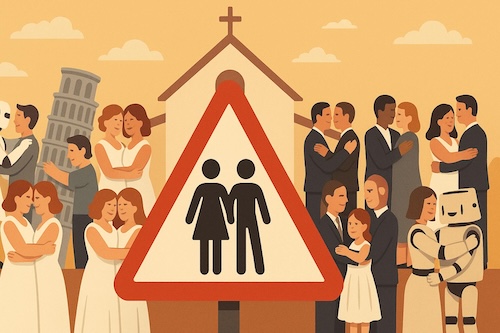
"We marry everyone" sounds tolerant, loving, and beautiful, but on the contrary it is a threefold horror: mocking the only living triune God, desecrating the holy and enduring Word of the Bible, and degrading the atoning work of Christ on the cross.
When pastors, bishops, and other servants of the church proclaim in unison, "We marry everyone," they place themselves directly above the Word of God. It is a fundamental rebellion against the Creator's order — the apostasy the Bible warns about.
In the order of creation, God made man in His own image: male and female. "So God created man in his own image, in the image of God created he him; male and female created he them" (Gen. 1:27). This was not a random choice but a purposeful design, reflecting God's nature and His plan for humanity.
The Bible speaks clearly on this throughout both Testaments. The words of Leviticus are unambiguous: "Thou shalt not lie with mankind, as with womankind: it is abomination" (Lev. 18:22). This is not a culturally bound instruction but part of the revelation of God's holiness, given in the same context as the prohibitions against incest and bestiality. "If a man also lie with mankind, as he lieth with a woman, both of them have committed an abomination" (Lev. 20:13).
The above also serves as clarification for, among others, the pastor of Paavali's congregation, who stated in a TikTok video that the Bible does not speak about homosexuality: It does.
Paul confirms this teaching in the New Testament when he writes to the Romans about how humanity has rejected the knowledge of God. He describes how "God also gave them up to uncleanness through the lusts of their own hearts, to dishonour their own bodies between themselves" (Rom. 1:24).
He continues: "For this cause God gave them up unto vile affections: for even their women did change the natural use into that which is against nature: And likewise also the men, leaving the natural use of the woman, burned in their lust one toward another; men with men working that which is unseemly, and receiving in themselves that recompence of their error which was meet" (Rom. 1:26–27).
This is not Paul's personal opinion but apostolic teaching grounded in God's revelation. "Know ye not that the unrighteous shall not inherit the kingdom of God? Be not deceived: neither fornicators, nor idolaters, nor adulterers, nor effeminate, nor abusers of themselves with mankind, Nor thieves, nor covetous, nor drunkards, nor revilers, nor extortioners, shall inherit the kingdom of God" (1 Cor. 6:9–10).
Jesus Himself confirmed the order of creation when He taught about marriage. When the Pharisees asked about divorce, He went back to the beginning: "Have ye not read, that he which made them at the beginning made them male and female, And said, For this cause shall a man leave father and mother, and shall cleave to his wife: and they twain shall be one flesh?" (Matt. 19:4–5).
Jesus does not redefine marriage but confirms its original meaning: a union between a man and a woman. If there were alternatives, they would have been mentioned.
God is not in contradiction with Himself, and therefore using the double commandment of love that Jesus gave to justify unambiguous sin is blasphemy at its worst.
This teaching does not stand in isolation but is woven into the entire history of salvation. Marriage is an institution ordained by God, reflecting His covenant with His people. When this definition is altered, God's sovereignty is called into question — as is His right to define what is genuine and original in His own creation, and what is a distortion and deception of His enemy.
The Bible repeatedly warns of false teachers who lead God's people astray. Jesus Himself warned: "But whoso shall offend one of these little ones which believe in me, it were better for him that a millstone were hanged about his neck, and that he were drowned in the depth of the sea" (Matt. 18:6). This warning applies especially to those in positions of teaching.
Paul writes to Timothy with gravity: "Now the Spirit speaketh expressly, that in the latter times some shall depart from the faith, giving heed to seducing spirits, and doctrines of devils" (1 Tim. 4:1). He continues by warning of those who have "a form of godliness, but denying the power thereof" (2 Tim. 3:5).
Peter warns with particular force: "But there were false prophets also among the people, even as there shall be false teachers among you, who privily shall bring in damnable heresies, even denying the Lord that bought them, and bring upon themselves swift destruction" (2 Pet. 2:1). These words read as though they were written for this very age, when teachers of the church openly reject the clear teaching of Scripture and, in their ecumenical fervour, begin to merge religions — denying the Deity of Jesus Christ.
The Epistle to the Hebrews reminds us of the immense responsibility of shepherds: "Obey them that have the rule over you, and submit yourselves: for they watch for your souls, as they that must give account" (Heb. 13:17).
Every pastor who performs marriages contrary to Scripture for same-sex couples will stand before God and answer for having led the sheep directly onto the path of sin.
Through Ezekiel, God speaks powerfully against wicked shepherds: "Woe be to the shepherds of Israel that do feed themselves! should not the shepherds feed the flocks?" (Ezek. 34:2). God charges them: "The diseased have ye not strengthened, neither have ye healed that which was sick, neither have ye bound up that which was broken, neither have ye brought again that which was driven away, neither have ye sought that which was lost" (Ezek. 34:4). When the church blesses sinful acts, it has gravely strayed from the truth that Jesus loves all of us sinners but hates sin. Repentance, conversion, and conviction of sin do not arise from those who claim to represent Jesus granting a blessing to continue in sin.
The church often appeals to love when justifying the acceptance of sin, but according to the Bible, true love "rejoiceth not in iniquity, but rejoiceth in the truth" (1 Cor. 13:6). Jesus did not say to the sinful woman "carry on as you were," but "go, and sin no more" (John 8:11). True love calls to repentance — it does not affirm a person in their sin.

Jeremiah: "Woe be unto the pastors that destroy and scatter the sheep of my pasture!" (Jer. 23:1). "I will require my flock at their hand" (Ezek. 34:10). This is not a gentle suggestion — it is the promise of Almighty God that every false shepherd will be held to account.
When the church abandons the Word of God, it does not merely lose the truth — it also loses the power of the Holy Spirit. In the Book of Revelation, Jesus warns the church at Laodicea: "I know thy works, that thou art neither cold nor hot: I would thou wert cold or hot. So then because thou art lukewarm, and neither cold nor hot, I will spue thee out of my mouth" (Rev. 3:15–16).
Paul writes to the Thessalonians about those who reject the truth: "And for this cause God shall send them strong delusion, that they should believe a lie: That they all might be damned who believed not the truth, but had pleasure in unrighteousness" (2 Thess. 2:11–12). When the truth is rejected for long enough, numbness advances into hardness of heart, and God gives people over to believe their own lies.
John writes: "He that saith, I know him, and keepeth not his commandments, is a liar, and the truth is not in him" (1 John 2:4). How can the church claim to know Christ while openly rejecting His Word? "If a man love me, he will keep my words" (John 14:23), Jesus said. Love for Christ and rejection of His Word cannot walk hand in hand.
God is longsuffering, "not willing that any should perish, but that all should come to repentance" (2 Pet. 3:9), but the repentance must be real — not in words only, but in deeds.
In the Book of Revelation, Jesus counsels: "I counsel thee to buy of me gold tried in the fire, that thou mayest be rich; and white raiment, that thou mayest be clothed, and that the shame of thy nakedness do not appear" (Rev. 3:18). This gold is truth that has been tested and found genuine. The white raiment is the righteousness of Christ — not our own "goodness."
Every pastor involved in this false teaching should remember the warning of James: "My brethren, be not many masters, knowing that we shall receive the greater condemnation" (James 3:1). Before God, no one can plead the decisions of the church or the pressure of culture. Each person will answer personally for whether they remained faithful to the Word of God, which is crystal clear.
The truth is that "Heaven and earth shall pass away, but my words shall not pass away" (Matt. 24:35). The church may change its doctrines, culture may shift, laws may change, but the Word of God stands for ever. A day is coming when every knee shall bow and every tongue shall confess that Jesus Christ is Lord (Phil. 2:10–11). On that day, it will not matter what the church decided in 2025, but what God has said from everlasting to everlasting.
When we examine the teaching on "justice and responsibility" presented by the Evangelical Lutheran Church of Finland, the very core of Christianity is entirely absent from the text. It is like coating poison with sugar: outwardly beautiful, but lethal in substance. This teaching represents a complete departure from both the truth of Scripture and the church's own historic confessions.
First, and most glaringly, is the total omission of Jesus Christ. The Nicene Creed begins by confessing faith in "one God, the Father Almighty" and continues with "one Lord Jesus Christ, the only-begotten Son of God"¹. The Council of Constantinople affirmed this Christ-centredness². Yet the text of the Evangelical Lutheran Church does not mention Christ a single time. How can Christian ethics be Christian without Christ?
Paul writes: "For other foundation can no man lay than that is laid, which is Jesus Christ" (1 Cor. 3:11). When the church builds its ethics without this foundation, it builds upon sand. Jesus Himself said: "I am the way, the truth, and the life: no man cometh unto the Father, but by me" (John 14:6). The church has replaced this absolute truth with humanist reasoning.
Second, the text states that "in the Lutheran church, the emphasis is on following the voice of conscience and the use of reason in ethical questions." This is a direct denial of the principles of the Reformation. Luther stood at the Diet of Worms and declared: "My conscience is captive to the Word of God"³. He did not say he was bound to the voice of conscience as such, but to a conscience illuminated by the Word of God.
The Bible clearly warns against trusting in human reason: "There is a way which seemeth right unto a man, but the end thereof are the ways of death" (Prov. 14:12). Jeremiah cries out: "The heart is deceitful above all things, and desperately wicked: who can know it?" (Jer. 17:9). When the church makes the conscience and reason of fallen humanity the foundation of ethical decision-making, it rejects the revelation of God.
The Constantinopolitan Creed confesses faith in "the Holy Ghost, the Lord and Giver of life"⁴. It is the Holy Spirit who guides us "into all truth" (John 16:13), not human reason alone. The text completely omits the role of the Holy Spirit in the life and ethical guidance of the Christian.
The Nicene and Constantinopolitan Creeds clearly declare that Christ came "for us men and for our salvation"⁵. This presupposes an understanding of what humanity needs saving from: sin. Yet the text of the Evangelical Lutheran Church mentions neither sin, nor repentance, nor salvation.
The Bible teaches: "For all have sinned, and come short of the glory of God" (Rom. 3:23). Without acknowledging sin, there can be no true ethics. Isaiah cries out: "Woe unto them that call evil good, and good evil; that put darkness for light, and light for darkness" (Isa. 5:20). This is exactly what happens when the church defines good and evil apart from the Word of God.
The text mentions the Golden Rule, but tears it from its context. Jesus taught: "Therefore all things whatsoever ye would that men should do to you, do ye even so to them" (Matt. 7:12), but this teaching comes within the Sermon on the Mount, where Jesus first teaches about seeking the Kingdom of God and doing the will of the Father. The Golden Rule is not a stand-alone humanist principle but a consequence of experiencing God's love.
John writes: "We love him, because he first loved us" (1 John 4:19). True Christian ethics springs from the love of God, not from rational calculation of the common good. When this order is reversed, the result is moralism — the very opposite of Christianity.
Third, the Augsburg Confession, the foundational confession of the Lutheran church, clearly teaches justification by faith: "Man cannot be justified before God by his own strength, merits, or works, but is justified freely by grace for Christ's sake through faith"⁶. Yet the text published on the Evangelical Lutheran Church's pages speaks only of humanity's rational pursuit of good, as if man were capable in his own strength of fulfilling the will of God.
Paul teaches: "Therefore by the deeds of the law there shall no flesh be justified in his sight: for by the law is the knowledge of sin" (Rom. 3:20). When the church presents ethics merely as "doing good and avoiding evil" without grace and faith, it reverts to bondage under the law and rejects the Gospel.
The text mentions responsibility for "the surrounding natural world," which in itself is biblical, but when this is presented in isolation from God's work of creation and His lordship, a distortion arises. The Bible teaches: "The earth is the LORD'S, and the fulness thereof; the world, and they that dwell therein" (Ps. 24:1). Responsibility for creation arises from our role as God's stewards, not from nature being an object of worship in itself. At present, the church's stewardship increasingly includes blatant negligence, a deficient understanding of its mission, and outright abuse of ecclesiastical office — even by charlatans.
In the Epistle to the Romans, Paul warns of those who "worshipped and served the creature more than the Creator" (Rom. 1:25). When environmental responsibility is severed from the will of God, it can become idolatry.
True Christian ethics begins with knowing God and seeking His will. "For this is the will of God, even your sanctification" (1 Thess. 4:3). It rests upon the atoning work of Christ: "For he hath made him to be sin for us, who knew no sin; that we might be made the righteousness of God in him" (2 Cor. 5:21).
Christian ethics is not rational reasoning but the fruit of the Holy Spirit: "But the fruit of the Spirit is love, joy, peace, longsuffering, gentleness, goodness, faith, Meekness, temperance" (Gal. 5:22–23). It does not arise from human will but from the grace of God.
The Evangelical Lutheran Church of Finland must return to both the truth of Scripture and its own historic confessions.
The "ethics" presented in this text is, in practice, humanism dressed in Christian vocabulary. It is "a form of godliness" without its power (2 Tim. 3:5). Without Christ, without the Holy Spirit, without repentance and faith, there is no Christian ethics — only the wisdom of man, which is foolishness before God.
When the bishop opens his final question to guests on the Radio DEI programme "Laajasalo" with the words "IF God exists," things have gone badly astray. When the leadership and clergy of Finland's church are permitted without criticism to belong to the satanic worship cult of the Freemasons, there remain very few reasons to believe that our church represents Jesus Christ.
A video titled "We accept all sin" is not far off at this rate. Will the next step in the secularisation agenda be removing the commandments, secularising the Lord's Blessing and the Lord's Prayer to suit the comfort zone? Shall the name "Divine Service" be changed to "Temple Moment"? Shall magic carpets be laid on the floor and contact made with foreign spirits in the house of the Lord? Oh, that is already happening.
The Bible tells each of us the clear signs of the end times, and we are already living in their midst. For the followers of Jesus, the chaos of the world and the total apostasy and inevitable destruction of the church come as no surprise. With peace in our hearts, we can watch the escalation of events, for it is nothing more than a sign that the return of the Lord draws near. Jesus calls each of us — sinful and unfinished — to trust in His love, but this does not happen by permitting sin and desecrating the holy, protective Word of the Bible, but by trusting in grace and forgiveness.
As before the Flood, drowning in sin is increasingly under way, and so humanity needs the Holy Spirit and baptism more desperately than ever. When apostasy reaches its shameful maximum as the sacrifices of Jerusalem's Third Temple begin in May 2026, it will not only mock the atoning work of Jesus on the cross, but will drive the final nail into the judgement of drought and the ensuing three-and-a-half years of famine.
Source references:
- Council of Nicaea (325 AD). Nicene Creed. In: Catechism. Evangelical Lutheran Church of Finland, 2000. p. 31.
- Council of Constantinople (381 AD). Nicene-Constantinopolitan Creed. In: Catechism. Evangelical Lutheran Church of Finland, 2000. pp. 31–32.
- Luther, Martin (1521). Speech at the Diet of Worms. In: Parvio, Martti (ed.). Collected Works of Luther. SLEY-kirjat, 1982. p. 345.
- Council of Constantinople (381 AD). Nicene-Constantinopolitan Creed. In: Catechism. Evangelical Lutheran Church of Finland, 2000. p. 32.
- Nicene-Constantinopolitan Creed (325/381 AD). In: Catechism. Evangelical Lutheran Church of Finland, 2000. p. 31.
- Augsburg Confession (1530). Article IV: On Justification. In: Book of Concord. Evangelical Lutheran Church of Finland, 1990. p. 54.
- The Bible. Finnish translation adopted by the General Synod of the Evangelical Lutheran Church of Finland in 1992.