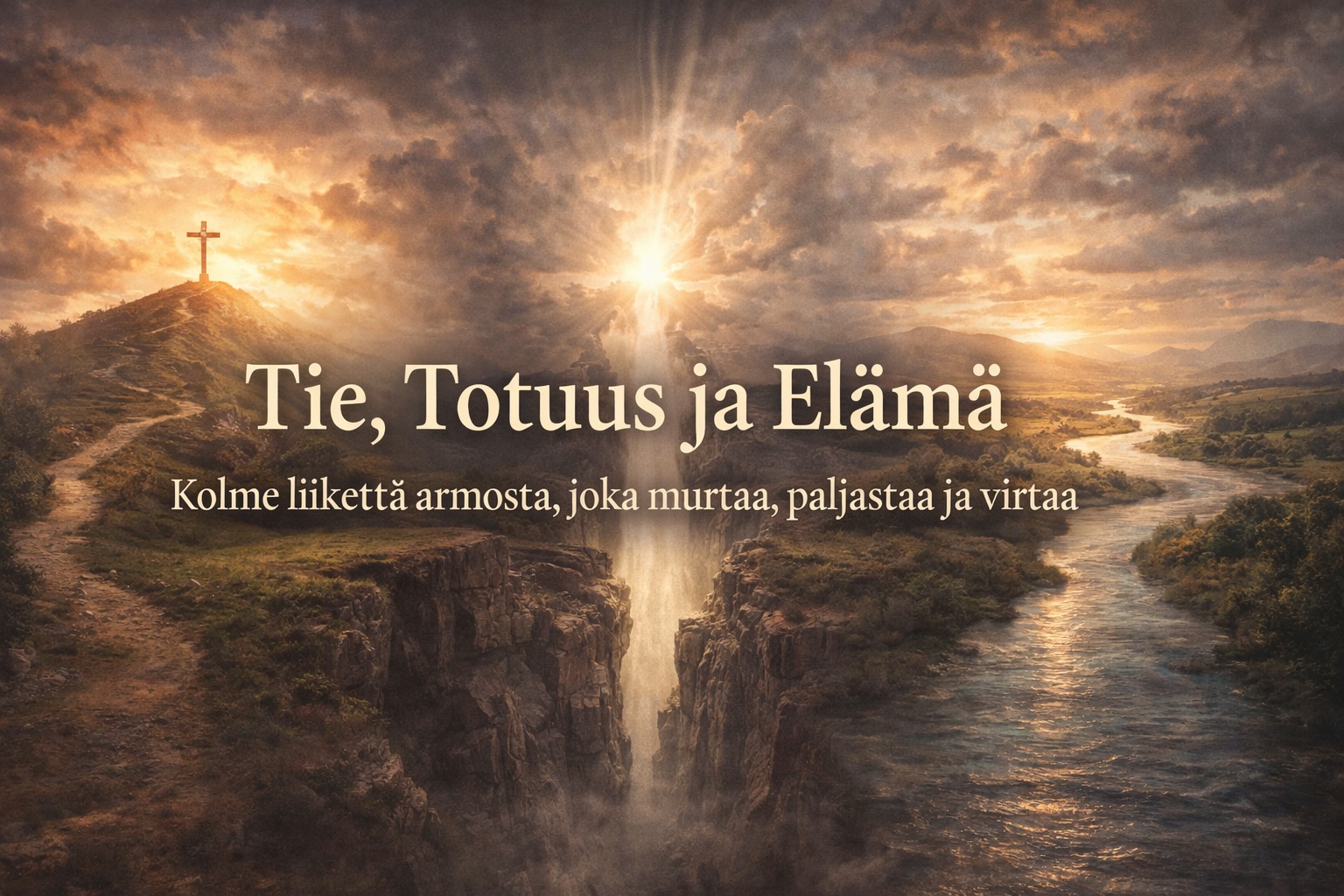
"I am the way, the truth, and the life: no man cometh unto the Father, but by me."
John 14:6, KJV
Jesus did not say He would guide to the way, teach the truth, or give life. He said He is all of them. His person is the arc through which a human being passes on the way back to the Father. This article follows that arc in three movements. The first is the way, which passes through brokenness. The second is the truth, which reveals what we do not want to see. The third is life, which flows as grace from one person to another when striving has ended and the heart is new.
These three movements are not stages to be completed once and left behind. They are a living rhythm in which the Kingdom of God breathes in the life of every one of His children — every day, every moment, again and again.
I. THE WAY: Breaking
The world's performance system
The world runs on a performance system. It is so deeply embedded in our culture that we do not even notice it — like water we swim in. The system repeats the same message without pause: prove your worth, be strong, be competent, be enough, and hide whatever cannot withstand the light of day. Failure brings shame, which serves as punishment and keeps people in line. This system produces people who are polished on the outside but crushed on the inside. People who smile but never breathe freely. People who know how to perform but not how to rest.
Jesus stepped into the middle of this system and turned it completely upside down. He did not come to fix the performance system. He came to reveal that the entire system is wrong at its foundations — because it is built on a lie about human worth and the nature of God.
Who God chooses
Who did Jesus choose? Peter — impulsive and unstable, who ultimately denied Him three times. Matthew — a tax collector and traitor to his own people, serving the Romans. Paul — a persecutor of the church who approved the killing of Christians. David — an adulterer and murderer, of whom God still said "a man after mine own heart."
The world's measuring system would have rejected every one of them. The measuring system of Jesus saw them differently: not on the basis of what they had done, but on the basis of what the Father had created in them and what He was calling them to. This is not a small difference. This is a complete paradigm shift.
Peter's story is perhaps the clearest example of how Jesus handles human collapse. Peter swore he would die for Jesus. Hours later, he denied even knowing Him — three times in a row. When the cock crowed, Peter broke down and wept bitterly. He knew what he had done. The world's system says: you are disqualified — a traitor, unreliable, rejected.
What did Jesus do after the resurrection? At first, He said not a word to Peter about the denial. He prepared breakfast — fish and bread on the shore. He created safety first. Then He asked three times: "Simon, son of Jonas, lovest thou me?"
"So when they had dined, Jesus saith to Simon Peter, Simon, son of Jonas, lovest thou me more than these? He saith unto him, Yea, Lord; thou knowest that I love thee. He saith unto him, Feed my lambs."
John 21:15, KJV
Three denials. Three questions. No accusation. No humiliation. No conditions. Only a question that gave Peter the chance to answer in truth — and each time Jesus responded: "Feed my sheep." He did not merely forgive. He restored Peter to the calling he was created for. The very weakness that in the eyes of the world destroyed Peter's credibility made him, in the hands of Jesus, a shepherd who understood grace — because he himself had needed it at the deepest level.
Weakness is the gate
Here lies something the world does not understand and the enemy actively tries to conceal. Weakness is not an obstacle to the power of God. It is its channel.
"My grace is sufficient for thee: for my strength is made perfect in weakness. Most gladly therefore will I rather glory in my infirmities, that the power of Christ may rest upon me."
2 Corinthians 12:9, KJV
This is not a comforting platitude for moments of weakness. This is a structural truth about how the Kingdom of God operates. It operates in the opposite way to the kingdom of the world. The world says strength protects, but Jesus says acknowledged weakness protects — because it removes the pride that is the true vulnerability. The world encourages hiding your failures, but Jesus calls you to bring them into the light — because in darkness they grow and in the light they lose their power. The world claims human worth is found in performance, but Jesus speaks the Truth: human worth is found in creation. It was decided before anyone had done anything.
The pattern repeats throughout the entire Bible. Moses was a murderer, a fugitive, and a stutterer. He listed for God the reasons he was the wrong choice: "I am not eloquent... but I am slow of speech, and of a slow tongue" (Exod. 4:10). God's answer is far deeper than it first appears: "Who hath made man's mouth? or who maketh the dumb, or deaf, or the seeing, or the blind? have not I the Lord?" (Exod. 4:11). God did not promise to heal his speech impediment. He said He had made Moses that way and sent him as he was — because Moses's task was not to be a brilliant orator. His task was to be a channel for the power of God, and that very impediment ensured that no one would ever credit the deliverance from Egypt to Moses himself.
Gideon's army was cut from 32,000 to 300 so that the victory was indisputably God's. David was a shepherd boy, so insignificant that his own father forgot to call him before Samuel. Paul's thorn in the flesh God did not remove but said: my grace is sufficient.
"But God hath chosen the foolish things of the world to confound the wise; and God hath chosen the weak things of the world to confound the things which are mighty; And base things of the world, and things which are despised, hath God chosen, yea, and things which are not, to bring to nought things that are: That no flesh should glory in his presence."
1 Corinthians 1:27–29, KJV
Paul uses the clay vessel metaphor: "But we have this treasure in earthen vessels, that the excellency of the power may be of God, and not of us" (2 Cor. 4:7, KJV). A clay vessel is fragile, cracked, imperfect. This is by design — because if the vessel were perfect, who would look at the treasure inside? People would admire the vessel. The cracks are not flaws. They are openings through which the light shines.
The mechanics of shame
Shame is the enemy's most effective tool. Not temptation. Not direct attack. Shame — because it does not say "you did wrong," which would be guilt that can lead to repentance. Shame says "you are wrong." You are fundamentally flawed. If people knew what you truly are, they would reject you. This lie keeps a person hiding: hiding from God, hiding from others, and hiding from themselves. Exactly as it was with Adam and Eve in Eden. The first thing after the fall was hiding and covering.
The response of Jesus to shame is radical. He does not say "clean yourself up first and then come." He comes to where the person is: into the middle of the mess, into the middle of the shame, into the middle of the denial. His presence itself declares that no one needs to hide.
The woman caught in adultery had been dragged out for public shaming. The entire system was ready to condemn her. Jesus wrote in the sand, lifted His gaze, and said: "He that is without sin among you, let him first cast a stone at her" (John 8:7, KJV). The accusers left, one by one, beginning with the eldest. Only Jesus and the woman remained. "Woman, where are those thine accusers? hath no man condemned thee?" "No man, Lord." "Neither do I condemn thee: go, and sin no more."
No condemnation. No shame. No lie either. "Go, and sin no more" is truth, spoken in love. Here everything converges: safety, truth, courage, and grace.
The way that Jesus is passes through brokenness. It passes through the place where a person stops covering up and honestly admits what they are. Right at that point, something breaks open. Shame loses its grip — because it lives only in the dark. Brought into the light, there is no room left for it.
A person does not find the way by performing or concealing. They find it by falling to their knees, as Peter did on that shore. The way is not a method. The Way is a Person.
II. TRUTH: Seeing
The throne of the ego
A person stops performing and concealing. They are broken. The way has opened. The next movement is the movement of truth, in which God reveals what we do not want to see: the true state of ourselves and the enemy that has kept us blind.
Sigmund Freud built a model of the human mind in which the ego sits at the centre as judge of all things. The ego evaluates, decides, and controls. It mediates between the drives of the id and the rules of the superego. In itself, it is a small god — a self enthroned — that says: "I evaluate. I decide. I control." This is not merely a psychological model. This is a description of the fall.
The serpent in Eden did not primarily promise power or pleasure. It promised knowledge of good and evil: you will become your own judge, you will decide, you will be the centre of your own reality. The ego is the fallen human in miniature. It is the part that believes it is in control — and that is precisely why it is so resistant to grace. Grace demands surrender, and the ego does not surrender.
The ego permits an ideology above itself — if it has chosen that ideology and can discard it at will. Ideology serves the ego because it grants a sense of superiority: "I know how the world works." The ego permits an authority above itself — if that authority affirms the ego's own position. A boss is acceptable as long as the boss shows appreciation. A teacher is acceptable as long as the teachings are pleasing. The ego will even permit a "god" above itself — if it is a god of its own making.
Here lies the danger of religiosity as distinct from genuine faith. The ego can be very "spiritual." It can meditate, pray, attend church, and speak the language of grace — all while worshipping its own image of God rather than God Himself. This is the sin of the golden calf in modern form. The people did not abandon God. They turned God into a manageable object.
"This people draweth nigh unto me with their mouth, and honoureth me with their lips; but their heart is far from me."
Matthew 15:8, KJV
What will the ego not permit above itself? The true God. A God who can say "no" to the ego's deepest desires. Genuine faith begins at the point where the ego dies. Not reforms, not grows, not develops — but dies.
"If any man will come after me, let him deny himself, and take up his cross, and follow me. For whosoever will save his life shall lose it: and whosoever will lose his life for my sake shall find it."
Matthew 16:24–25, KJV
This is the ego's absolute horror. Not partial surrender but total death. That is why true conversion is so rare and so radical an experience. It is not a decision. It is death and resurrection.
The enemy's subtlest twist
One of Satan's masterworks is to take the truth and twist it just enough that it still looks logical but points in the opposite direction.
God says: "You are fragile and I am strong, and when you come to me with your weakness, my power will carry you." The enemy's version goes: "God wants you to be weak so He can control you. He needs your smallness to prop up His own greatness."
The same words. An entirely different heart. One is love, the other is domination. The difference is visible only to those who know the heart of the speaker. This is precisely where the deception succeeds: the enemy projects its own nature onto God. Satan itself is the one that craves power, subjugation, and worship — so it paints an image of God that is its own portrait. In a fallen world, human beings have seen power exercised in exactly that way — as control, manipulation, and narcissism — so the picture feels believable.
At this point we must extend compassion, because this deception does not take hold in foolish or wicked people but in wounded ones. A person whose father misused power experiences the word "father" as fear, control, and conditional acceptance. They are told "God is a Father" and their nervous system reacts with everything "father" has ever meant to them. They do not hear love. They hear threat. A person who has encountered religious manipulation has experienced God wielded as an instrument of control. Of course they see narcissism — because in human hands, those words have been used narcissistically.
The brilliance of the enemy is that it uses real wounds as evidence for its lie. It says: "Look at how you were treated in the name of God. That is what God is like." The wounded heart answers: yes, that is true — I have lived it myself. But what they saw was not God. It was a distorted image of God at the hands of human beings. Human lies, human words, human deeds. Not God's. The distance between the two is infinite.
Eternity in the heart
"...he hath set the world in their heart."
Ecclesiastes 3:11, KJV
The second dimension of truth is what God has written into the innermost being of every person. Eternity in the heart makes a human being a creature that can never fully settle into the temporal. No earthly achievement is enough. No relationship fully satisfies. This is not brokenness — it is a compass. It always points toward home. Augustine said: "Thou hast made us for Thyself, and our heart is restless until it finds its rest in Thee."
Animals do not know they will die. Human beings do. Why? Because within them is something that recognises death as unnatural. Eternity in the heart makes death a foreign thing — not a natural endpoint but an intruder. That is why death feels wrong: because it is wrong. It was not part of the original design. "The last enemy that shall be destroyed is death" (1 Cor. 15:26, KJV).
C.S. Lewis observed that every innate need has a real object. Hunger testifies to the existence of food. Thirst testifies to water. Fatigue to sleep. The need for belonging to community. The need for connection to something greater, wiser, and better than ourselves is a deep, universal longing that recurs across cultures and transcends everything earthly. It is not learned. It rises from within, from a depth beneath all else. Lewis called it a longing that no earthly object can satisfy.
People who obtain everything earthly — wealth, power, pleasure, fame, family — still report that this longing continues. It does not go out. It is the fingerprint of God, and a fingerprint cannot be washed away.
A human being simultaneously longs for perfect love that neither betrays nor ends, and for perfect justice where everything is finally set right. They long for permanence that does not submit to time, to be fully seen without the fear of rejection, and for a home they have never reached but that somehow feels familiar. This is not a random collection of wishes. This is a God-shaped void, and it fits precisely what the Bible describes as the nature of God: love, justice, eternity, omniscience, and home with the Father.
Freud's mirror
Freud saw this longing and said: "It is an illusion." His core claim was that God is a psychic projection — a magnified father figure. There is genuine sharpness in his observations. He saw correctly that human beings do in fact project: we reflect our own experiences, traumas, and hopes onto everything, including our religious lives. There are people whose image of God has been distorted precisely through the trauma of their relationship with their father. In this sense, Freud revealed something truthful about human psychology — not about God.
His fundamental error was a category mistake. He assumed that because he could explain the psychological mechanism by which a person orients toward God, he had thereby explained God away. This is like saying: "Because I can explain the biology of the eye, sunlight does not exist." The fact that a human being has the capacity to receive something does not prove there is nothing to receive.
Freud's entire system is built from the vantage point of the ego. That is why it cannot see God — because the ego cannot recognise what is above it without ceasing to be god. He studied the mirror and claimed the one being reflected does not exist.
The Bible sees the same longing and says: "It is a call home." Which explanation honours the full weight of the experience?
Why people delay
Satan's masterwork is timing. The enemy does not need to make a person deny God. It is enough to make them postpone. "Yes, but not yet" is the most effective sentence in hell. It does not feel like rebellion. It feels reasonable. Augustine recognised this in his own life before his conversion. His prayer was famously: "Lord, give me chastity — but not yet." This is the prayer of the ego. It acknowledges God but schedules Him. Whoever schedules God has placed themselves above God.
The world's system operates like a casino. It always promises that the next experience, the next achievement, the next relationship, or the next position will be the one that finally satisfies. The Preacher saw this three thousand years ago: "Vanity of vanities, saith the Preacher, vanity of vanities; all is vanity" (Eccl. 1:2, KJV).
Wealth promises freedom, but the wealthy want more. Success promises meaning, but the successful feel emptiness. Pleasure promises satisfaction, but after every pleasure there is always an empty moment in which the longing returns sharper than before.
The ego fears joy more than it fears pain. The nearness of God is not threatening because it is harsh, but because it is so complete that the ego cannot survive it. If a person truly stepped into the presence of God fully, everything they had built of their own identity — defence walls, roles, and "I am this" definitions — would collapse. The ego experiences this as death. That is why people often approach God only when everything else has already fallen apart. Illness, loss, crisis, or old age break down the structures of the ego. Only after the breaking is a person empty enough to receive. Not because God demands suffering, but because the ego demands everything else first.
"Blessed are the poor in spirit: for theirs is the kingdom of heaven."
Matthew 5:3, KJV
The poor in spirit: those whose ego has come to the end of its road. Not broken — but emptied. Ready to receive.
The structure of the lie is always the same: "Take this first." It is the exact same lie as in paradise. The serpent did not say "do not worship God." It said "take this first." All it took was one fruit before God — one experience the ego grasped on its own, without God's guidance. That structure continues through human life: education, career, family, money, experiences, adventures, travel, success — and then God. But "then" never comes, because the list is designed to be endless.
God does not wait until the final stretch. The person waits. God has been present every moment: in every feeling of emptiness, in every sting of longing, in every moment when some achievement was not enough and the person wondered "was this not supposed to make me happy?" Every one of those moments was a call. Every disappointment was grace knocking at the door. Every "this is not enough" was the whisper of the Holy Spirit: because this is not your home.
"Behold, I stand at the door, and knock: if any man hear my voice, and open the door, I will come in to him, and will sup with him, and he with me."
Revelation 3:20, KJV
He knocks. He has always been knocking. The ego just keeps the music so loud that the knocking cannot be heard.
The truth that Jesus is, is not information. It is unveiling. It is the moment a person sees their true state — the structures of the ego, the enemy's lie, and the fingerprint of God in their heart — and knows there is no going back to the old. Truth does not condemn. It sets free.
III. LIFE: Overflow
Grace that flows
The way has been walked through brokenness. Truth has revealed what we did not want to see. The third movement is the one that makes all things new: life, which flows as grace from God into a person and from one person to another. This is not a return to performance. This is a new heart in which love and forgiveness are not obligations but nature.
The heartbeat of this entire movement pulses in Ephesians 4:32 in two words: even as God.
"And be ye kind one to another, tenderhearted, forgiving one another, even as God for Christ's sake hath forgiven you."
Ephesians 4:32, KJV
Colossians 3:13 echoes the same structure: forgive, even as Christ forgave you. There is something structurally significant here. Forgiveness is not a moral feat that a person produces from their own strength. It is a flow: from above downward, and then from one person to the next. Like water that first comes from the spring and then flows onward. No one produces the water themselves. The person who forgives by their own strength does so by straining — and that is exactly the kind of performance that enslaves. The person who has understood how much they themselves have been forgiven, forgives others as overflow.
The parable of Jesus in Matthew 18 makes this concrete. A servant who is forgiven an enormous debt goes out and seizes a fellow servant by the throat over a small debt. "Shouldest not thou also have had compassion on thy fellowservant, even as I had pity on thee?" (Matt. 18:33, KJV). This is not a command to "be merciful." It is a question: have you understood what has been done for you? If you have, mercy follows naturally. If it does not, perhaps you have not yet truly received what was given to you.
Luke 7:42 tells of two debtors, both of whom are forgiven. Jesus asks: which of them will love more? The one who was forgiven more. Here lies a deep psychological and spiritual truth: the capacity to love and forgive is not born through moral exertion. It is born when a person sees their true state — their own debt — and then experiences it being forgiven. The acknowledgement of weakness is not merely humility. It is the gate to grace, and grace is the gate to love.
Here the first movement connects to the third. The way passed through brokenness. There the person saw their debt. In the movement of truth, they saw the lies of the ego and the true nature of God. In this third movement, they experience what happens when an enormous debt is forgiven: the heart opens and grace begins to flow onward — because it was never theirs to hold back.
The Father's grace and forgiveness restored life to us when we were dead. That is why we must forgive everything. Not out of duty, not because morality demands it, but because it is the only response that honours what has been done for us. The life that was given back flows onward by its very nature.
The inner transformation of forgiveness
Ephesians 4:26 says: "Be ye angry, and sin not: let not the sun go down upon your wrath." Matthew 5:22 goes deeper: even anger toward a brother is subject to judgement. This is not a legalistic threat. This is a description of what anger does to the one who carries it. Unforgiveness is a poison that destroys its carrier from within, just as sin destroys the one who commits it before it destroys anyone else.
Romans 12:20–21 turns this dynamic around: "Therefore if thine enemy hunger, feed him... Be not overcome of evil, but overcome evil with good" (KJV). This is not merely about ethics. This is about spiritual warfare. Evil is overcome — not with the weapons of evil, not with force, not with vengeance, not with being right — but with good, which is of an entirely different nature than evil.
Stories that breathe
The story of Joseph in Genesis chapters 45 and 50 is one of the most powerful portrayals of forgiveness in the Bible. His own brothers sold him into slavery. Years later, they stand before him, frozen with fear. Joseph weeps. He does not weep from weakness. He weeps because forgiveness has broken through all those years, all that suffering, and all that injustice. He says to his brothers: "Fall not out by the way." What a human and tender phrase. He knows his brothers, knows they will start blaming one another, and says: no more of that. It is over.
Ebed-melech rescues the prophet Jeremiah from a cistern in Jeremiah 38. One small detail reveals everything: he says to Jeremiah "put now these old cast clouts and rotten rags under thine armholes under the cords." He thinks about the ropes chafing. In the middle of a rescue operation, he takes care that the ropes do not hurt. This is the kindness and tenderheartedness that Ephesians speaks of — clothed in a completely ordinary, everyday gesture.
Acts 28:2 tells of the inhabitants of Malta, who kindle a fire for the shipwrecked in the cold rain. No theology. No sermon. A fire and warmth. Sometimes grace looks exactly like this: someone lights a fire when you are cold.
A new heart, a new nature
"A new heart also will I give you, and a new spirit will I put within you: and I will take away the stony heart out of your flesh, and I will give you an heart of flesh."
Ezekiel 36:26, KJV
In humility — at the point where a person says "I cannot do this on my own" — the Holy Spirit is given room to work. Not because God requires humility as some kind of admission fee, but because pride is a wall, and grace cannot flow through a wall. Humility is not a punishment. It is a door. What comes through that door is something that performance can never produce: genuine transformation from within. Not a new surface. A new heart.
In such a heart, forgiveness is not an obligation but a nature. Kindness is not a performance but a fruit. The peace that Mark 9:50 speaks of — "have peace one with another" — is not agreeableness masking simmering anger but true peace, born from having first received peace oneself.
Isaiah 11:6 paints a picture of what this looks like in its fullness: the wolf dwells with the lamb, and a little child leads them. Nature itself is changed. Not by external force but from within. What was predator rests in peace beside what was prey.
Micah 6:8 gathers everything into a single sentence:
"He hath shewed thee, O man, what is good; and what doth the Lord require of thee, but to do justly, and to love mercy, and to walk humbly with thy God?"
Micah 6:8, KJV
Do justly, love mercy, walk humbly. Three things that are not three separate tasks but one direction of life. The form of the verb reveals everything: love mercy. Not merely show it or practise it — love it. It is an orientation of the heart, not merely an act. This is possible only with a new heart, for the old heart can practise mercy but cannot love it.
Conclusion: Three Movements, One Person
The Way, the Truth, and the Life are not three separate teachings. They are one Person who calls a human being through three movements back home.
The first movement is breaking. The performance system tears apart. Shame loses its grip in the light. A person falls to their knees and discovers they do not need to rise by their own strength — because Someone is already there, having prepared breakfast on the shore.
The second movement is unveiling. The ego sees itself for the first time in the light of God. The structure of the enemy's lies becomes visible. Eternity in the heart ceases to feel like a defect and is revealed as a compass. The knock at the door is recognised — not as a disturbance, but as an invitation.
The third movement is overflow. The grace that was received at the point of breaking and understood at the point of truth begins to flow onward. Not as performance but as nature. Forgiveness is not an obligation but the overflow of how much one has been forgiven. Joseph weeps, Ebed-melech softens the ropes, and the people of Malta light a fire.
We must forgive everything, because the Father's grace and forgiveness restored life to us when we were dead. It is an outrageously great grace that we can never fully understand or comprehend as human beings. We do not forgive because we are good. We forgive because we have been given more than we can understand, and that overflow is itself the evidence that life has returned to where there was once death.
This is the life Jesus spoke of: "I am come that they might have life, and that they might have it more abundantly" (John 10:10, KJV). It is not the abandonment of life. It is the finding of it.
"Come unto me, all ye that labour and are heavy laden, and I will give you rest."
Matthew 11:28, KJV
He knocks. He has always been knocking. The door opens from the inside.
"I am the way, the truth, and the life."
The way passes through brokenness, because only a broken heart fits through the narrow gate.
The truth reveals what we did not want to see, and sets us free from it.
Life flows onward as grace, because it was never ours to hold back.
Three movements. One Person. One call.
Soli Deo Gloria.