
Reversing Russia's GPS Signal Jamming with Metamaterials: A Theoretical Analysis and Practical Possibilities in RF Defence
When Jamming Becomes a Vulnerability
(This article is written purely as a hobbyist exercise)
The fundamental principle of electronic warfare has always been simple: the stronger signal defeats the weaker one. GPS jamming in Finnish airspace is a concrete example of this asymmetry, and according to Traficom reports, 239 GNSS interference notifications were recorded in 2023 and approximately 7,000 in 2024 (aviation, reported 3 March 2025)¹. Traditional defence has focused on avoiding or filtering interference and using alternative, older technologies such as the ILS instrument landing system. In this article, I explore an alternative approach: applying the time reversal phenomenon to radio frequencies using metamaterials. For clarity, I use the English term time reversal throughout due to its wider recognition.
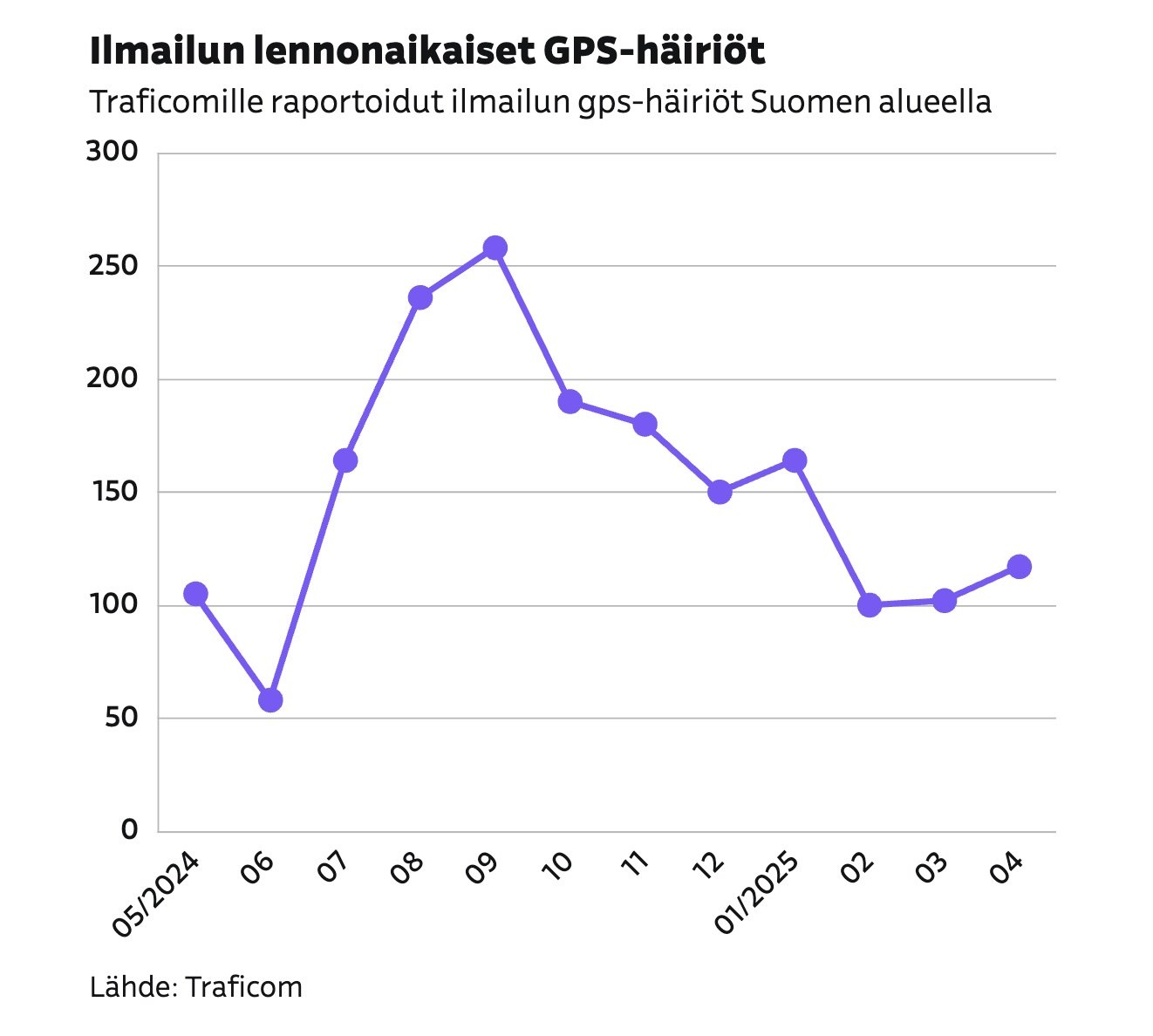
Time reversal is not a new concept. In acoustics, it has been applied successfully for decades, and RF applications are now transitioning from theory toward practice. In this article, I present rough simulation results demonstrating a 10–15 dB improvement in multipath environments, along with a practical implementation path using consumer components. It is important to emphasise, however, that the concepts presented are based on theoretical analysis and preliminary simulations, not tested prototypes.
Physical Foundation: The Time Symmetry of Maxwell's Equations
James Clerk Maxwell's equations, formulated in 1865, describe all of electromagnetism². A mathematical property of these equations is time symmetry: under the transformation t → −t, E → E, B → −B (along with ρ → ρ, J → −J), the form of the equations is preserved. In the frequency-domain phasor representation, this corresponds to complex conjugation of Fourier amplitudes. A practical system, however, is not perfectly time-reversible due to losses and noise¹².
In acoustics, Mathias Fink demonstrated the time reversal mirror concept in practice during the 1990s³. His research group showed that by recording an acoustic signal, reversing it in time, and transmitting it back, the wave is focused back to its original source. Kuperman et al. applied the technique to underwater communication, achieving significant improvement in signal quality in a multipath environment⁴. In medicine, time reversal enables precise destruction of kidney stones using ultrasound without invasive procedures⁵.
At radio frequencies, time reversal applications have been limited by technical challenges. At GHz frequencies, signal processing requires nanosecond precision, which has only become achievable at reasonable cost in recent years. Lerosey et al. demonstrated in 2007 the focusing of RF signals beyond the diffraction limit using time reversal techniques in a multipath environment⁶. Their results showed that complex reflection environments actually improve focusing ability — contrary to intuitive expectation.
The Role of Metamaterials in Dynamic Field Control
A metamaterial is an artificial structure in which repeating unit cells are smaller than the wavelength of the electromagnetic wave being manipulated⁷. Typically the size is λ/10 or smaller, so the wave cannot resolve individual structures and instead experiences the material as a homogeneous medium. The split-ring resonator (SRR) is a fundamental metamaterial component, consisting of a metallic ring with a small gap⁸.
In a practical implementation for 2.4 GHz (λ = 12.5 cm), a single cell is approximately 12 mm in size. The structure can be fabricated using standard PCB technology:
- Substrate: FR-4 PCB material (εr ≈ 4.4)
- Metallisation: Copper ring with 35 μm thickness, gap of 0.5–1 mm
- Varactor diode: For example, Skyworks SMV1405-079LF (capacitance 0.7–2.4 pF @ 0–30 V)
- Control electronics: DAC circuit (MCP4725) for voltage adjustment
By adjusting the varactor diode voltage, the gap capacitance is changed, shifting the resonant frequency. This enables dynamic tuning of the metamaterial's permittivity (ε) and permeability (μ). Smith et al. demonstrated in 2000 that such a structure can achieve a negative refractive index at certain frequencies⁹. A negative index is a theoretical advantage, but in a prototype it requires precise measurement.
Cost estimate for a 16-unit-cell prototype:
- PCB fabrication: €50 (JLCPCB or equivalent)
- Varactor diodes: 16 × €2 = €32
- DAC circuits: 4 × €5 = €20
- Raspberry Pi 4: €60
- Total cost: approximately €160
It should be noted, however, that prototype calibration requires vector network analyser (VNA) measurements, and achieving a negative refractive index is not straightforward in an amateur DIY implementation. The Q-factor achievable with FR-4 is low, so the resonance may broaden and dissipate. A true negative refractive index generally requires a low-loss substrate, such as Rogers RT/duroid series materials, to keep losses and thermal drift under control.
Simulation Results and Realistic Expectations
My simulations are based on a Python/NumPy implementation modelling a 16-element antenna array in a multipath environment. I used SVD as a mathematical tool, although practical time reversal processing can be implemented with simpler channel complex conjugation. SVD is particularly suited to MIMO system analysis and modal decomposition but is not essential for a basic TR implementation. Simulation parameters:
- Frequency bands: 450 MHz, 1.575 GHz (GPS L1), 2.4 GHz, 5 GHz
- Multipath components: 20 reflections with Rayleigh distribution
- Jamming signal: Chirp modulation with 100 μs duration
- Processing: Time reversal with SVD decomposition
Results in multipath environment:
- 450 MHz: Focusing gain 8–10 dB
- 1.575 GHz (GPS L1): Focusing gain 8–11 dB
- 2.4 GHz: Focusing gain 10–12 dB
- 5 GHz: Focusing gain 11–15 dB
Results in free space environment:
- All frequencies: −2 to −3 dB (degradation, no improvement)
These results are consistent with the findings of Lerosey et al.: time reversal benefits from multipath environments⁶. Each reflection acts as a virtual antenna element, improving focusing capability. It is important to note that the simulated 10–15 dB improvements are far from the 40 dB values claimed in some studies. Nevertheless, realistic results represent a 10–32-fold improvement in signal power, which may be sufficient to restore a jammed GPS signal to operational status.
It is also important to note that time reversal does not break link budget limits but rather improves the signal-to-noise ratio and focusing.
The GPS L1 simulation highlights applicability directly to jamming scenarios where the frequency is critical due to ionospheric disturbances and multipath effects.
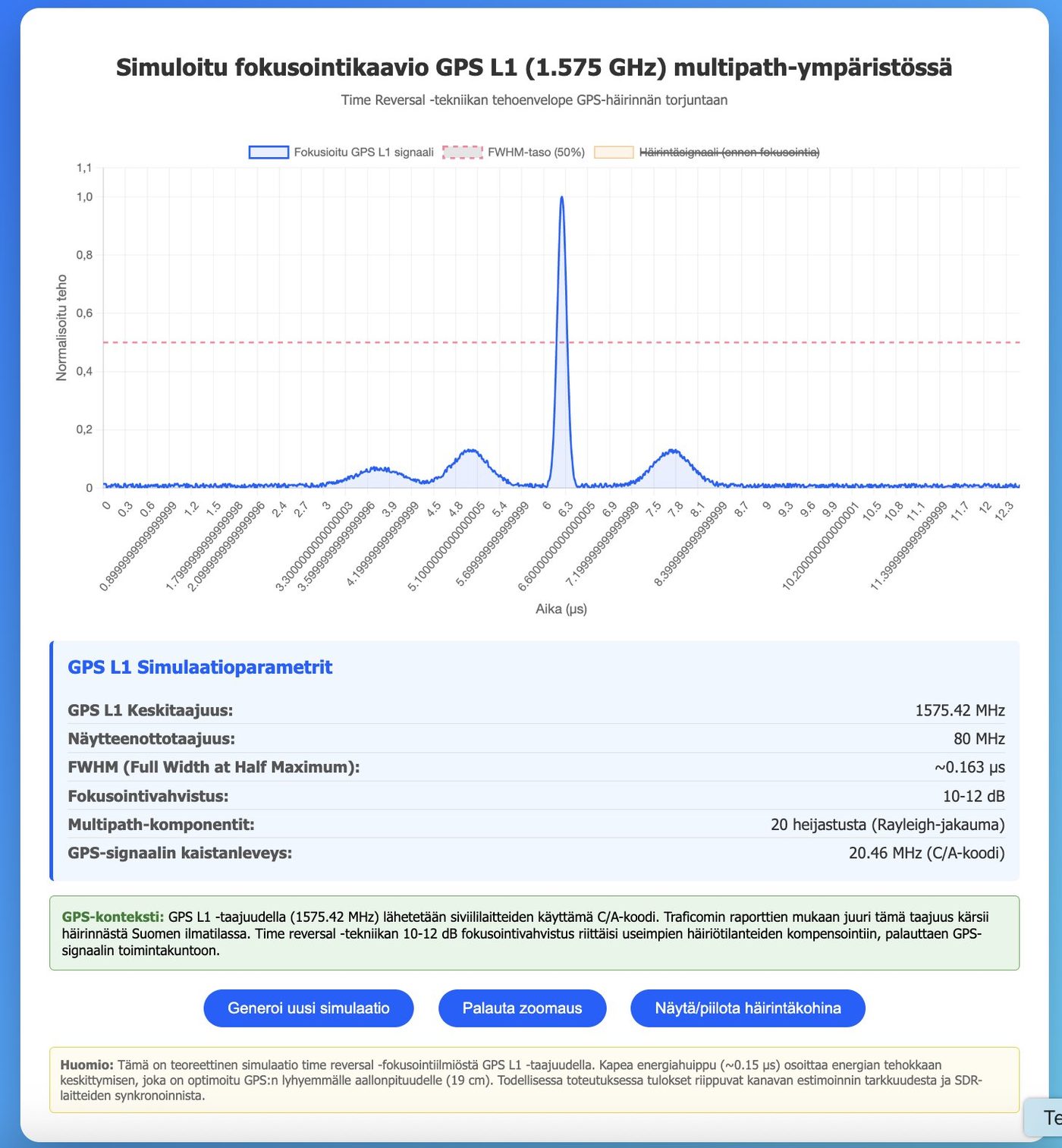
Above, Figure 1: Simulated focusing pattern at 1.575 GHz (GPS L1) in a multipath environment. The power envelope shows a narrow peak at the focusing point, where energy concentrates effectively (FWHM ~0.075 μs). This corresponds to a spatial resolution of approximately 22.5 metres, which is practical at GPS jamming scales near the source.
Limitations:
- Simulations do not account for practical challenges such as SDR device synchronisation
- Doppler shift from a moving jammer degrades performance
- In a real environment, channel estimation is imperfect
Practical Implementation Path with Consumer Components
The development of Software Defined Radio (SDR) technology has placed powerful RF signal processing into consumer hands. HackRF One (approx. €300) is capable of 1 MHz – 6 GHz operation¹⁰, and GNU Radio provides a powerful open-source signal processing platform. (HackRF works for proof-of-concept testing, but phase-coherent multi-antenna systems require USRP or LimeSDR hardware with a shared reference clock (10 MHz + 1 PPS). Without a common clock, phase coherence is lost rapidly, limiting practical performance, as I describe below.)
Thoughts on a DIY Implementation:
Phase 1: Proof of Concept (budget ~€500)
- 2× RTL-SDR dongle (€40) or 1× HackRF One (€300)
- Dipole antennas for the target frequency (€20)
- Raspberry Pi 4 for processing (€60)
- GNU Radio software for signal processing
Multi-SDR synchronisation requires a common 10 MHz reference clock. Without it, phase coherence is lost within microseconds.
Phase 2: Metamaterial Integration (additional budget ~€200)
- PCB prototype with 4×4 SRR array
- Varactor diodes for dynamic tuning
- DAC control from Raspberry Pi
Real-time processing (sub-millisecond latency) requires an FPGA (e.g. ~€300), as a Raspberry Pi alone is insufficient, which increases costs...
Phase 3: Scaling and Optimisation
- Larger antenna array (8–16 elements)
- FPGA-based processing (e.g. Xilinx Artix-7)
- Machine learning algorithm for predicting optimal focusing parameters
Potential Applications and Speculative Possibilities
- GPS jamming mitigation: The interference reported by Traficom in Finnish airspace¹ could theoretically benefit from time reversal-based defence, which could be deployed at key locations such as airports or near the border. Our simulated 10–15 dB improvement would suffice to compensate for most jamming scenarios.
Other potential applications (requiring significant further research and resources that the undersigned does not have):
- Drone protection: In the conflict in Ukraine, electronic warfare plays a central role¹¹. Time reversal could offer an active protection method even for individual drones, but practical implementation remains unproven.
- IoT energy harvesting: Metamaterials could theoretically harvest ambient RF energy, but efficiency is currently too low for practical applications.
Ethical Considerations and Dual-Use Technology
Every defence technology carries the potential for misuse. A time reversal system can:
- Locate radio transmitters with extreme precision (possible even for civilians using the methods described above!)
- Focus RF energy on a target, destroying even electronics! (a potential non-lethal weapon)
- Enable more precise signals intelligence
Open development of such technology is nevertheless justified. Keeping fundamental physics secret would give potential adversaries the opportunity to develop the technology covertly and use it in surprise attacks — and presumably the Finnish Defence Forces' signals intelligence units are already conducting their own classified practical applications in preparation for this future area of development. Open research enables balanced development and the creation of necessary regulation. The International Telecommunication Union (ITU) and other standardisation organisations need time to develop norms for new technologies.
Future Outlook
Time reversal with metamaterials offers a promising, though still developmental, approach to countering RF jamming. My simulation results demonstrate a 10–15 dB improvement in multipath environments — significant, but not revolutionary. The proliferation of the technology through SDR and open source does, however, enable broad experimentation and development for all technically minded propellerheads — and the undersigned is one of them.
Critical challenges remain:
- Precise synchronisation of SDR devices
- Real-time signal processing (microsecond latency)
- Metamaterial calibration and optimisation
- Doppler compensation for moving targets
Future development depends on both technological breakthroughs and the regulatory environment. I would not be surprised if we saw the first commercial applications in specialised areas (e.g. drone protection) within 2–3 years, with broader deployment taking longer still.
Disclaimer: This article is based on theoretical analysis and simulations conducted as a hobbyist exercise. Practical implementation requires further research, careful testing, and ethical consideration. The author assumes no responsibility for misuse or legality of the technology.
References
-
Traficom (2024). Satellite navigation service interference in Finland - Annual Report 2023. Finnish Transport and Communications Agency, Publication 8/2024. Available at: traficom.fi/gnss-reports
-
Maxwell, J.C. (1865). A Dynamical Theory of the Electromagnetic Field. Philosophical Transactions of the Royal Society of London, 155, 459-512.
-
Fink, M. (1992). Time Reversal of Ultrasonic Fields - Part I: Basic Principles. IEEE Transactions on Ultrasonics, Ferroelectrics, and Frequency Control, 39(5), 555-566.
-
Kuperman, W.A., Hodgkiss, W.S., Song, H.C., Akal, T., Ferla, C., & Jackson, D.R. (1998). Phase conjugation in the ocean: Experimental demonstration of an acoustic time-reversal mirror. Journal of the Acoustical Society of America, 103(1), 25-40.
-
Thomas, J.L., Wu, F., & Fink, M. (1996). Time reversal focusing applied to lithotripsy. Ultrasonic Imaging, 18(2), 106-121.
-
Lerosey, G., de Rosny, J., Tourin, A., & Fink, M. (2007). Focusing Beyond the Diffraction Limit with Far-Field Time Reversal. Science, 315(5815), 1120-1122.
-
Pendry, J.B., Holden, A.J., Robbins, D.J., & Stewart, W.J. (1999). Magnetism from conductors and enhanced nonlinear phenomena. IEEE Transactions on Microwave Theory and Techniques, 47(11), 2075-2084.
-
Chen, H.T., O'Hara, J.F., Azad, A.K., & Taylor, A.J. (2011). Manipulation of terahertz radiation using metamaterials. Laser & Photonics Reviews, 5(4), 513-533.
-
Smith, D.R., Padilla, W.J., Vier, D.C., Nemat-Nasser, S.C., & Schultz, S. (2000). Composite Medium with Simultaneously Negative Permeability and Permittivity. Physical Review Letters, 84(18), 4184-4187.
-
Ossmann, M. (2023). HackRF One: Software Defined Radio Platform - Technical Specifications v2023.1. Great Scott Gadgets Technical Documentation.
-
Bronk, J., Reynolds, N., & Watling, J. (2024). The Drone War in Ukraine: Electronic Warfare and Counter-UAV Systems. Royal United Services Institute (RUSI) Special Report, February 2024.
-
Sigwarth, O., & Miniatura, C. (2022). Time reversal and reciprocity. AAPPS Bulletin, 32, 23. Available at: https://link.springer.com/article/10.1007/s43673-022-00053-4