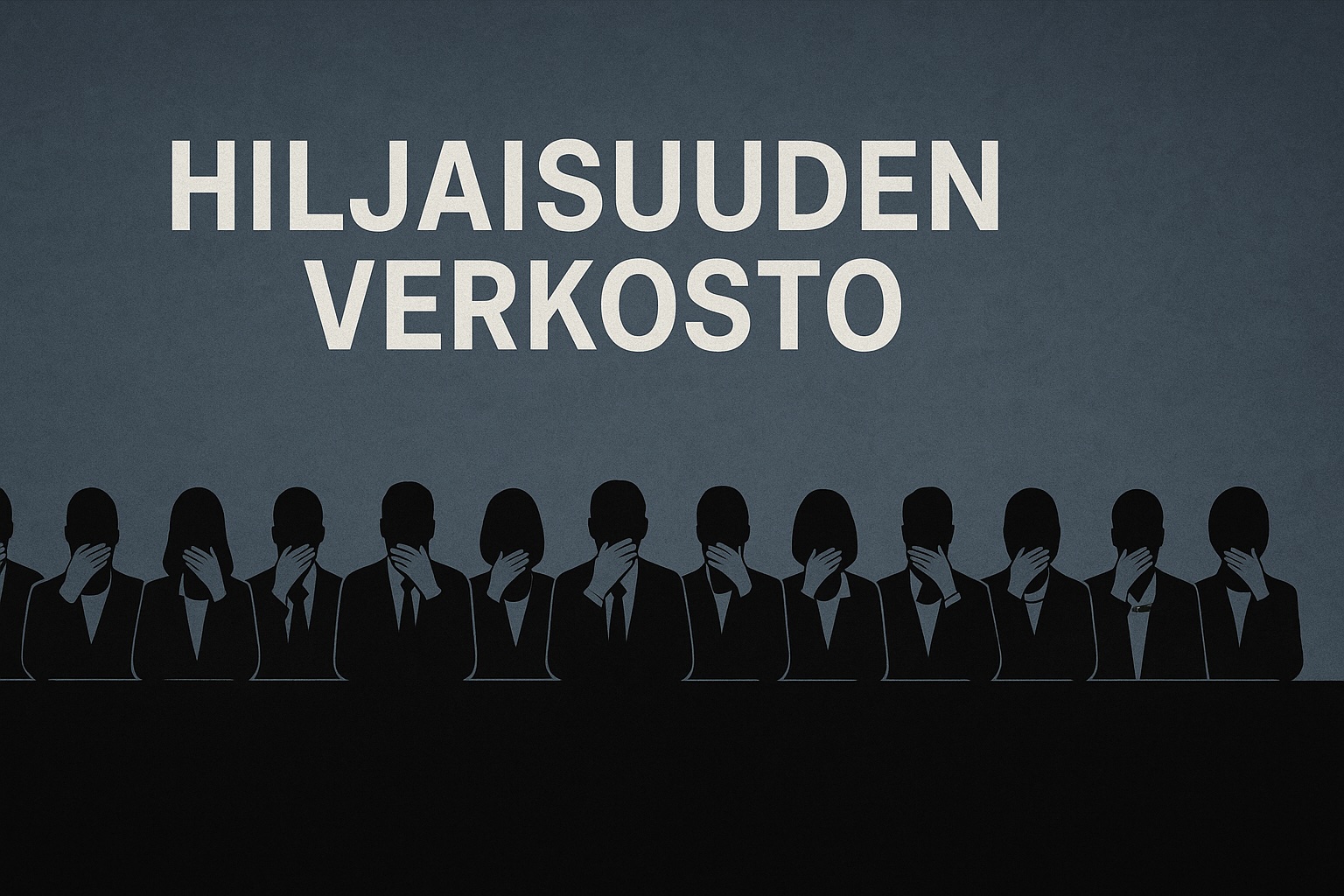
The Network of Silence
When 18 Western Leaders Went Silent in the Face of a Corruption Scandal
On November 28, 2025, Andriy Yermak, head of the Ukrainian Presidential Office and one of Volodymyr Zelensky's closest advisers, resigned from his position. That same day, Ukraine's National Anti-Corruption Bureau (NABU) had conducted a search of his residence as part of Operation Midas — an estimated $100 million bribery scheme that is Ukraine's largest corruption case since the start of Russia's full-scale invasion.
Yermak was not merely Zelensky's right hand. He was also the co-chair of the International Task Force on Security and Euro-Atlantic Integration of Ukraine — a high-profile organisation whose membership includes 18 Western leaders: former prime ministers, foreign ministers, a NATO Secretary General, and a former US Secretary of State.
Two weeks have passed. Not one of them has said a word.
The Task Force Was Created to Chart Ukraine's Path West
The Task Force was established in January 2024 in Kyiv on Zelensky's initiative. Its stated objective is to develop "a systematic vision for Ukraine's integration into the Euro-Atlantic security space." In practice, the group lobbies for Ukraine's NATO and EU membership and builds Western support for security agreements.
The group is co-chaired by Yermak and Anders Fogh Rasmussen, Denmark's former Prime Minister and NATO Secretary General from 2009 to 2014. Rasmussen heads the consultancy firm Rasmussen Global, which calls itself "Europe's leading Ukraine advisory firm" and works directly with the Presidential Office.
The membership is impressive: Boris Johnson (former Prime Minister of the United Kingdom), Hillary Clinton (former US Secretary of State), Carl Bildt (former Prime Minister of Sweden), Dalia Grybauskaitė (former President of Lithuania), Aleksander Kwaśniewski (former President of Poland), and a host of other former foreign and defence ministers.
And Sanna Marin, former Prime Minister of Finland.
Yermak Was at the Centre of the Scandal Before His Resignation
The Operation Midas investigation began covertly in the summer of 2024 and became public on November 10, 2025, when NABU carried out over 70 simultaneous raids across Ukraine. Five people were arrested, seven were charged. The raids yielded over four million dollars in cash: in US Federal Reserve packaging intended for interbank transfers, not retail use.
At the heart of the investigation is an alleged "barrier mechanism" — a system in which companies had to pay bribes of 10–15 per cent to secure government contracts. The contracts in question involved Energoatom, specifically the protection of energy infrastructure from Russian strikes.
Timur Mindich, a Ukrainian-Israeli businessman and long-time friend of Zelensky from the Kvartal 95 production company, fled Ukraine for Israel on November 10 — hours before a NABU raid planned at his premises. An arrest warrant was issued for him in absentia on December 1.
The search of Yermak's residence took place on November 28. He resigned the same day. According to Zelensky, the reason was "fatigue" — three years in the midst of a full-scale war.
NABU has not yet filed charges against Yermak, but his resignation on the very day of the corruption investigation's search of his home leaves questions unanswered.
18 Leaders, Zero Statements
Our investigation reviewed the public statements, social media accounts, press releases, and interviews of all 18 Task Force members following November 28.
The result is unambiguous: not one has commented on Yermak's resignation, the Operation Midas scandal, or the future of the Task Force.
Anders Fogh Rasmussen's consultancy Rasmussen Global published an article on the "Rasmussen Plan for Ukraine" in EU News on December 9. The article made no mention whatsoever of the Task Force or its co-chair's resignation — despite being published 11 days after Yermak's departure.
Hillary Clinton spoke at the Doha Forum on December 7 and broadly criticised Trump's Ukraine policy. She made no mention of the Task Force or Yermak.
Boris Johnson, Carl Bildt, Dalia Grybauskaitė — silence.
The Task Force itself has issued no official statement. Its most recently documented activities date to May 2024, when the group published a report at the Copenhagen Democracy Summit.
Sanna Marin Stayed Silent in the Midst of Her Book Tour
Sanna Marin's silence is particularly noteworthy. In November 2025, she was actively in the public eye promoting her memoir and gave several interviews.
An extensive Yle article on November 30, 2025 — just two days after Yermak's resignation — covered Marin's Ukraine work at the Tony Blair Institute. The article made no mention whatsoever of Yermak, the Task Force, or the corruption scandal. Marin was reported to have "declined an interview" and responded to questions only by email in general terms.
This is journalistically significant for two reasons. First, Marin is a Task Force member whose co-chair resigned amid a corruption investigation. Second, she has repeatedly emphasised in her public statements Ukraine's obligation to "fight corruption" as a prerequisite for EU membership.
The Task Force is not Marin's only connection to Ukraine's power structures. She has met Yermak in person: a documented meeting in March 2024 is recorded on the official website of the Ukrainian Presidential Office.
A Nexus of Three Networks
The case of Sanna Marin illustrates a broader phenomenon: how certain individuals move simultaneously within multiple international elite networks.
Marin was named a World Economic Forum Young Global Leader in 2020, the same year she became Prime Minister. The YGL programme opens access to the Davos summits and the networks of the global elite — the selection committee is chaired by Queen Rania of Jordan.
In January 2024, Marin joined the Task Force. In September 2023, just six days after stepping down as leader of the Social Democrats, she announced her role as a strategic adviser to the Tony Blair Institute.
Three networks, one person: YGL, Task Force, TBI.
This is no coincidence: our investigation shows that these networks are institutionally connected to one another.
WEF: The Meta-Network That Links Them All
The World Economic Forum functions as a connective structure linking the Task Force, the Tony Blair Institute, and the Clinton Global Initiative to one another.
Tony Blair joined the WEF Foundation Board in 2007 and served as chair of the Davos Annual Meeting in 2008. The Tony Blair Institute is an official WEF partner organisation with its own profile on weforum.org. In November 2025, TBI and WEF jointly launched the Africa ADAPT initiative — active programme collaboration, not merely a nominal partnership.
The Clinton Global Initiative was born at Davos. Bill Clinton announced the founding of CGI at the WEF Annual Meeting in January 2005. Hillary Clinton has spoken at Davos on multiple occasions, and Chelsea Clinton was named a Young Global Leader in 2013.
At least six Task Force members have confirmed WEF connections. Three are Young Global Leaders or Global Leaders for Tomorrow alumni: Sanna Marin (2020), Lord William Hague (1994), and Aleksander Kwaśniewski (1994). Four — including Anders Fogh Rasmussen — are official WEF "Agenda Contributors."
Yermak himself was deeply integrated into the WEF before the scandal: he presented Ukraine's peace formula at Davos, led delegations to WEF-facilitated meetings of national security advisers, and maintained direct contact with WEF President Børge Brende.
Four Finnish Prime Ministers in the Same Network
Finland is a small country, but its representation in the WEF's Young Global Leaders programme is exceptionally strong. Four prime ministers have been selected for the programme: Esko Aho in 1993, Jyrki Katainen in 2003, Alexander Stubb in 2009, and Sanna Marin in 2020.
This means that every National Coalition Party or Social Democrat prime minister since Paavo Lipponen has been a WEF-selected "future global leader."
Klaus Schwab, the founder of the WEF, stated at Harvard in 2017: "We are very proud that we penetrate the governments of countries with our Young Global Leaders." The context of the remark was celebratory, but it confirms the WEF's own awareness of its political influence.
Current President Alexander Stubb is a YGL 2009 alumnus and has attended Davos meetings at least nine times. He has also attended Bilderberg meetings three times.
Stubb is not a Task Force member. This distinction matters: the sitting president is outside this particular network, while the former prime minister is inside it — and silent about its crisis.
Rasmussen Global: A Consultancy in the Shadow of Scandal
Anders Fogh Rasmussen's consultancy firm Rasmussen Global warrants particular scrutiny. The firm calls itself "Europe's leading Ukraine advisory firm" and works directly with the Presidential Office. It has an office in Kyiv, headed by former Member of Parliament Olena Sotnyk.
The firm has made no statement on Yermak's resignation. Instead, it continues marketing its Ukraine lobbying as though nothing has happened.
Rasmussen Global's Ukraine clients include the Ukrainian government since 2016. According to the EU lobbying register, clients also include European energy companies and British think tanks. According to the Financial Times and Politico, the list may also include Lockheed Martin and Chevron.
No connections to key figures in the Operation Midas investigation — Mindich, Myronkiuk, Basov — were found, but the firm worked directly with the very Presidential Office whose head resigned amid a corruption scandal.
The Media's Blind Spot
Yermak's resignation received extensive international media coverage. The Financial Times described it as "an additional problem for a beleaguered Ukrainian leader." Politico called it "a tectonic shift." The New York Times, Washington Post, Bloomberg, and Reuters covered the event comprehensively.
Yet not a single major international outlet asked the Task Force's Western members for comment or questioned the group's credibility.
This is a remarkable gap. Yermak was the co-chair of a high-profile group. The Task Force includes former prime ministers, foreign ministers, and NATO leaders. The corruption allegations are substantial. The group's work directly concerns Ukraine's NATO integration — a question at the very heart of European security.
Finnish media has not asked Marin for comment on the Task Force situation.
Marin's Arc: From Critic to Network Insider
Sanna Marin's silence on the Task Force scandal gains further context when one examines her political trajectory.
In 2009–2010, as a 23–24-year-old city councillor in Tampere, Marin wrote two blog posts that demonstrate an early critical stance towards elite networks.
In September 2009, she published a post titled "The City of Tampere — a Target of Pfizer's 'Bribery'?", in which she referenced Pfizer's $2.3 billion fraud settlement and criticised the city for accepting invitations from pharmaceutical companies. She filed a dissenting opinion on the matter.
In August 2010, she wrote a piece for the Social Democrats' Debatti magazine titled "The Money-Rich Pharmaceutical Industry," in which she stated about swine flu: "It is now finally clear: there was no real swine flu threat... Vaccine manufacturers received over 100 million euros from Finland alone for vaccines whose health effectiveness is supported by weak evidence."
She described pandemic communication as "fear-based marketing manipulation" and concluded her text by describing those who purchased the vaccines as "brainless sheep."
When these posts resurfaced on social media in May 2020, in the midst of the COVID pandemic, Marin's website "went down for maintenance" on a Sunday evening. Her staff described it as routine maintenance.
As Prime Minister, Marin called vaccines "our most important tool," demanded more effective pharmaceutical production from the EU Commission, and her government pushed for mandatory vaccination of healthcare workers.
This is not an accusation of hypocrisy. People can change their positions: COVID-19 was a different virus from swine flu. But the arc from critical young politician to WEF-YGL, Task Force member, and TBI adviser illustrates how networks operate: they select, shape, and integrate.
What Does the Silence Tell Us?
There are three possible explanations for the collective silence.
The first is internal review: the situation is being handled behind the scenes before any public statements are made. This would be understandable, but two weeks of silence raises questions.
The second is a de facto suspension: the Task Force has effectively stalled, waiting for clarity on Ukraine's leadership changes. Zelensky nominated five candidates for head of the Presidential Office on December 5, but no selection has been made. The Task Force's Ukrainian co-chairmanship remains vacant.
The third is a deliberate avoidance strategy: a decision not to comment that shields the network and its members from difficult questions.
Whatever the explanation, the silence itself is significant. These are leaders who have built their careers on speaking about democracy, transparency, and the fight against corruption. They have demanded that Ukraine reform as a prerequisite for EU membership.
When the head of their own organisation resigns amid a corruption investigation, they fall silent.
Open Questions
This investigation leaves several questions unanswered — questions the Task Force members have not addressed.
Who leads the Task Force now that the Ukrainian co-chairmanship is vacant? Does the group continue to operate, or is it effectively suspended? Has the group convened since Yermak's resignation?
Did the members know about the corruption allegations against Yermak before his resignation was announced? How do they assess the group's credibility now?
Why has not a single one of the 18 members issued a public statement? Is this coordinated silence or a collection of individual decisions?
Why has international media not asked these questions?
Conclusion: Networks Protect Their Own
The Task Force has drifted into operational limbo: not officially dissolved, but not actively functioning either. Its co-chair resigned amid a corruption scandal, and 18 Western leaders have chosen silence.
This silence reveals something fundamental about how international elite networks operate. The WEF, the Task Force, the Tony Blair Institute, and the Clinton Global Initiative are not separate organisations but interconnected structures with overlapping membership and documented institutional ties.
When one part of the network falls into crisis, the rest of the network goes silent. Not because it has something to hide, but because the logic of networks is to protect their members — including from difficult questions.
Sanna Marin sits in three networks simultaneously: YGL, Task Force, TBI. She exemplifies how certain individuals are selected and circulated among these structures.
Her silence on Yermak's resignation is not a scandal. It is a symptom of how the system works.
The question is: whose interests do these networks ultimately serve?
This article is based on public sources: official Task Force documents, Ukrainian Presidential Office communications, NABU publications, WEF websites, international media (Financial Times, Politico, The Guardian, New York Times), Finnish media (Yle, Helsingin Sanomat), and social media archives. Not all claims could be independently verified, and investigations are still ongoing.