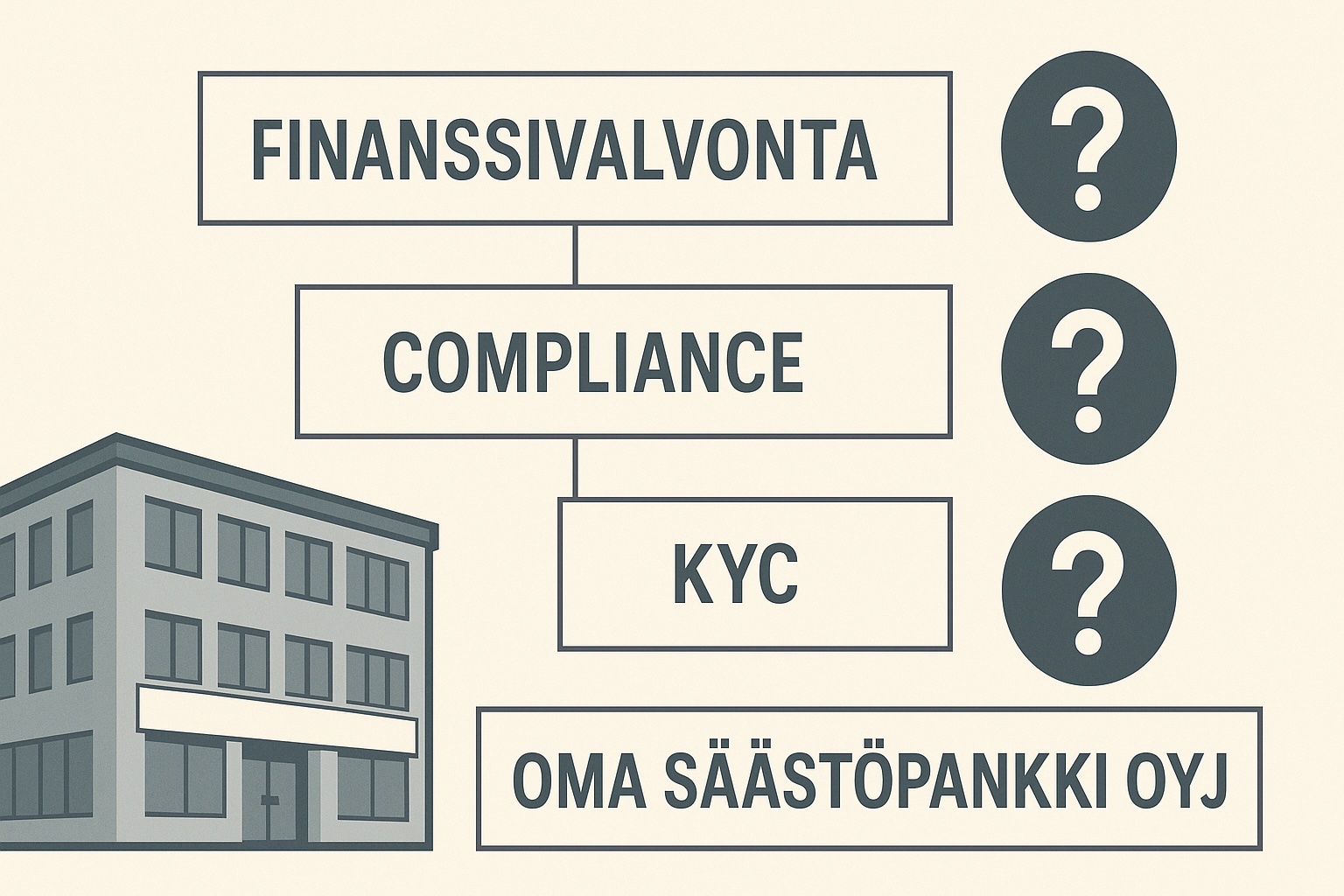
The Structure That Doesn't Ask – The Pattern of Historical Banking Scandals and a Finnish Savings Bank
Part 1: Structure – What Happens When the Structure Doesn't Ask?
This publication is a continuation of yesterday's article. You can find yesterday's publication at this link.
Introduction
This article does not claim that Oma Säästöpankki is a money laundering institution, even though all the structures would allow it. The article does not accuse anyone of a crime. Instead, it asks a question that is rarely posed: if someone wanted to use a Finnish bank, such as Oma Säästöpankki Oyj, for money laundering, what kind of structure would make that possible?
And then it asks a second question: does Oma Säästöpankki meet those criteria?
To find the answer, we examine three levels:
- The historical pattern: What do the YBM Magnex and Bank of New York scandals teach us about the structures of money laundering?
- The Financial Supervisory Authority's findings: What has the regulator concluded about OmaSp's operations?
- Individual cases as symptoms: What do they reveal about the system?
We do not know exactly everything that has happened at OmaSp — that is likely known only to the Financial Supervisory Authority and possibly the National Bureau of Investigation (NBI) — but we do know what kind of structure enables abuse, and we can compare these to the events at Oma SP.
1. The Anatomy of Money Laundering: What Does It Take to Work?
1.1 Three Essential Elements
According to the Financial Action Task Force (FATF), the international anti-money laundering body, successful money laundering requires three things:
1. Weak Customer Due Diligence (KYC/AML)
- The bank does not know who the customer truly is
- The bank does not know where the money comes from
- The bank does not ask why the transactions are taking place
2. Complex Ownership Structure
- True beneficiaries are concealed
- Ownership chains run through multiple entities
- No one is "responsible" in a legal sense
3. Insider Control or Complicity
- Decision-making is concentrated in a small group
- External oversight is weak
- Anomalies are not questioned
When these three elements combine, an environment is created in which illicit money flows can pass undetected.
1.2 "The Bank That Doesn't Ask"
The same pattern recurs in historical scandals: a bank that didn't ask. Didn't ask who truly owns. Didn't ask where the money comes from. Didn't ask why millions are moving.
This does not always mean that the bank was complicit in a crime. Sometimes it is negligence. Sometimes a lack of resources. Sometimes a culture in which "good clients" receive special treatment.
The end result is the same: a structure that enables.
2. Historical Cases: Identifying the Pattern
2.1 YBM Magnex International (1993–1998)
Background:
YBM Magnex was a Canadian publicly listed company behind which stood the Ukrainian-born organised crime leader Semion Mogilevich. The company was founded solely to commit securities fraud.
How it worked:
| Element | Implementation |
|---|---|
| Weak KYC | Auditors were bribed, true ownership was not investigated |
| Complex ownership | A shell company network concealed Mogilevich's ownership |
| Insider control | Mogilevich directed operations from Budapest |
Outcome:
- Investors lost over 150 million dollars
- The company admitted in court that it was established to commit fraud
- A connection was found to the Bank of New York scandal
Lesson:
When nobody asks who truly owns, the answer may be organised crime.
2.2 The Bank of New York Scandal (1999)
Background:
Over three and a half years, approximately 7 billion dollars from Russia flowed through the Bank of New York's Benex and BECS accounts to third parties around the world.
How it worked:
| Element | Implementation |
|---|---|
| Weak KYC | The bank did not conduct adequate due diligence |
| "Know Your Customer" absent | When employees tried to check, they were told there was no system in place |
| Complex structure | The accounts were part of an underground money transfer operation |
Outcome:
- One of the largest money laundering scandals in history
- Connection to Inkombank, controlled by Mogilevich
- Bank of New York paid a 38-million-dollar settlement
Lesson:
Money laundering does not require active complicity — it is enough that the structure doesn't ask.
2.3 The Common Denominator
Both cases share the same DNA:
1. A bank that did not know its customers
2. An ownership structure that concealed the true beneficiaries
3. An inner circle that controlled without external oversight
4. Documentation that was deficient or falsified
5. Supervision that failed
The question is: can the same pattern be found elsewhere?
3. A Finnish Exception? The Peculiarity of Foundation Ownership
3.1 A Foundation Has No Owners
The Finnish Foundations Act creates a unique structure: a foundation has no actual owners in a legal sense.
According to the Finnish Patent and Registration Office (PRH):
"The actual beneficiaries of a foundation are considered to be the members of the board and the supervisory board registered in the foundation register."
But board members do not own anything. They merely administrate.
In practice, this means:
- No one is legally responsible for a foundation's assets in the same way as in a limited company
- Foundations are not required to separately declare actual beneficiaries in the trade register
- "Ownerless money" — assets that no one owns
3.2 Self-Perpetuating Governance
The historical structure of savings bank foundations is telling. One commentator described it as follows:
"Elections chose 10 new members for a 40-person board of delegates. Then these old 40 and new 10 convened and selected 40 'new' delegates from among themselves. Usually the old 40 continued."
This structure enables:
- A closed circle — the same people select one another
- Opacity — outsiders cannot exert influence
- Unaccountability — no one is truly answerable
3.3 OmaSp's Ownership Structure
The largest owner of Oma Säästöpankki is Etelä-Karjalan Säästöpankkisäätiö (the South Karelia Savings Bank Foundation) at 45%.
Notable:
- The foundation is domiciled in Lappeenranta — right next to the Russian border
- The foundation was established in 1919, but the current structure was created in 2014
- According to public sources, the foundation's financial data has not been available for the past five years
Hypothesis:
Foundation ownership creates a structure in which transparency is limited and actual control is difficult to trace. This does not mean that anything illegal is taking place, but it does mean that the structure would not prevent it.
4. The Financial Supervisory Authority's Findings: The Same Deficiencies as in History
4.1 What Did FIN-FSA Find?
The Finnish Financial Supervisory Authority (FIN-FSA) conducted an inspection of OmaSp covering the period 1 January 2022 – 21 December 2023. The results were exceptionally serious.
FIN-FSA identified "deficiencies of very high significance" in the following areas:
| Area | Finding |
|---|---|
| Identification of beneficial owners | Deficiencies in identification and maintenance of records |
| Understanding of customer activity | Widespread deficiencies |
| Determination of the origin of funds | Widespread deficiencies |
| Enhanced procedures | The bank was unable to implement the requirements of the Anti-Money Laundering Act |
In plain terms: the bank did not know (or document):
1. Who actually owned the client companies
2. Where the clients' money came from
3. What the clients' actual business was
4.2 Comparison: Bank of New York 1999 vs. OmaSp 2024
| Element | Bank of New York 1999 | OmaSp 2024 (FIN-FSA findings) |
|---|---|---|
| Due diligence | "Insufficient checks" | "Widespread deficiencies" |
| Customer knowledge | "No know-your-customer inquiries" | "Unable to implement enhanced procedures" |
| Beneficiary identification | True owners unknown | "Deficiencies in identification" |
| Origin of funds | Not investigated | "Deficiencies in determining the origin of funds" |
| Internal controls | Employees were told there was no system | FIN-FSA: systematic deficiencies |
Note: This comparison does not claim that OmaSp committed the same crimes as Bank of New York. It demonstrates that the structural deficiencies are nearly identical.
4.3 What Does This Mean?
FIN-FSA's findings describe a bank that meets the criteria of a structure enabling money laundering:
✓ Weak customer due diligence
✓ Beneficial owners unidentified
✓ Origin of funds undetermined
This does not prove that money laundering has occurred. It proves that the structure would not have prevented it.
5. Individual Cases as Symptoms
5.1 The Minkkinen Case: An Example of "Not Asking"
The publicly shared, documented "Minkkinen case" offers a window into the bank's operating culture:
What happened:
- The bank granted a one-million-euro loan for NHI Apartments shares
- The sole collateral was 10% of the shares
- The loan officer (Deputy CEO) was himself a 50% owner of the selling company
- The approach came from the bank's side
What this reveals:
- Conflicts of interest were not identified — or were disregarded
- Collateral assessment was exceptional
- Documentation was deficient
On the Inderes forum, one commentator summed it up:
"The organisation lost all basic competence in the most elementary matters related to collateral."
5.2 Missing Documentation
According to a Talouselämä journalist, a significant number of credit decision documents are missing from the bank's vaults — documents that should absolutely be preserved.
Question: Is the disappearance random or systematic?
If it is an isolated error, it is serious but correctable.
If it is a systematic deficiency, it points to a structure in which documentation is not a priority — or in which its absence serves someone.
5.3 The Lauttasaari Pattern
The Lauttasaari luxury apartment case reported by Talouselämä raises further questions:
- Adjacent multi-million-euro apartments for bank insiders and business partners
- A complex corporate structure (Hallon House)
- Pohjola Rakennus involved in the arrangements
Question: Was this normal business, or insider favouritism?
6. Hypothesis: If the Pattern Were Realised
6.1 A Theoretical Model
If someone wanted to use a structure like OmaSp's for money laundering, the model might look like this:
LEVEL 1: Offshore company (Cyprus, BVI, Cayman)
    ↓
LEVEL 2: European holding company (Switzerland, Luxembourg)
    ↓
LEVEL 3: Investment in bank shares or client relationship
    ↓
LEVEL 4: Bank grants loans for real estate projects
    ↓
LEVEL 5: Money "laundered" through Finnish real estate
Why this would work:
- Foundation ownership conceals the beginning of the chain
- Weak KYC does not reveal the true beneficiaries
- Deficient documentation leaves no trail
- Geographic location facilitates cross-border arrangements
6.2 What We Do Not Know
It must be emphasised what we do not know:
- We do not know whether this has happened
- We do not know who the potential actors would be
- We do not know whether FIN-FSA's findings have led to corrections
- We do not know what the NBI investigation has uncovered
We only know that the structure would allow it.
7. International Exposure Routes
7.1 Why Concealment Is Difficult
If abuses have occurred, they will most likely come to light through international channels:
| Route | Mechanism | Timeframe |
|---|---|---|
| SWIFT/USA | All dollar transactions are visible to US authorities | Immediate |
| AMLA (EU) | The new Anti-Money Laundering Authority begins operations 2025–2026 | 1–2 years |
| FATF evaluation | International assessment | 1–3 years |
| Whistleblower | EU protections enable disclosure | Ongoing |
| Offshore leaks | Panama/Pandora Papers type | Unpredictable |
7.2 Critical Vulnerability
Every international transaction leaves a trace in systems that Finnish authorities do not control.
If money flows have gone abroad — to banks, real estate, companies — they are subject to investigation by other countries' authorities.
8. Open Questions
This analysis does not provide answers. It poses questions to which answers should be sought:
On structure:
- Why does foundation ownership make transparency impossible?
- Who truly controls Etelä-Karjalan Säästöpankkisäätiö?
- Why are financial data not publicly available?
On oversight:
- Why did FIN-FSA's findings not lead to immediate action?
- Is the supervisory system structurally incapable of detecting problems?
- Why does the NBI investigation appear to focus on individual clients rather than the bank?
On documentation:
- Why are credit decision documents missing?
- Is the disappearance random or systematic?
- Who benefits from missing documentation?
On operating culture:
- Why did insider conflicts of interest not prevent transactions?
- Why did collateral assessments deviate from standard practices?
- Is this the conduct of individual persons, or a system?
In Closing: Structure or Coincidence?
This article does not claim that money laundering has occurred at Oma Säästöpankki, even though the conditions for it have been near-ideal. It does not accuse anyone of a crime.
It demonstrates that:
- There is an identifiable pattern in historical banking scandals
- The same pattern — weak KYC, complex ownership, insider control — appears to recur
- The Financial Supervisory Authority's findings confirm the structural deficiencies
- Individual cases point to systematic problems
The question is no longer whether something has happened.
The question is what has happened, why the structure allows it, and why nothing has been done about it.
And these questions deserve answers.
10.12.2025
Sources
Regulatory Sources
-
Finnish Financial Supervisory Authority (2024).
-
Finnish Patent and Registration Office (PRH). Foundation Register: Declaration of Beneficial Owners. https://www.prh.fi/
-
Financial Action Task Force (FATF). International Standards on Combating Money Laundering and the Financing of Terrorism & Proliferation. https://www.fatf-gafi.org/
News Sources
-
Talouselämä (24.10.2024). Oma Säästöpankki's former Deputy CEO and real estate investments. https://www.talouselama.fi/
-
Talouselämä (week 37/2024). 15 million euros and a plot in Helsinki's Lauttasaari – Talouselämä investigated how Oma Säästöpankki's banker and businessmen ended up buying luxury apartments.
-
Koponen, Taneli (2024). Talouselämä's OmaSp reporting, multiple articles.
Historical Cases
-
U.S. Department of Justice (1999). United States v. Bank of New York. Court documents.
-
Securities and Exchange Commission (SEC). YBM Magnex International Investigation. Investigation reports.
-
O'Brien, Timothy L. (1999). "Follow the Money: A special report.; Tracking How a Web of Suspect Accounts Funnelled Billions Abroad". The New York Times.
Corporate Information
-
Asiakastieto / Proff.fi. Business register data: Etelä-Karjalan Säästöpankkisäätiö, NHI Apartments I Oy, New House Innovation Oy, Hallon House Oy.
-
Kauppalehti. Oma Säästöpankki Oyj — corporate information and ownership structure.
Discussion Forums (referential)
- Inderes Forum (2024–2025). Oma Säästöpankki discussion thread. https://forum.inderes.com/t/oma-saastopankki/1310/
Legislation
-
Anti-Money Laundering Act (444/2017). Act on Preventing Money Laundering and Terrorist Financing.
-
Foundations Act (487/2015).
-
EU Anti-Money Laundering Directive (AMLD6).