Tibetan Singing Bowls — Myth vs. Truth
(sample chapter, from the book New Age Encyclopedia)
Tibetan singing bowls are among the most iconic objects in the New Age world — brass and bronze bowls claimed to be ancient healing instruments from Himalayan monasteries. In reality, the vast majority of these bowls have been manufactured over the past thirty years for the tourist markets of Nepal and India, and their connection to genuine Tibetan spiritual tradition is as thin as their walls. Yet millions of people around the world believe they own a piece of ancient wisdom when they strike a metal bowl — made from recycled metal in a factory on the outskirts of Kathmandu — with a wooden mallet.
The myth of Tibetan singing bowls is a masterfully constructed narrative that weaves together Western romanticisation of Tibet, a longing for the exotic, and a belief that somewhere far away a pure spiritual tradition has survived, untainted by the modern world. This story claims that monks used these bowls for meditation and healing for millennia, that each bowl is forged from seven sacred metals corresponding to seven planets, and that their sound opens chakras, cleanses auras, and connects the listener to cosmic consciousness. The truth is far more prosaic — but also far more fascinating, because it reveals how spiritual longing becomes a commercial commodity in the global economy.
The Real History and Origins
Metal bowls have been used in the Himalayan region for centuries, but not primarily as musical instruments or meditation tools — they were everyday vessels used for eating, collecting alms, and storing water. The oldest surviving examples date from the 1500s, and they are simple, unadorned utilitarian objects with no mystical markings or symbols whatsoever. Monks did indeed use metal bowls, but in the same way they used spoons, knives, and other daily necessities: for practical purposes, with no special spiritual significance.
The idea of singing bowls as meditation tools did not emerge until the 1970s, when Western hippie travellers began flooding into Nepal and India in search of enlightenment. Local merchants, who had been selling tourists carpets, jewellery, and Buddha statues, realised that old metal bowls could be sold as exotic instruments — provided the right story was attached. They began telling buyers that the bowls came from destroyed monasteries, that they contained secret knowledge of vibrations, and that their sound could open spiritual gateways.
Nancy Hennings, an American music teacher who lived in Kathmandu from 1972 to 1974, has documented how the singing bowl business was born. According to her, the first "antique" singing bowls were sold at the hippie café on Freak Street, and they were in fact old food vessels that local families had sold as scrap metal. The merchants noticed that the older a bowl looked, the more they could charge for it, so they began "ageing" new bowls with acid, mud, and fire to create a patina that appeared centuries old.
The Seven Metals Myth
One of the most central myths about singing bowls is that they are made from seven sacred metals corresponding to seven planets: gold (Sun), silver (Moon), mercury (Mercury), copper (Venus), iron (Mars), tin (Jupiter), and lead (Saturn). This claim sounds like ancient wisdom and resonates with Western alchemy and astrology, but it is an entirely fabricated marketing story with no basis in Tibetan or Buddhist tradition.
Metallurgical analyses have shown that the vast majority of singing bowls are made from simple brass — an alloy of copper and zinc — with small amounts of tin occasionally added to improve tonal quality. Few bowls contain more than three metals, and gold or silver are virtually never found, as they would make the bowls too expensive to produce and too soft to use. Adding mercury to a metal alloy would be technically impossible due to its low boiling point, and it would render the bowls toxic.
Joseph Forno, a metallurgist at the University of Melbourne, analysed fifty "antique" singing bowls in 2019 using X-ray fluorescence spectroscopy. His findings were unambiguous: 92 per cent of the bowls were ordinary brass, six per cent were bronze, and only two per cent contained more than three metals. Not a single one contained seven metals, nor did any contain gold, silver, or mercury. Yet sellers continue to tell the seven-metals story, because it drives up prices and gives the bowls a mystical aura.
The Manufacturing Process and Reality
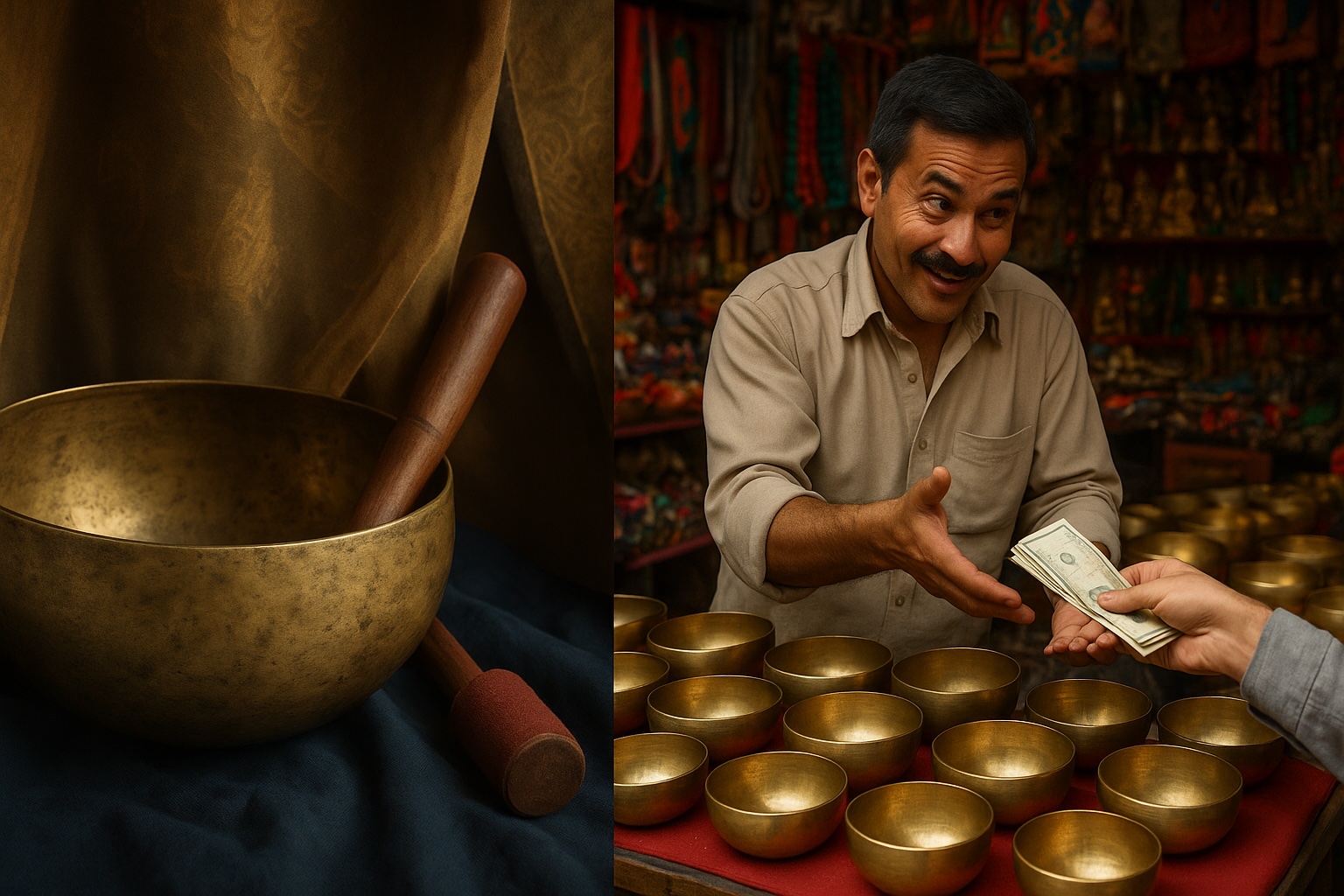
Today, the vast majority of "Tibetan" singing bowls are manufactured in Kathmandu and Patan in Nepal, and in Moradabad and Jaipur in India. The manufacturing process is largely mechanised: metals are melted in industrial furnaces, poured into moulds, and finished on lathes. Handmade bowls, marketed as premium products, are often produced the same way — only the finishing is done by hand to create an uneven, "authentic" surface.
The Himalayan Bowls Factory in Kathmandu's Thamel district produces roughly a thousand bowls per week, employing fifty workers who earn an average of three dollars a day. Bowls that cost five dollars at the factory are sold wholesale for ten dollars, exported to the West, and sold there for 50 to 500 dollars depending on the story attached to them. A "master healing bowl" that sells for 800 dollars in a New York metaphysical shop may have been made by a sixteen-year-old boy in Kathmandu who has never heard of chakras or sound therapy.
Manufacturers have learned what Western buyers want: bowls that look old, inscribed with Sanskrit texts, Buddha images, and mystical symbols. They have created an entire industry producing "antiques" to order — using acids to create patina, hammer marks to create a handcrafted appearance, and engraving mantras that no one in Tibet recognises. The irony is that many of these modern bowls are better instruments than genuine antique bowls, because they are designed to produce a long, resonant tone — unlike the original utilitarian vessels.
Western Appropriation and Romanticisation
Behind the popularity of singing bowls lies a deep Western romanticisation of Tibet and the Himalayan region as a whole. In the Western imagination, Tibet has been transformed into Shangri-La — a mythical place where spiritual masters live in harmony with nature, free from the corrupting influences of the modern world. This fantasy, rooted in James Hilton's 1933 novel Lost Horizon and reinforced by the Dalai Lama's exile in 1959, has created a market for everything "Tibetan," whether or not it has any real connection to Tibet.
Singing bowls are a perfect example of this appropriation: they are taken out of their context, assigned meanings they never carried, and sold back to Westerners as a spiritual product. Tibetan refugees who sell these bowls to survive have learned to tell the stories tourists want to hear, even though they know they are not true. They speak of chakras, auras, and vibrational healing — concepts that entered their culture only through Western tourists.
Martin Brauen, a Swiss anthropologist and former curator at the Rietberg Museum, has studied the singing bowl phenomenon for decades. According to him, there is not a single Tibetan text predating the 1960s that mentions singing bowls as instruments of meditation or healing. On the contrary, traditional Tibetan instruments have been bells, cymbals, drums, and wind instruments used in rituals and ceremonies. Singing bowls are a Western invention projected onto Tibetan culture and then sold back as authentic heritage.
Claimed Healing Properties
Singing bowls are claimed to heal nearly everything from depression to cancer, and every claim comes with a "scientific" explanation that sounds plausible but does not withstand scrutiny. The most common claim is that the sound waves produced by the bowls resonate with the body's water molecules — because the human body is 70 per cent water — and that this resonance harmonises cells, purges toxins, and restores balance. This explanation mixes real scientific facts with pseudoscientific speculation in a way that confuses even educated people.
In reality, the effect of sound waves on water molecules in the body is negligible. The sound pressure a singing bowl produces is so weak that it cannot cause any significant vibration in the body's fluids. While sound can affect water molecules — as Masaru Emoto's famous but thoroughly discredited experiments claimed to demonstrate — this would require sound pressure levels that would be painful or even dangerous to a human being. The 60–80 decibel sound produced by a singing bowl is far too weak to cause any physical changes at the cellular level.
Another common claim is that singing bowls produce "binaural beats" that synchronise brainwave activity and shift brain waves into theta or delta states associated with deep meditation and healing. This is again a half-truth: binaural beats are a real phenomenon in which hearing two slightly different frequencies in each ear creates a third, perceived frequency in the brain. Singing bowls, however, do not produce binaural beats, because they emit the same frequency to both ears. They may produce complex overtones and interference patterns, but these are not the same thing as binaural beats.
Uses and Techniques
Singing bowls are used in many different ways depending on the tradition, the teacher, and the situation, but the most common technique is to rub the rim of the bowl with a wooden or leather-covered mallet, producing a continuous, singing tone. This technique, which looks simple, requires practice: too little pressure produces no sound, too much pressure dampens the vibration, and uneven movement causes the bowl to skip and the sound to break. Many beginners become frustrated when they cannot make the bowl "sing" — and this frustration is sold to them as a sign that their energy is blocked and they need more practice or a more expensive bowl.
Another technique is to strike the bowl with a soft mallet, producing a shimmering tone that fades slowly. This is often used at the beginning and end of meditation to mark the transition from ordinary consciousness to a meditative state and back again. Some practitioners claim that the force, direction, and placement of the strike determine which chakra the sound activates, though this claim has no basis whatsoever in physics or traditional chakra teachings.
Modern practitioners have developed increasingly elaborate techniques: bowls are filled with water to create rippling patterns, played over the body with claims that the vibrations penetrate tissues, or arranged in geometric configurations to create "sound mandalas." Each new technique comes with a new course, book, or DVD, creating an endless cycle of consumption in which there is always something new to learn, a new level to reach, and a new bowl to buy.
Psychological Effects and Placebo
While the physical healing effects of singing bowls are questionable, their psychological effects are real and measurable. Studies have shown that singing bowl meditation can reduce stress, lower blood pressure, and improve mood — but these effects are not unique to singing bowls; they are common to all relaxation techniques. The same effect can be achieved by listening to classical music, walking in nature, or simply sitting quietly with eyes closed.
The placebo effect is powerful, particularly when combined with ritual, expectation, and social reinforcement. A singing bowl session is packed with placebo enhancers: exotic instruments, a mystical atmosphere, the practitioner's authority, and the energy of the group. People pay hundreds of euros for the experience, so they have a strong motivation to believe it works. They arrive expecting healing, and often they experience healing — not because of the bowls, but because of the power of their own minds.
Jessica Hische, a psychologist at the University of Amsterdam, studied the effects of singing bowl meditation in a controlled experiment in 2021. She divided 120 participants into three groups: one listened to real singing bowls, another listened to a digital sound imitating bowls, and the third sat in silence. All three groups reported similar positive effects, with no statistically significant difference. Interestingly, the group told they were listening to "ancient Tibetan bowls" reported stronger effects than the group told they were listening to "the sound of metal vessels" — even though the sound was exactly the same.
Cultural Appropriation and Ethical Questions
The singing bowl phenomenon raises serious questions about cultural appropriation and ethics. Westerners have taken an everyday object from another culture, assigned it a spiritual meaning it never had in its original context, and now sell this invented tradition back to the world as authentic ancient wisdom. At the same time, they profit financially from Tibet's tragedy and the plight of its refugees, using Tibetan suffering as a marketing tool.
Many Tibetans are bitter about how their culture has been distorted and commercialised. Lama Tenzin Norbu, who now lives in Dharamsala, says: "Westerners come to me asking about singing bowls and I have to explain that we did not use them in the monasteries. They own bowls that cost more than most Tibetans earn in a year, and they believe they possess a piece of our culture. It is sad and ironic at the same time."
On the other hand, many Tibetan refugees make their living from the singing bowl trade. They have learned what tourists want to hear, and they tell stories that sell. Do they have a moral obligation to correct misconceptions, or do they have the right to profit from Western ignorance? This is a complex ethical question with no simple answer, but it exposes an imbalance in the global economy where exoticism is currency and authenticity is a commodity.
In Closing
Tibetan singing bowls are the perfect symbol of modern spiritual consumer culture: exotic objects loaded with meanings and powers they never held in their original context, sold to Westerners searching for a connection to something ancient and sacred. They are at once real and false, ancient and modern, sacred and commercial. Their sound may be beautiful and soothing, but that no more makes them ancient healing instruments than the clang of a cooking pot makes it magical.
The real tragedy is not that people believe the lie about singing bowls, but that this lie prevents them from seeing the true beauty and wisdom found both in Tibetan culture and in simple silence. People pay hundreds of euros to hear metal vibrate when they could listen to the voice of their Creator for free. They seek healing from the slopes of the Himalayas when healing awaits the created in their Creator.
A Christian Perspective
The real danger of singing bowls lies not in their sound but in their spiritual significance — they serve as a gateway into the realm of foreign spirits. "There shall not be found among you any one that maketh his son or his daughter to pass through the fire, or that useth divination, or an observer of times, or an enchanter, or a witch" (Deut. 18:10, KJV). Though singing bowls are presented as harmless relaxation tools, they carry pagan practices with them and open the door to spiritual powers that seek entry into a person's life.
Many Christians are led astray thinking that singing bowls are merely instruments — neutral tools that can be used to the glory of God. They organise "Christian singing bowl baths" in churches, claiming that the vibrations can deepen prayer and worship. This is a dangerous delusion that mixes the holy with the unholy. "And what agreement hath the temple of God with idols? for ye are the temple of the living God" (2 Cor. 6:16, KJV). Singing bowls bring with them the spirit of Eastern religions — the gods of Buddhism and Hinduism — whether or not the user is aware of it.
True peace and healing come only from Christ, not from the vibrations of metal bowls. "Peace I leave with you, my peace I give unto you: not as the world giveth, give I unto you" (John 14:27, KJV). The world offers peace through singing bowls, meditation, and vibrational therapies, but this peace is temporary, superficial, and deceptive. The peace of Christ is deep, enduring, and real — and it requires no expensive instruments or exotic techniques, only simple faith and trust in God.
For Reflection
If singing bowls are truly ancient healing instruments, why does not a single historical document of their use exist before the 1970s?
Why are people willing to pay hundreds of euros for a metal bowl claimed to be from Tibet, but actually manufactured in an Indian factory a few months ago?
Can a genuine spiritual connection be bought at a tourist shop, or is it something found only from within?
Sources:
- Brauen, Martin (2004). Dreamworld Tibet: Western Illusions. Orchid Press.
- Hennings, Nancy (1992). The Invention of Tibetan Singing Bowls. Asian Music Journal.
- Forno, Joseph et al. (2019). Metallurgical Analysis of Himalayan Singing Bowls. Materials Science and Engineering.
- Goldsby, Tamara L. et al. (2017). Effects of Singing Bowl Sound Meditation. Journal of Evidence-Based Complementary Medicine.
- Hische, Jessica (2021). Placebo Effects in Sound Therapy: A Controlled Study. Psychology of Music.
- Norberg-Hodge, Helena (1991). Ancient Futures: Learning from Ladakh. Sierra Club Books.
- Lopez, Donald S. (1998). Prisoners of Shangri-La: Tibetan Buddhism and the West. University of Chicago Press.
- Huber, Toni (1999). The Cult of Pure Crystal Mountain. Oxford University Press.
- Beyer, Stephan (1973). The Cult of Tara: Magic and Ritual in Tibet. University of California Press.
- Powers, John (2004). History as Propaganda: Tibetan Exiles versus the People's Republic of China. Oxford University Press.