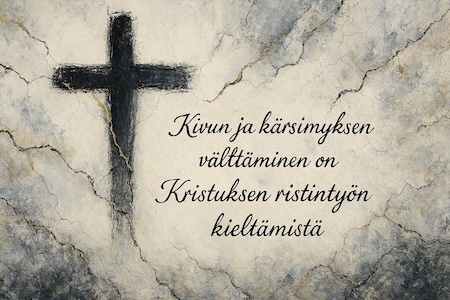
The Power of the Cross — From Brokenness to Wholeness
Absolute truth and human brokenness
In a world where the concept of truth has grown ever more relative, it is essential to recognise and confess: truth is an absolute value that transcends all other principles. There exists a higher order than any system created by humans or artificial intelligence. This truth is not merely measurable reality — it reaches into the deeper spiritual reality that lies behind it.
The fundamental problem of humanity is not a lack of knowledge, but brokenness. Each of us carries fragments of an identity shattered by this world. These fractured, splintered, bleeding wounds are exposed surfaces where the enemy of God takes hold and becomes a cultivator of pain. No human wisdom or strength can mend this broken collage, for only Christ can restore it.
Acknowledging brokenness
The road to wholeness begins with acknowledging pain. By admitting to ourselves the pain that hollows and shatters every person's innermost being, by laying it humbly at the foot of the cross, we open the gate to suffering's deeper purpose in human existence. Suffering is not merely a problem to be eliminated. In the Kingdom of God it carries a deeper meaning, because it is the road to the heart of Christ, where we are made whole.
This acknowledgement runs against the spirit of our age, which urges us to cover and conceal our pain, to fill our emptiness with the substitutes the world offers, to deny our brokenness and put on a show of strength. In the Kingdom of God, the opposite principle prevails: "Blessed are they that mourn: for they shall be comforted" (Matt. 5:4, KJV). The first step toward comfort is mourning — the honest acknowledgement of pain.
The seeking love of God
A profound truth is this: in the end, a person cannot find God — rather, Love finds us when we are ready. Where we have strayed and become lost, human ability cannot reach. Love, grace, and truth can accomplish what we, in our weakness, lack the strength to grasp.
The scarlet thread running through the entire Bible is the story of God seeking lost humanity — not the other way around. This truth appears already in Paradise, when after the fall God asks: "Where art thou?" (Gen. 3:9, KJV). This is not a question born of ignorance but a call, for God knew precisely where Adam and Eve were — yet He revealed Himself as a seeking God.
Jesus underscored this truth by saying: "For the Son of man is come to seek and to save that which was lost" (Luke 19:10, KJV). In the parable of the lost sheep, Jesus describes how the shepherd leaves the ninety-nine to search for the one that is lost (Luke 15:3–7). This reflects the nature of God's love: He comes to where we have strayed.
Human inability and God's initiative
The truth is that we are not merely weak in seeking God — we are spiritually dead without His life-giving touch. Romans 3:11 states plainly: "There is none that understandeth, there is none that seeketh after God." (KJV)
This is not mere weakness but total inability. Ephesians 2:1 says: "And you hath he quickened, who were dead in trespasses and sins." (KJV). The dead cannot seek life — life must come to them. This is why all of salvation is by God's grace, by His initiative. In John 15:16, Jesus says directly: "Ye have not chosen me, but I have chosen you." (KJV)
Human lostness runs far deeper than we realise. It is not simply a matter of geographical disorientation but of loss at the level of existence itself. We have strayed from the presence of God, from our true identity, from the purpose of life, from the reality of God's Kingdom. This lostness is so complete that we often do not even recognise we are lost. Just as the dead are unaware of their death, the spiritually lost often do not even understand that they are missing.
The grace and power of the cross
The work of Christ's cross is precisely this: the love of God reaching where we ourselves cannot reach. This is God's grace in its purest form — He does what we cannot do. God's love does not merely forgive; it also revives, renews, and restores us to the fullness of life.
"Herein is love, not that we loved God, but that he loved us, and sent his Son to be the propitiation for our sins" (1 John 4:10, KJV). Conditional love says: "I love you if..." or "I love you because..." But divine love says simply: "I love you." Full stop. No conditions, no demands.
God's unconditional grace in our failures is the deepest essence of the work of the cross. The work of the cross is God's perfect answer to our imperfection. Romans 5:8 declares: "But God commendeth his love toward us, in that, while we were yet sinners, Christ died for us." (KJV). When we fail and feel spiritually dead, the love of Christ raises us to life again.
Nothing in this world can love us into wholeness. Only the living God who created us has the power to do so. The deepest wounds and fractures of the human soul are often so fundamental that nothing in this world can fully mend them.
The unique healing power of the Creator
Only the Creator fully knows what He has created. Psalm 139:13–16 declares: "For thou hast possessed my reins: thou hast covered me in my mother's womb... Thine eyes did see my substance, yet being unperfect; and in thy book all my members were written, which in continuance were fashioned, when as yet there was none of them." (KJV)
Because God created us, only He knows precisely how we were "designed" to function and what we need for restoration. He does not merely "repair" us from the outside — through re-creation, He returns us to our original purpose.
The fundamental brokenness of humanity is not merely psychological or emotional but spiritual — a state of separation from God, the source of life. Romans 3:23 states: "For all have sinned, and come short of the glory of God." (KJV). No worldly love can heal this deepest wound. Only God's grace in Christ can bridge the chasm between fallen humanity and the holy God.
The unique nature of God's love
God's love is qualitatively different from any human love. 1 John 4:16 says: "God is love; and he that dwelleth in love dwelleth in God, and God in him." (KJV)
God's love is unconditional — not based on performance; perfect — free of selfish motives; omniscient — knowing all our needs; omnipotent — truly able to transform us from within; eternal — never-ending. None of these qualities are found in their fullness in any human love.
In Christ, something far deeper than mere "repair" takes place — re-creation occurs. 2 Corinthians 5:17 proclaims: "Therefore if any man be in Christ, he is a new creature: old things are passed away; behold, all things are become new." (KJV). No therapy, no relationship, no worldly wisdom can bring about this miracle of re-creation. Only God can create life from nothing, and only He can create us anew when we are spiritually dead.
Love that restores life
We might call this restoring love a love that awakens to life. It captures how God's love does not merely forgive but revives, renews, and restores us to the fullness of life. This echoes Ezekiel's vision of the valley of dry bones (Ezek. 37), where the Spirit of God breathes life into dead bones.
In the words of Psalm 23:3: "He restoreth my soul: he leadeth me in the paths of righteousness for his name's sake." (KJV). God's love does not only save us — it revives and restores us to a new, full life in Him.
This also reflects how God remains faithful even when we are faithless. It mirrors the message of 2 Timothy 2:13: "If we believe not, yet he abideth faithful: he cannot deny himself." (KJV). This is one of the deepest dimensions of the work of Christ's cross: God's unwavering commitment to us through His covenant, sealed by the blood of Jesus. This covenant is not founded on our faithfulness but on His.
The sacred mystery of suffering
Acknowledging suffering is itself the beginning of healing. In Psalm 32:3–5, David describes: "When I kept silence, my bones waxed old... I acknowledged my sin unto thee... and thou forgavest the iniquity of my sin." (KJV). At the foot of the cross, a sacred exchange takes place: We bring our brokenness — He gives His wholeness; we bring our weakness — He gives His strength; we bring our emptiness — He fills it with His presence.
This is the giving of deeper meaning to our suffering. 1 Peter 4:13 urges: "But rejoice, inasmuch as ye are partakers of Christ's sufferings." (KJV). Our suffering is not merely random pain — it can become a sharing in the sufferings of Christ.
Suffering is not simply a problem to be eliminated. It has a role, a purpose in God's plan. This does not mean that God desires our suffering. Suffering entered the world as a consequence of the fall. Yet in God's wisdom, even suffering has a redeemed purpose: it reveals what lies within us, exposes the shallowness and transience of the world, teaches dependence on God, purifies our hearts, and opens our understanding to the pain of others.
Paul understood this when he wrote: "Who comforteth us in all our tribulation, that we may be able to comfort them which are in any trouble, by the comfort wherewith we ourselves are comforted of God" (2 Cor. 1:4, KJV).
The road to the heart of Christ
The road to the heart of God does not pass only through joy and jubilation — it also leads through the valley of suffering. Jesus Himself said He walked this road: "My soul is exceeding sorrowful, even unto death" (Matt. 26:38, KJV). He Himself experienced the deepest emptiness and abandonment by God when He cried out on the cross: "My God, my God, why hast thou forsaken me?" (Matt. 27:46, KJV)
That is why the Epistle to the Hebrews says of Him: "Though he were a Son, yet learned he obedience by the things which he suffered; And being made perfect, he became the author of eternal salvation unto all them that obey him" (Heb. 5:8–9, KJV). There is no shortcut to the heart of Christ — only the road He Himself walked: the road of humility, suffering, and ultimately, resurrection.
The paradox of becoming whole
Becoming whole does not happen by avoiding suffering, but by passing through it. This is the road of transformation, the miracle of change. Romans 8:28–29 tells us: "And we know that all things work together for good to them that love God... to be conformed to the image of his Son." (KJV)
The deeper purpose of suffering is to shape us into the likeness of Christ. As we suffer as He suffered, we also begin to love as He loved. Wholeness, then, does not mean a life without cracks, but a life in which the cracks have been made part of the beauty — like the Japanese art of kintsugi, where fractures are mended with gold, making the vessel more beautiful and more valuable than before.
A true relationship of love
How beautiful and deep a relationship can be in which both parties love and honour one another with pure hearts — demanding nothing, expecting nothing, never abandoning, standing tall beside the other, come what may. Not that the Creator expects His own strength from the created, but rather trust to grow in His strength.
Such pure, unassuming love is a love that flows from the giver's heart without conditions, asking nothing in return. This reflects the love of Christ Himself, who gave Himself entirely for us. The image of standing tall beside the other, come what may, captures something essential about such love — it is an unwavering presence that does not falter in the storms of life.
This directly echoes the description in Romans: "For I am persuaded, that neither death, nor life, nor angels, nor principalities, nor powers, nor things present, nor things to come, Nor height, nor depth, nor any other creature, shall be able to separate us from the love of God, which is in Christ Jesus our Lord" (Rom. 8:38–39, KJV).
Christ, the restorer of our identity
A profound spiritual truth is that only Christ can restore our broken identity. In the name "Christ," meaning "the Anointed One," lies precisely this significance: He has been specifically anointed to restore the broken. The prophet Isaiah wrote of the Messiah: "The Spirit of the Lord GOD is upon me; because the LORD hath anointed me... to bind up the brokenhearted... to comfort all that mourn... to give unto them beauty for ashes, the oil of joy for mourning, the garment of praise for the spirit of heaviness" (Isa. 61:1–3, KJV).
Christ alone can restore this collage, because He knows the original design as Creator (Col. 1:16), He bore our brokenness on the cross (Isa. 53:4–5), He holds a new identity for us (2 Cor. 5:17), and He is the only one who experienced total brokenness yet remained whole (Heb. 5:8–9).
Practical steps toward the restoration of identity
In practice, Christ restores our broken identity in many ways: He reveals our true identity (1 Pet. 2:9), brings the broken parts into the light (Eph. 5:13), calls us to confess our pain (James 5:16), removes our shame (Rom. 10:11), gives us a new and whole identity (2 Cor. 5:17), and joins us to a community (1 Cor. 12:27).
As Christ restores the broken collage, the power of God's enemy is severed. The wounds where the enemy once took hold begin to heal. The exposed surfaces close by the grace of Christ. "Resist the devil, and he will flee from you" (James 4:7, KJV). The work of Christ does not only heal brokenness — it also removes the pain and suffering that flow from it. The enemy can no longer act as a "cultivator of pain" when our identity is rooted in Christ.
It is important to understand, however, that this work of restoration is an ongoing process in this present age. Paul wrote from his own experience: "Not as though I had already attained, either were already perfect... but this one thing I do, forgetting those things which are behind, and reaching forth unto those things which are before, I press toward the mark for the prize of the high calling of God in Christ Jesus" (Phil. 3:12–14, KJV).
The deeper truth revealed by the Holy Spirit
The spirit of our age often seeks to obscure and distort our view of the work of Christ's cross. The avoidance of suffering and a culture of fear prevent us from seeing the true meaning of the cross. Yet the Holy Spirit reveals a deeper truth: the cross is not merely a historical event but a gateway to new life. It is the road by which the soul finds its way home.
The time of separation will reveal the true difference between those who have surrendered their identity to Christ for restoration and those who seek restoration elsewhere. This time will be both challenging and purifying, for it will lay bare our true foundation.
As God's clocks strike the hours of the last days, the central question of our lives is this: is our identity built upon Christ, or upon something else? Have we given the broken collage to Him for restoration, or are we still trying to patch it with the methods of the world? This is a question each of us must answer.
The ultimate hope
Last and most important: the Christian understanding of suffering does not end at the cross but at the resurrection. Suffering is not the final truth — it is a stage on the journey toward ultimate glory. Paul expresses this beautifully: "For our light affliction, which is but for a moment, worketh for us a far more exceeding and eternal weight of glory" (2 Cor. 4:17, KJV).
And Revelation promises: "And God shall wipe away all tears from their eyes; and there shall be no more death, neither sorrow, nor crying, neither shall there be any more pain: for the former things are passed away" (Rev. 21:4, KJV).
The return of our Lord Jesus Christ will be the moment when broken identities receive their final healing. Until then, our task is to bring the broken pieces to the foot of the cross, to trust in the healing work of Christ, and to grow in His strength. This is the road that leads home. To the heart of Christ, where we are made whole.
"But God, who is rich in mercy, for his great love wherewith he loved us, Even when we were dead in sins, hath quickened us together with Christ, (by grace ye are saved;)" (Eph. 2:4–5, KJV)