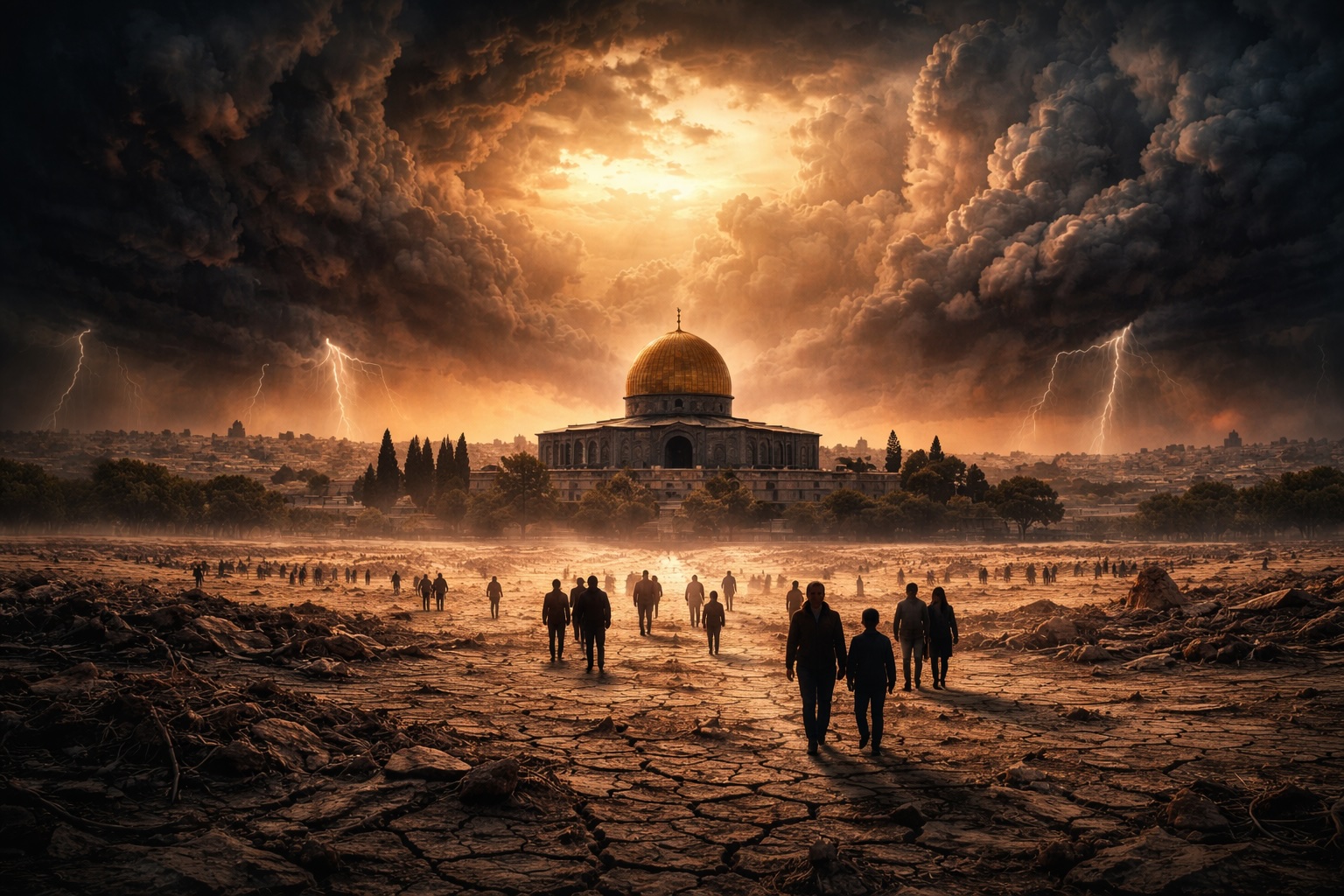
When the Heavens Close: What Has Happened Since August 2025
On August 5, 2025, we published the text When the Heavens Close: Third Temple Preparations and the Coming Drought and Famine.. The text described the progress of the Temple Mount preparations, their spiritual significance, and the coming drought that would follow the commencement of sacrificial activity. It was a prophetic call to repentance.
This text is not prophecy. It is a review of what has happened since August 2025. Every piece of data is based on public, verifiable sources: Finnish Meteorological Institute measurements, United States Department of Agriculture reports, Copernicus Climate Change Service data, Israel Water Authority figures, official EU documents, and analyses from international research institutions.
Data does not lie. It paints a picture that anyone can verify for themselves.
I. The Temple Mount and the Heavens: Two Timelines Accelerating in Tandem
Our original text described the connection between the Temple Mount preparations and weather phenomena. Seven months have passed since then. Here is everything that has happened, month by month, on two parallel timelines.
July 2025
On the Temple Mount: A red heifer was physically burned for the first time in the Samarian mountains on July 1. The ceremony was performed by a kohen and organised by Texas-based Byron Stinson of Boneh Israel. Temple Institute classified the event as "a groundbreaking exercise," although the animal had been disqualified for ritual use and the location was wrong. This was the first physical burning of heifers in connection with these preparations¹.
In the heavens: Finland experienced a record-breaking 20 consecutive days of temperatures above 30°C — a phenomenon never before recorded. The European Centre for Medium-Range Weather Forecasts revealed a broader European heatwave: Portugal and Spain registered readings of 40–45°C. Meteorologists described the situation as exceptional and were unable to explain the full scale of the phenomenon².
August 2025
On the Temple Mount: National Security Minister Itamar Ben-Gvir led the first open Jewish prayer service (minyan) on the Temple Mount on Tisha B'Av, August 3. It was the first time a government minister openly led a worship gathering at the holy site. A record 3,527 Jews visited the Mount that day — 32 per cent more than the previous record. Visitors sang, danced, and waved Israeli flags without police intervention. Allies called the event "a monumental shift not seen in a thousand years." Days later, on August 5–6, Temple Institute officially confirmed the disqualification of all five Texas heifers³.
In the heavens: Al Jazeera reported on August 19 that Iraq had experienced its driest year since measurements began in 1933. The country's water reserves had dropped from 60 billion cubic metres to roughly 10 billion — an 83 per cent collapse. Lebanon's Qaraoun reservoir recorded its worst drought since the dam was built in 1959: inflows had fallen 87 per cent, from 350 million cubic metres to 45 million⁴.
September 2025
On the Temple Mount: The Sea of Galilee — the biblical Kinneret — fell below the lower red line for the first time since 2018. Over the course of the Hebrew year, a total of 76,448 Jews ascended the Temple Mount, a 31 per cent increase from the previous year and more than sevenfold growth since 2015, when the number was 10,700⁵.
In the heavens: The Sea of Galilee's annual surface drop exceeded 2.5 metres, compared to a historical drought average of 0.9–1.2 metres. The lake was only 1.65 metres above the "black line" — the threshold below which irreversible ecological destruction begins. Israel activated the first-ever reverse national water pipeline: desalinated Mediterranean water was pumped into the freshwater lake at approximately 1,000 cubic metres per hour. Nothing like this has ever been done anywhere in the world⁶.
November 2025
On the Temple Mount: Temple Institute and the re-established Sanhedrin issued coordinated statements definitively classifying the July burning as an exercise and declaring the burned animal ritually unfit. The Sanhedrin officially stated: "We fully trust the attached statement by the Temple Institute." Meanwhile, Jerusalem District Deputy Police Commander Arzani was replaced after opposing Ben-Gvir's Temple Mount directive. His successor was described as a Ben-Gvir ally⁷.
In the heavens: A World Weather Attribution study confirmed the Tigris-Euphrates region's 2020–2025 drought as the worst ever recorded. Climate change had made the drought more than ten times more likely and shifted its classification from "normal" to "exceptional." That same month, the first polar vortex disruption was triggered by a Madden-Julian Oscillation event. From this moment onward, weather in the Northern Hemisphere turned⁸.
December 2025
On the Temple Mount: Finance Minister Smotrich announced the approval of 19 new settlements, stating the aim was to "prevent the establishment of a Palestinian state." The total number of housing units approved during the government's term rose to 51,370. The Knesset voted 49–35 to advance the controversial "Implementation of Jewish Identity in the Public Space" bill. The Sea of Galilee ended the year at 4.585 metres below its maximum, 38.5 centimetres below the lower red line and only 1.50 metres above the black line⁹.
In the heavens: The polar vortex split. Snow cover across the western United States dropped on December 7 to 90,646 square miles — the lowest ever recorded for that date in the satellite era. Within a single month, Europe experienced a temperature swing of more than 3.5°C: from record December warmth to the coldest January in 16 years. Snow water equivalent in the upper Colorado River basin fell to 36 per cent of the median — the lowest since 1986¹⁰.
January 2026
On the Temple Mount: On January 5–6, Prime Minister Netanyahu said aloud for the first time what he had never said before: "The changes Ben-Gvir is making do not change the status quo, and they are coordinated with me. I decide the policy." This was the first time an Israeli Prime Minister openly backed Temple Mount prayer changes rather than distancing himself from them. 62 coalition members of Knesset signed a letter in Ben-Gvir's defence. On January 21, police allowed Jews to bring printed prayer sheets onto the Temple Mount for the first time, including the Amidah prayer. A Beyadenu representative stated: "This is something they used to check to make sure you weren't carrying."¹¹
In the heavens: Europe experienced its coldest January in 16 years. In Finland, January was 3–10 degrees colder than normal, with precipitation at only a quarter of the average. Several measurement stations recorded their driest January ever. At Enontekiö airport, temperatures plunged to −44.3°C — the coldest reading in Finland in the entire 21st century. In the United States, January was the 11th driest in 132 years of recorded history. The cold wave killed at least 22 people and caused over 4 billion dollars in damage. More than 43 million Americans were under extreme cold warnings. Snow cover in the Alps was half the normal level. In the Adige river basin in Italy, the snow water equivalent deficit was 67 per cent¹².
February 2026
On the Temple Mount: The ancient pilgrimage route from the Pool of Siloam to the Temple Mount was opened to the public, with plans to expand infrastructure to accommodate larger numbers of visitors. Heritage Minister Amihai Eliyahu was photographed visiting the red heifers in Shiloh, confirming ongoing government-level interest. The breeding programme to maintain "99 per cent pure" Red Angus genetics in the heifers continued¹³.
In the heavens: A second polar vortex disruption began around February 6. In Vihti, temperatures dropped to −32.8°C on Valentine's Day — a record for southern Finland. In Lappeenranta, −32.6°C. A meteorologist's description: "The fierce frost is made possible by dry, windless conditions." Dry. No rain. No snow. The ski holiday season began without skiing conditions. The meteorological forecast going forward: "Snowfall will remain minimal." February continued January's pattern without interruption¹⁴.
II. What the Original Text Said, and Where We Are Now
Our original text in August 2025 described a chain of events that would begin with sacrificial activity on the Temple Mount and lead to drought, famine, and global control. The text included specific descriptions of what the first year would look like.
The text said: "The first year, through to the end of 2026, will still appear tolerable, and Europe along with the rest of the world will be in a state of denial, refusing to acknowledge the severity of the situation."
Where we are: The USDA's February 2026 report shows global wheat production reached an all-time record in 2025. Global grain reserves are at record levels — 925.5 million tonnes. Brazil's soybean production broke records. There is food¹⁵. At the same time, water is vanishing everywhere. Iraq has banned agriculture entirely. In Syria, 16.3 million people face food insecurity. Rains have failed across the Horn of Africa. Seawater is being pumped into the Sea of Galilee. Finland's January was the driest ever recorded. The snow deficit in the United States is the worst in the satellite era.
Tolerable. On the surface — exactly as the August text described.
The text said: "Climate scientists will search for explanations... They will speak of climate change, La Niña, shifting air currents."
Where we are: Meteorologists explain Finland's winter with a blocking high-pressure system and polar vortex disruption. Iraq's drought with climate change. America's snow deficit with La Niña. The Alpine situation with a warm December. Each explanation is mechanistically true. None of them explains why all of it is happening simultaneously, everywhere — and why every escalation on the Temple Mount coincides with a deepening of the global weather pattern.
The text said: "First imperceptibly, then at an accelerating pace."
Where we are: Families head off on ski holidays and wonder why the trails are icy and the snow thin. Children ask why it is not snowing. Adults answer: "Just how winter is this year." No one connects January's record drought to the historic decline of the Sea of Galilee. No one connects America's snow deficit to Iraq's driest year. Each of these is a separate news story, a separate weather event, a separate "exceptional" occurrence. Imperceptibly.
Three months until May 2026. The original timeline holds. Unfortunately.
III. Infrastructure Waiting for a Crisis
Alongside weather phenomena and Temple Mount preparations, a third trajectory advances quietly, moving in the same direction. The world's major powers are building control capacity that will activate at the moment of crisis.
The United States: Capacity to Govern Without Resilience
Over the past two years, the United States federal government has built an unprecedented combination: domestic control capacity while simultaneously dismantling citizens' own capacity to survive¹⁶.
Built: The FedNow instant payment system serves over 1,500 financial institutions across all 50 states, with transaction volumes growing 1,200 per cent annually. The GENIUS Act requires stablecoin issuers to maintain the technical capability to freeze, seize, or destroy tokens by government order. National Guard civil disturbance rapid-response forces of 23,000 troops are deployable within 8–24 hours across all 50 states. Biometric surveillance is expanding: facial recognition, a database of 60 billion images, data retention for 75 years. Over 40,000 American troops are stationed in the Persian Gulf — the largest concentration since the Iraq War¹⁷.
Dismantled: There is no strategic grain reserve, nor has one been proposed. FEMA has lost a third of its staff. Climate science has been destroyed more systematically than in any industrialised nation in history: the EPA lost 23 per cent of its workforce, roughly 880 were terminated from NOAA, all national climate assessment researchers were dismissed, and climate data was removed from federal servers. The rescission of the greenhouse gas endangerment finding in February 2026 eliminated the legal basis for all climate regulation. WaterSMART programme funding was zeroed out. The United States withdrew from the UNFCCC, the IPCC, and 64 other international organisations — the only country on the planet outside the climate framework convention¹⁸.
A state that builds the capacity to govern while dismantling the self-sufficiency of its citizens is not preparing to protect them. It is preparing to control them under conditions in which they have no alternatives. Coincidence? Hardly.
The European Union: Control Infrastructure, Labelled as Crisis Management
Between 2023 and 2026, the EU has enacted over 80 significant regulations and institutional reforms that together form a comprehensive control apparatus¹⁹.
Digital identity: The eIDAS 2.0 wallet has been in force since May 2024, with member states required to offer it by the end of 2026. The wallet stores identity documents, driving licences, academic credentials, health records, and banking details. 500 cybersecurity experts warned that Article 45 "radically expands governments' ability to surveil their citizens."
Financial surveillance: The AMLA anti-money laundering authority began operations in Frankfurt in July 2025, with direct supervisory power and access to IT systems and algorithms. SEPA instant payments are mandatory, with settlement in 10 seconds. An EU-wide cash payment ceiling of 10,000 euros takes effect in 2027. The digital euro is advancing through legislation, with a possible pilot in 2027²⁰.
Border control and biometrics: The Entry/Exit System collects fingerprints and facial images from all non-EU nationals. The Eurodac reform lowered the age for fingerprint collection to six years. All systems will be linked to a common search portal and biometric identification service by 2028²¹.
Water control: The EU Water Resilience Strategy requires digital registration of all water usage. Smart meters report in real time to a centralised system. The Drinking Water Directive requires all water data to be submitted to the European Environment Agency²².
A common food reserve? The EU does not have one. None has been created, proposed, or planned.
Finland: Europe's Most Prepared — and Europe's Most Governable
Finland has prepared in a way no other Western democracy has matched²³. The National Emergency Supply Agency maintains nine months of grain reserves, five months of fuel reserves, and twelve months of medical supplies. The civil defence shelter network comprises 50,500 shelters with capacity for 4.8 million people. The comprehensive security model integrates the military, civilian administration, the private sector, and citizens into a single system. Defence capability rests on nearly one million reservists and the largest artillery force in Western Europe. 95 per cent of electricity production is fossil-free.
At the same time, Finland is Europe's most cashless society — only 27 per cent of point-of-sale transactions occur in cash — while being almost entirely dependent on foreign payment systems. Finland adopted the shortest MiCA transition period in the entire EU. During the pandemic, the country moved from normality to a state of emergency in four days²⁴.
Infrastructure is neutral. It serves whatever purpose it is directed toward. Nine months of grain reserves can protect a nation, or they can function as a distribution system through which access to food is controlled. 4.8 million shelter places can save lives, or they can serve as assembly centres from which no one leaves. A comprehensive security model can unite a people, or it can be a framework within which there is no room for dissent.
It depends on who holds the keys. Europe's most prepared nation is simultaneously Europe's most governable.
IV. Final Words
What is there to say in closing, other than what was already said in the text of August 5, 2025. For all its darkness, the original text was simply a call to repentance. The events of November and December in Finland and abroad point in a different direction — and that should concern everyone.
May 21, 2026, draws near, and only God alone knows what will happen then — or whether anything will happen at all. We do not know, nor do we even claim to know. We write only what has been given to us to write, and it is not always comfortable. Neither do we claim to be anything or anyone, and this text carries no agenda. It simply is, and each person may do with this information as they see fit.
What we do hope is that you would join us in prayer for Finland's leaders, its people, and the entire nation. Finland has had — and still has — every prerequisite to endure, but it would require a miracle: the turning of our leaders' hearts toward the Lord.
We pray that the Lord would bless our leaders and our people, that He would turn His face toward all of us and bless our entire nation in the highest and best way. We pray that the Lord would open our eyes and our hearts to see and to know the truth, in Jesus Christ. Amen.
Sources
-
Temple Institute official statements, July–August 2025; Al Jazeera investigation; Charisma Magazine verified reporting.
-
European Centre for Medium-Range Weather Forecasts (ECMWF), July 2025; Finnish Meteorological Institute summer 2025 review.
-
Times of Israel, August 3, 2025; Temple Institute formal statement, August 5–6, 2025; Haaretz analysis.
-
Al Jazeera, August 19, 2025; FEWS NET Iraq Targeted Analysis, October 2025; Lebanon Ministry of Energy and Water.
-
Israel Water Authority; Beyadenu visitor statistics, Hebrew year 5785.
-
Jerusalem Post, February 2, 2026; Ynetnews; Israel Water Authority reports.
-
Temple Institute and Sanhedrin coordinated statements, November 2025; Religion News Service; Israel Police personnel records.
-
World Weather Attribution study, November 21, 2025; NOAA CPC polar vortex analysis; AER Polar Vortex Blog (Dr. Judah Cohen).
-
Times of Israel; Peace Now settlement tracking; Israel Water Authority, Kinneret annual report.
-
Copernicus Climate Change Service, December 2025 bulletin; NOAA NCEI; California DWR; Drought.gov Snow Drought Update.
-
Times of Israel, January 5–6, 2026; Jerusalem Post; Beyadenu spokesman statement, January 21, 2026.
-
Copernicus C3S Monthly Climate Bulletin, January 2026; Finnish Meteorological Institute Ilmastokatsaus, January 2026; NOAA NCEI National Climate Report; CIMA Research Foundation; European Drought Observatory (JRC).
-
Temple Institute breeding programme updates; Heritage Minister Eliyahu visit documentation, February 2026; Pilgrimage Road opening reports.
-
Foreca meteorological summary, February 14, 2026; Finnish Meteorological Institute station data; Severe Weather Europe polar vortex analysis.
-
USDA WASDE #668, February 10, 2026; FAO Cereal Supply and Demand Brief, February 2026.
-
White House Executive Order archive 2025–2026; Federal Register; Congress.gov.
-
FedNow Service statistics, Federal Reserve; GENIUS Act (P.L. 119-XX); National Guard civil disturbance memoranda, October 2025; DHS biometric collection rules; US Department of Defense deployment records.
-
FEMA staffing reports; EPA workforce reduction records; NOAA termination documentation; USGCRP website shutdown; EPA Endangerment Finding rescission, February 12, 2026; Bureau of Reclamation WaterSMART records; Presidential memorandum on international organization withdrawal, January 7, 2026.
-
European Commission legislative database; EUR-Lex; compilation based on 80+ enacted instruments 2023–2026.
-
Regulation (EU) 2024/1183 (eIDAS 2.0); AMLA Regulation; SEPA Instant Payments Regulation; ECB Digital Euro preparation phase; Council negotiating position, December 2025.
-
Entry/Exit System launch, October 12, 2025; Eurodac Regulation (adopted May 2024); Interoperability Roadmap 2027–2028.
-
European Commission (2025), European Water Resilience Strategy, COM(2025) 280 final; Drinking Water Directive implementation.
-
National Emergency Supply Agency (NESA) annual reports; Government Decision on Security of Supply Objectives 568/2024; Finnish civil defense shelter assessment, October 2024; Finnish Defence Forces statistics.
-
Bank of Finland payment statistics; ECB SPACE Survey 2024; Valtioneuvosto (2020), Valtioneuvoston asetus valmiuslain käyttöönotosta, Finlex 16.3.2020.