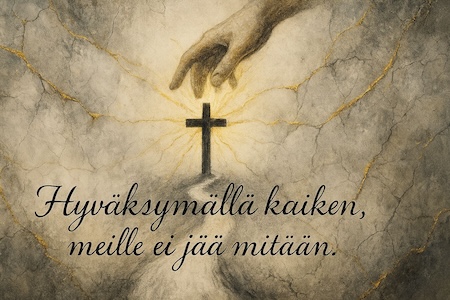
The Rock of Truth Amid the Currents of Apostasy
We live in an era where the boundaries between truth and falsehood are blurring in profound ways. The very core of the Christian faith — Jesus Christ as the only way to God — is being called into question both in society and, most alarmingly, within the walls of the churches themselves. Understanding this development is vital for every Christian who desires to remain faithful as the separation of the last days intensifies.
The Gradual Advance of Apostasy
Apostasy advances through our society like a slowly accelerating current. It begins as a barely noticeable trickle, but eventually swells into a flood that sweeps entire institutions along with it. How does this process unfold? The apostle Paul warned of this very development nearly 2,000 years ago: "For the time will come when they will not endure sound doctrine; but after their own lusts shall they heap to themselves teachers, having itching ears; And they shall turn away their ears from the truth, and shall be turned unto fables" (2 Tim. 4:3–4, KJV).
The first step in apostasy is the blurring of truth's boundaries. In today's society, this manifests in claims that "all religions ultimately teach the same thing" or that "there are many paths up the same mountain." Such statements sound tolerant and loving, but they stand in fundamental contradiction to the teaching of Jesus himself: "I am the way, the truth, and the life: no man cometh unto the Father, but by me" (John 14:6, KJV).
Once the boundaries of truth have been blurred, the natural next step is to question the uniqueness of Christ. We hear with growing frequency how Jesus is described as "merely one of many spiritual teachers" or "a good moral example." This seemingly innocent redefinition strips Christ of his divine status and the significance of his atoning work. The apostle Peter, by contrast, declared boldly: "Neither is there salvation in any other: for there is none other name under heaven given among men, whereby we must be saved" (Acts 4:12, KJV).
In the third stage, sin is redefined. It is no longer rebellion against a holy God but at most "a lack of awareness" or "an obstacle to personal growth." In such thinking, there is no room for the need for repentance or atonement. In our society, this manifests as the triumph of moral relativism, where everyone defines their own truth. Yet Scripture reminds us: "For all have sinned, and come short of the glory of God" (Rom. 3:23, KJV).
In the fourth stage, the authority of the Bible is challenged. The Word of God is no longer regarded as the ultimate source of truth but rather as a culturally bound collection of texts requiring "modern interpretation." In many churches, this has led to the abandonment of Scripture's clear teachings in the name of societal acceptance. Yet Jesus affirmed: "Heaven and earth shall pass away, but my words shall not pass away" (Matt. 24:35, KJV).
In the fifth stage of apostasy, universalism rises as the dominant doctrine. The idea that everyone will be saved regardless of their faith in Christ gains a foothold. This corrupts the very heart of the gospel and renders the crucifixion of Christ unnecessary. It offers false comfort that has no basis in Scripture. Jesus himself warned: "Enter ye in at the strait gate: for wide is the gate, and broad is the way, that leadeth to destruction, and many there be which go in thereat" (Matt. 7:13, KJV).
As apostasy advances to its sixth stage, Christianity is openly blended with neo-spirituality. Christian concepts such as prayer, salvation, and the Holy Spirit are replaced by meditation, self-actualisation, and "universal energies." In such syncretism, the uniqueness of Christianity vanishes entirely. The apostle Paul warned: "Be ye not unequally yoked together with unbelievers: for what fellowship hath righteousness with unrighteousness? and what communion hath light with darkness?" (2 Cor. 6:14, KJV).
In the final stage, a thorough apostasy occurs in which the divinity, atoning work, and resurrection of Christ are openly denied. This fulfils the prophecy of Jesus: "And because iniquity shall abound, the love of many shall wax cold" (Matt. 24:12, KJV). In our society, this is already visible in the marginalisation of Christian values and even the open mockery, persecution, and criminalisation of the Christian faith.
The Consequences of Apostasy in the Church and Society
This process of apostasy is not merely a theoretical trajectory — it is a reality unfolding all around us. In many churches and congregations across the world, doctrinal compromises have led to a watered-down gospel. The message of salvation has been replaced by a social gospel, self-actualisation, or even prosperity theology. Critical doctrines such as the reality of sin, the existence of hell, and the necessity of blood atonement are sidelined or reinterpreted into meaninglessness.
The ecumenical movement, which originally sought to build unity among Christians, has in many cases devolved into the pursuit of a false unity in which truth is sacrificed in the name of peace and fellowship. The prophetic voice has gone silent in the churches — they no longer speak out against sin but conform to the acceptance of moral decay. The warning Jesus gave to the church of Laodicea describes many of today's congregations with striking accuracy: "Because thou sayest, I am rich, and increased with goods, and have need of nothing; and knowest not that thou art wretched, and miserable, and poor, and blind, and naked" (Rev. 3:17, KJV).
At the societal level, this apostasy is visible in the systematic removal of Christian values from public life. Christian symbols and traditions are being erased, the expression of Christian convictions is being restricted, and Christian institutions are pressured to conform to worldly standards. Christians are increasingly branded as intolerant or even dangerous if they hold firm to biblical teaching on matters such as marriage, the family, or morality.
Satan's Strategy: Rejecting Jesus Means Choosing Satan
Behind this apostasy lies a sophisticated strategy of Satan. People are not enticed to openly worship evil — instead, they are encouraged to reject Jesus in the name of "love," "tolerance," or "enlightenment." Scripture, however, reveals that in spiritual reality there is no neutral ground. Jesus himself said: "He that is not with me is against me; and he that gathereth not with me scattereth abroad" (Matt. 12:30, KJV).
When you reject Jesus, you simultaneously place yourself under the authority of "the prince of this world" (John 12:31, KJV). Paul writes: "But if our gospel be hid, it is hid to them that are lost: In whom the god of this world hath blinded the minds of them which believe not, lest the light of the glorious gospel of Christ, who is the image of God, should shine unto them" (2 Cor. 4:3–4, KJV).
Worship does not require formal rituals or conscious intent. At its core, it is a matter of who receives our heart, our time, our resources, and our allegiance. When we refuse to acknowledge Jesus as Lord, we give our allegiance elsewhere. This is a stark truth that is often concealed from today's seekers: when you reject Jesus, you choose Satan — whether consciously or unknowingly.
Many so-called "alternative forms of spirituality" are in reality gateways to satanic influence. Neo-spirituality, meditation without Christ, energy healing, expanding consciousness through psychedelics, and countless other modern practices serve Satan's purposes — regardless of their practitioners' good intentions — by leading people further from Christ. As Paul declared: "The things which the Gentiles sacrifice, they sacrifice to devils, and not to God" (1 Cor. 10:20, KJV).
The True Church of Christ in the Last Days
As apostasy spreads, the true church of Christ will never fully disappear. Jesus himself promised: "I will build my church; and the gates of hell shall not prevail against it" (Matt. 16:18, KJV). But where is this church to be found in an age when many institutional churches have abandoned the truth?
First, God has preserved faithful remnants even within apostate denominations — individuals and small groups who hold fast to the truth amid compromise. Just as God answered Elijah, who thought himself the only faithful one remaining: "Yet I have left me seven thousand in Israel, all the knees which have not bowed unto Baal" (1 Kings 19:18, KJV).
Second, a growing number of believers are gathering in homes, small groups, and house churches, apart from institutional structures. This reflects the pattern of the early church, where believers met "from house to house" (Acts 2:46, KJV) and entire households came to faith (Acts 16:31). Families have become key fortresses of faith as public institutions abandon the truth. This fulfils the prophecy of Malachi: "And he shall turn the heart of the fathers to the children, and the heart of the children to their fathers" (Mal. 4:6, KJV).
In many countries, growing persecution has driven the true church underground. This is not a new phenomenon in the history of Christianity, but a recurring pattern in which persecution ultimately purifies and strengthens the church. Jesus warned: "If they have persecuted me, they will also persecute you" (John 15:20, KJV), but he also gave comfort: "In the world ye shall have tribulation: but be of good cheer; I have overcome the world" (John 16:33, KJV).
The Rise of the Antichrist System
One of the most dangerous and least understood truths for today's Christians is that we are undeniably moving toward a system that will ultimately force every person to choose between Christ and the Antichrist. This system is described in the Book of Revelation: "And that no man might buy or sell, save he that had the mark, or the name of the beast, or the number of his name" (Rev. 13:17, KJV).
There are hidden facts that the mainstream is silent about. Technological development has already created the infrastructure that makes such total control possible. Digital identifiers, biometric systems, central bank digital currencies, and social credit system trials are together laying the foundation upon which all economic and social activity can be monitored and restricted. These systems are presented to the public as beneficial advances in the name of efficiency, security, and convenience, yet they enable an unprecedented level of control.
At the same time, we see social coercion intensifying. Living according to Christian values leads with increasing frequency to discrimination, censorship, and the loss of rights. Christian teachers, police officers, doctors, members of parliament, lawyers, and other professionals face mounting pressure to either conform to the prevailing ideology or lose their livelihood. This development echoes the warning of Jesus: "And ye shall be hated of all men for my name's sake" (Matt. 10:22, KJV).
A global system of unification is also developing rapidly. The sovereignty of nation-states is weakening as international organisations, global financial institutions, and multinational corporations seize ever more power. This creates the foundation for the worldwide governance of the Antichrist, of which Revelation speaks: "And power was given him over all kindreds, and tongues, and nations" (Rev. 13:7, KJV).
Economic dependence on the system deepens continuously. The use of cash is declining, the ownership of assets is concentrating, and it is becoming harder for ordinary people to sustain an independent livelihood. This development makes people increasingly dependent on the system for survival, creating the conditions described in Revelation where one "cannot buy or sell" without the mark of the beast.
The Distortion of the Gospel: Satan's Masterwork
Perhaps the most alarming and dangerous trend is how the worship of Jesus Christ is gradually and imperceptibly being transformed into the worship of Satan. This is Satan's masterwork — not a direct assault on Christianity, but its subtle distortion.
We already see how Christ is being redefined. With growing frequency, Jesus is presented merely as a teacher, a social reformer, or one of many spiritual masters — not as God in the flesh who died for sinners. This recalls the warning of Paul: "But I fear, lest by any means, as the serpent beguiled Eve through his subtilty, so your minds should be corrupted from the simplicity that is in Christ" (2 Cor. 11:3, KJV).
Syncretism — the blending of diverse religious elements — is becoming ever more common. Christ is placed alongside other religious figures, and Christian practices are mixed with elements from other religious traditions. In such a blend, the uniqueness of Christ vanishes, and the way to the worship of the beast is laid open.
The gospel is gradually being replaced by a different message. Instead of speaking of the cross and salvation, the focus shifts to worldly matters — human-centred and materialistic goals. Social justice, environmental protection, or personal success are elevated to the heart of the gospel in place of the atoning work of Christ. The apostle Paul warned of just such a development: "But though we, or an angel from heaven, preach any other gospel unto you than that which we have preached unto you, let him be accursed" (Gal. 1:9, KJV).
Christians are also offered "deeper" spirituality that in reality leads them into occult practices. Christian-seeming meditations, distorted forms of spiritual warfare, and "prophetic" activity that draws more from astrology or clairvoyance than from the Word of God have infiltrated many congregations. These practices serve as gateways to demonic influence that ultimately leads to the worship of Satan.
We are approaching a time when the public confession and worship of the true Jesus will be regarded as "hate speech," "intolerance," or even a "threat to society." When this happens, Christians will be offered an "acceptable" version of Christianity that is, in reality, the worship of Satan through the rejection of truth. This fulfils the words of Jesus: "The time cometh, that whosoever killeth you will think that he doeth God service" (John 16:2, KJV).
The Faithful Followers of Christ Amid Trials
What should faithful Christians do in this situation? First, we must hold fast to the pure gospel. Jude exhorts: "Earnestly contend for the faith which was once delivered unto the saints" (Jude 1:3, KJV). This means defending the authority of Scripture, the divinity of Christ, his atoning work, and his resurrection without compromise.
We must also strengthen our families. Families are the last fortresses of the faith, and the Word of God must be taught within them: "And these words, which I command thee this day, shall be in thine heart: And thou shalt teach them diligently unto thy children, and shalt talk of them when thou sittest in thine house, and when thou walkest by the way, and when thou liest down, and when thou risest up" (Deut. 6:6–7, KJV). As society and many churches abandon the truth, families become ever more critical in passing the faith on to the next generation.
We must also seek genuine fellowship with other true believers. "Not forsaking the assembling of ourselves together, as the manner of some is; but exhorting one another" (Heb. 10:25, KJV). This does not necessarily mean institutional churches, but fellowship with those who love the truth. Such connections may form in house churches, small groups, or informal communities.
We must also prepare for persecution. "Yea, and all that will live godly in Christ Jesus shall suffer persecution" (2 Tim. 3:12, KJV). This is not pessimism but the realistic view of Scripture. Preparation means developing spiritual and mental resilience — not surrendering to fear or hatred.
Finally, we must proclaim the truth boldly. "Preach the word; be instant in season, out of season; reprove, rebuke, exhort with all longsuffering and doctrine" (2 Tim. 4:2, KJV). The time for subtle witness may be drawing to a close, and we must speak the truth in love — but clearly and without compromise.
A Vision of Hope: The Return of Christ
Though the situation appears dark, we have an unshakeable hope in Christ. Apostasy and the rise of the Antichrist system are, in fact, signs that the return of Christ draws near.
It is toward this hope that we must fix our gaze. "And when these things begin to come to pass, then look up, and lift up your heads; for your redemption draweth nigh" (Luke 21:28, KJV). In the midst of trials, we must not forget that Christ has already conquered: "In the world ye shall have tribulation: but be of good cheer; I have overcome the world" (John 16:33, KJV).
We should remember that the church has endured persecution before and has even grown stronger through it. History shows that while apostasy reduces the number of believers, it also purifies the church. The first congregation in Jerusalem suffered severe persecution, yet "they that were scattered abroad went every where preaching the word" (Acts 8:4, KJV).
We live in an era where falsehood and truth, light and darkness, Christ and Antichrist contend for souls before the final time of separation. We cannot remain neutral in this battle. As Joshua challenged the Israelites: "Choose you this day whom ye will serve" (Josh. 24:15, KJV).
The true church of Christ consists of those who refuse to bow to the spirit of the age, who hold fast to the Word of God without compromise, and who confess Jesus Christ as the only way to God. This church may be small in number, it may be scattered, it may be persecuted — but it is the true bride of Christ, awaiting the return of her Bridegroom.
By letting go of the ecumenical lie that seeks to blend all spirituality into one vague whole, we affirm the truth that Jesus Christ is the only way, the truth, and the life. By rejecting Satan's sophisticated strategy that seeks to distort the gospel beyond recognition, we hold fast to the pure message: "For God so loved the world, that he gave his only begotten Son, that whosoever believeth in him should not perish, but have everlasting life" (John 3:16, KJV).
Today we are called to make a choice: Christ or Satan, truth or falsehood, light or darkness. There is no neutral ground, no compromise, no middle way. When you reject Jesus, you always — automatically — choose Satan. This is a stark truth that many do not wish to hear, yet upon it hangs the eternal destiny of souls.
Let us therefore hold fast to the truth in love, awaiting the return of our Lord Jesus Christ, ready to meet him with pure hearts and unwavering faith.