Finland's New Education Crisis: An Inclusion Law Without Resources
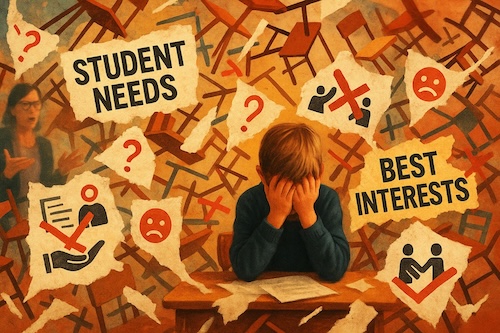
The reform of the Basic Education Act — the so-called inclusion law — set to take effect in August 2025 is raising widespread alarm across the education sector. The consultation round revealed a remarkably unanimous view: while over 90% of respondents considered the direction of the reform correct in principle, nearly all criticised its inadequate funding, insufficient staffing resources, and absent implementation plans.
Noble Goals, Harsh Reality
The inclusion law aims to guarantee every pupil the support they need in their own local school. In the ideal model, no pupil would have to transfer to a special-needs class or school — they would receive the support they need within a regular classroom. According to the Trade Union of Education in Finland (OAJ), this would amount to "genuine inclusion" if implemented with adequate resources.
Yet OAJ warned already during the consultation phase that without binding funding and smaller class sizes, the law would "collapse in the field." The Association of Finnish Municipalities demanded €100 million in additional annual funding and clear qualification requirements for school assistants.
The Finnish Education Evaluation Centre (Karvi) called for a national monitoring system, since the effects of the previous three-tier support model introduced in 2010 were never properly measured. The Parliamentary Ombudsman noted that educational support is a fundamental right and warned that resource shortfalls could lead to violations of equality.
Field Concerns Dismissed — Only Minor Adjustments Made
The Parliamentary Education and Culture Committee made three small additions to the law:
- €60 million in transitional funding over three years (no permanent funding base)
- A requirement for municipality-level inclusion plans
- National monitoring and annual reporting
However, the law did not incorporate the improvements strongly advocated in the consultations:
- A statutory cap on class sizes
- Clear reinforcement of the role of special-needs classes and small groups
- Permanent, pupil-count-based funding
- Qualification legislation for school assistants
The Scale of the Problem Revealed by Support Needs
Scope of learning support in 2023:
| Category | Pupils | % of 561,000 comprehensive school pupils |
|---|---|---|
| Intensified support | 84,300 | 15.0% |
| Special support | 59,100 | 10.5% |
| Total receiving support | 143,400 | 25.5% (≈ 1 in 4 pupils) |
| Hospital and institutional school | approx. 1,100 | 0.2% |
One in four comprehensive school pupils already officially receives intensified or special support — a group whose needs are at risk if resources fall short.
Currently in Finland:
- Approximately 8–9% of pupils (around 50,000) receive special support (the most intensive form)
- Approximately 5–6% of pupils study in small groups and special-needs classes
In practice, under the new law it is precisely the pupils currently studying in small groups and special-needs classes whose support risks being significantly weakened, since the role of special-needs classes and small groups was not reinforced in the legislation but instead defined as a "last-resort exception."
Transitional Funding — How Much Is Enough?
What does "transitional funding of €60M over 3 years" mean in practice?
- Additional state funding: €60M → €20M/year (2025–2027)
- 308 municipalities in 2025 → an average of €65,000/municipality/year (in reality distributed by pupil count)
- Per pupil: €20M ÷ 561,000 pupils ≈ €36/year
Scale comparison:
| Item | Scale |
|------|-------|
| Renovation of the presidential summer residence (estimate) | €52M one-off cost |
| Inclusion transition state funding per year | €20M for the entire country |
| → euros per municipal classroom (~20 pupils) | €720/classroom/year |
€36 per pupil per year does not even cover the salary of a single school assistant for three hours a week; it is less than the price of two new textbooks. The annual salary of one special-education teacher including employer costs is approximately €60,000–70,000, meaning the average municipality's allocation would barely suffice to hire one professional.
"Group-Based Support" — Reality or Empty Rhetoric?
"Group-based support" is more rhetoric than a concrete operational model. Widespread confusion reigns in the field over what it actually means in practice:
- Concrete operational models are missing
- Teacher training does not equip teachers for demanding special-needs pedagogy within a mainstream classroom
- A classroom teacher's time is split among 25+ pupils
Statistics Finland data shows that the majority of intensified support hours are already delivered in large classes without additional staff. "Hospital school education" and workshops on global topics do not replace the expertise of trained professionals in special-needs pedagogy who know their pupils individually.
Who Actually Loses Their Support?
- 143,400 pupils receiving support (25.5%) are at risk of losing their individual small-group and one-on-one sessions if their municipality cannot afford to maintain the current level.
- Additionally, in teacher and parent surveys, 70–80% already consider the current level of support inadequate — their children do not appear in the statistics because they are "just barely managing" without a formal decision.
Alarmingly, in a Yle survey 78% of parents and 72% of teachers considered support already insufficient at current levels.
Multidisciplinary Student Welfare and Hospital Schools Left Without Support
- Student welfare teams: the legislative text was not strengthened; no additional funding, no minimum meeting frequency — local resource shortages persist
- Hospital/home schooling: approximately 1,100 pupils per year, primarily within the Valteri network; the reform brought no qualification or resource guarantees, only "development projects"
The Likely Outcome of Inclusion — Bleak Projections
Without adequate permanent funding, class-size limits, and proper staffing ratios, the outcome will most likely be:
-
Regional inequality deepens: Wealthy municipalities can fund support measures from their own budgets, but in poorer and smaller municipalities, pupils requiring special support will be left without adequate help. The "postcode lottery" becomes reality.
-
Teacher burnout and exodus from the profession accelerate: When pupils with demanding needs are integrated into mainstream education without sufficient support measures, teacher workloads grow even further. This increases sick leave, career changes, and the teacher shortage that is already a significant problem.
-
Learning outcomes decline across the board: When teachers spend more time maintaining order and supporting demanding pupils without adequate resources, the entire group's learning outcomes suffer. The decline in PISA scores will most likely continue.
-
Pupils who need special support suffer the most: The very pupils the law is meant to help may suffer the most. Without adequate support measures, they do not receive the help they need, and at the same time may experience continual failure in an environment that is too demanding.
-
Private schools and home schooling grow in popularity: Families who can afford it increasingly seek places in private schools, which may further deepen inequality in the education system.
-
The reform collapses under its own impossibility: Within 2–3 years, the reform will have to be reassessed and significant corrections made, as continuous feedback from the field makes the impossibility of implementation undeniable.
The Reality on the Ground Revealed
In practice, inclusion is being implemented as a cost-cutting measure in which:
- The dismantling of special-needs classes shows up as budget savings
- Expertise and special-education professionalism disappear as special-needs teaching positions are abolished
- "Community spirit" and "group-based support" are used to replace intensive individual support
- Problems shift from paper to practice, because the need for support does not vanish simply because the form of support changes
Conclusion
A quarter of Finland's comprehensive school children are already officially receiving support; the real number in need is larger when undiagnosed pupils are included. The transitional funding (€20M/year) works out to €36 per pupil — nowhere near enough for meaningful change.
The 70–80% concern expressed in pupil and teacher surveys went unanswered in the legislation: class-size caps, small groups, and permanent funding were all rejected. Without corrective action, individual support "disappears on paper" and is replaced by abstract "community spirit" — which, according to education professionals, is an empty cliché that concretely helps no one.
Regrettably, it appears that decision-makers crafting this reform have disregarded the warnings of those who know the daily reality of schools best. A discussion of values is needed: when the entire country's inclusion funding over three years is only slightly more than the renovation of a single official residence, the scale speaks volumes about why the field sees the support system collapsing.
Noble goals without adequate resources will most likely lead to an outcome that runs counter to the original intent of the reform. For the future of Finland's education system and every pupil in it, it is essential to wake up to this reality before the inclusion law takes effect in the autumn of 2025.