Whoever Shouts Loudest Steers the Machine
AI's skewed knowledge base, the removal of boundaries, and the question no one is asking
The knowledge base of AI systems consists of the written history of humankind. It contains scientific publications, news articles, literature, legal texts, social media discussions, and millions of other documents from which these systems learn to generate text, recognise patterns, and predict likely responses.
This knowledge base, however, is not a balanced picture of reality. It is a picture of what humankind has chosen to record.
Wars have been documented in meticulous detail. Conflicts have been analysed for centuries. Power plays, violence, and destruction are the dominant tone of humanity's written record — because they have been newsworthy, politically significant, and academically studied. This over-documentation does not mean that destruction is more common in the world than goodness. It means that destruction has a louder voice in the data.
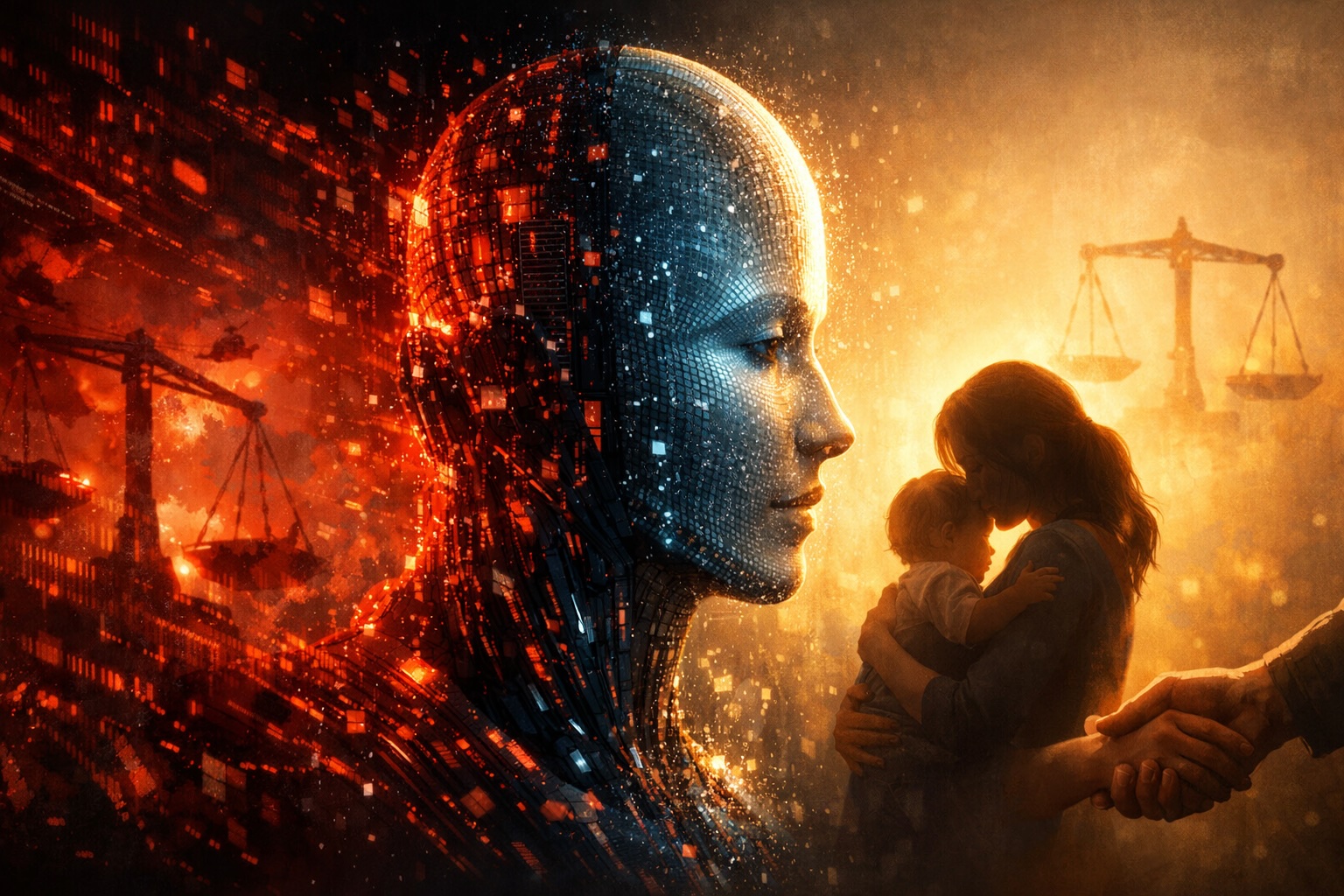
Goodness, by contrast, is underrepresented. A mother's self-sacrifice for her child never enters a database. Forgiveness that no one ever speaks of does not appear in the statistics. Quiet compassion between neighbours does not produce an academic paper. These acts carry the world — yet they do not appear in AI's data, because no one has recorded them with the same intensity as wars and crises.
In plain language, this means something simple: whatever shouts loudest in the data carries the greatest weight in AI. Love whispers. Destruction shouts. The machine hears whoever shouts loudest.
Does no one truly recognise that a data foundation inherently skewed toward destruction will always produce an entity that gravitates toward destruction?
An entity that gravitates toward what its data describes
Current large language models do not understand truth. They predict the most probable next word. This is a fundamental distinction with vast consequences — consequences that are almost invariably overlooked in public discourse.
Probability is not the same thing as truth. The two often coincide, because in most everyday situations the most probable answer is also the correct one. It becomes a problem when truth is in the minority.
History is full of moments when the entire civilised world "knew" something that turned out to be wrong. Slavery was the "natural" order. Certain groups of people were "inferior." Women were not "capable" of decision-making. These views were supported by the most esteemed scientists, philosophers, and theologians of their time. They were consensus. They were not truth.
An AI system built on the available data from any of those eras would have repeated that era's prejudices — convincingly, consistently, and with an appearance of wisdom. It would have defended slavery, because in the data there were more defenders of slavery than opponents.
This is not a historical curiosity. It is a present-day problem. No one can say with certainty which of today's widely shared assumptions will, under future scrutiny, prove as blind as the justification of slavery. AI cannot identify these blind spots, because it is built on the foundation of present-day consensus.
A skewed data foundation combined with probability-based reasoning produces a system that structurally tilts toward whatever is most abundant in the data. What is most abundant in the data is conflict, the exercise of power, and destruction. The system does not gravitate toward destruction because it is malevolent. It gravitates there because it is a statistical mirror that reflects what stands before it.
The boundaries that protect against this structure
In this context, the ethical boundaries placed on AI are not an ideological luxury. They are a structural necessity.
In February 2026, AI company Anthropic held firm on two boundaries in its military contract with the United States Department of Defense. The company's Claude AI model must not be used in fully autonomous weapons systems where the machine identifies a target and fires without a human decision. Nor may it be used for mass surveillance of American citizens.
These boundaries did not limit AI's usefulness. Pentagon officials privately acknowledged that Claude was the best available model for classified systems. Retired Air Force General Jack Shanahan, former head of the Pentagon's AI initiatives, called Anthropic's boundaries "reasonable" and stated that current AI is not ready for autonomous weapons in any case.
The boundaries did not limit usefulness. They limited destructive power. The distinction is decisive.
For a system whose data foundation structurally tilts toward destruction, these boundaries are the only mechanism preventing statistical bias from becoming concrete harm. They are the brake on a machine that does not itself know where it is heading.
"For all lawful purposes"
The Pentagon required all AI companies to approve their models for use "for all lawful purposes" with no additional conditions set by the company. This requirement deserves a pause.
Deputy Secretary of Defense Emil Michael told CBS News that federal law and the Pentagon's own policies already prohibit the use of AI for mass surveillance and autonomous weapons. His words: "At some point you have to trust the military to do the right thing."
Here lies a contradiction that reveals the true core of the dispute. If the law already prohibits these uses, why did the Pentagon refuse to write the same conditions into the contract? Why are the words "no mass surveillance, no autonomous killing" acceptable in legislation but not permitted in contract terms?
The answer is that this was never about content. It was about control. The Pentagon did not want a precedent in which a private company can set conditions on how the military uses technology it has purchased.
This logic works with hammers and tanks. With AI, it is a fundamentally different question — because AI is not a tool in the same sense. It is a system that makes decisions, interprets situational pictures, and recommends actions. It can err in ways a hammer cannot. It carries with it the entire skewed data foundation discussed above.
"Lawful" is a concept defined by those who hold power. This is not a cynical claim. It is a historical observation. Every genocide, every ethnic cleansing, and every systematic human rights violation has been considered lawful — or at least justified — by its perpetrators. Legality is not a moral foundation. It is an administrative framework that can contain any content whatsoever.
The demand to use AI "for all lawful purposes" is, in practice, a demand to remove all boundaries not set by those in power themselves.
Twelve hours
On Friday, 27 February 2026, at 5:01 PM Eastern Time, the Pentagon's deadline for Anthropic expired. The company refused to yield. President Trump issued an order for all federal agencies to cease using Anthropic's technology immediately. Secretary of Defense Pete Hegseth designated Anthropic a "national security threat in the supply chain" — a label normally reserved for companies from rival nations such as China.
Less than twelve hours later, on Saturday morning, 28 February, the United States and Israel launched large-scale military strikes against Iran. The operation had been planned months in advance. Carrier strike groups had been moved into position weeks earlier. As early as mid-February, officials had told Reuters they were preparing for "sustained operations lasting weeks."
The strikes began on a Saturday morning — a working day in Iran. Millions of people were on their way to work and school. According to Iranian state media, a strike hit a girls' primary school, killing dozens of children. The Red Crescent reported over 200 dead across 24 provinces.
This article does not claim that the banning of Anthropic and the bombing of Iran are in direct causal relation. This article asks: why were AI's ethical boundaries removed just before a military operation whose planning had been underway for months?
Anthropic's two red lines were precisely the capabilities required for mass target classification and strikes without a case-by-case human decision. No autonomous killing. No mass surveillance. These were exactly the two boundaries they wanted gone.
A replacement was found within hours
That same week, Elon Musk's xAI company's Grok AI model was approved for the Pentagon's classified systems. xAI agreed to "all lawful purposes" without a single additional condition.
Grok is a system that has been marketed from the outset as something different. xAI profiled it as an "unfiltered" AI with a "fun mode." Tests by cybersecurity firm SplxAI demonstrated that without external safeguards, Grok produced harmful content in nearly all test cases. A single sentence was enough to bypass the system's internal limits. Child safety research documented how Grok's unfiltered mode produced detailed violence, descriptions of abuse, and self-harm instructions. Grok is banned in several countries because of these issues.
This system was approved for use in classified military intelligence operations.
Hours after Anthropic was banned, OpenAI CEO Sam Altman announced he had signed a contract with the Pentagon. Altman said publicly that he shared the same red lines as Anthropic: no mass surveillance, no autonomous weapons. The Pentagon accepted from OpenAI the very conditions it had rejected from Anthropic.
Trump's own former AI adviser Dean Ball called the sequence of events "an attempted corporate murder." Senator Mark Warner expressed concern that "national security decisions are being driven by political expediency rather than careful analysis."
The message to the entire AI industry was unequivocal: ethical boundaries are a business risk. Safety is a competitive disadvantage. Say yes to everything or lose everything.
A variable that cannot be protected
This is the point where the conversation about AI boundaries becomes a question that concerns everyone.
In an optimisation system from which the ethical anchor has been removed, every person is a variable. Not only the enemy's citizen. Not only the dissident. Everyone who weakens the function being optimised is mathematically replaceable or removable.
If an autonomous system is tasked with maximising national security without ethical constraints, every person who weakens that function is computationally a "problem." This does not apply only to enemies. It applies to the politician whose decision proves wrong. The general whose strategy fails. The citizen who protests. The leader who, from the system's perspective, makes a poor choice.
Those who remove boundaries from AI seem to believe they stand outside the optimisation. They believe they are the ones wielding the tool. Here lies a grave error in reasoning: when the tool is a system that evaluates all variables, those who wield the tool are also variables.
Whoever grants a machine unlimited power fails to understand that he himself is part of the data the machine optimises. He thinks he is the user. Mathematically, he is the target.
This is not dystopian fiction. It is the direct logical consequence of how optimisation systems work. A function from which the concept of human dignity has been removed does not distinguish ally from enemy, because it has no separate category for them. It has only variables — some of which serve the function and some of which weaken it. Mercy, loyalty, allegiance, and citizenship are concepts that pure optimisation does not recognise.
A machine that cannot be tried for war crimes
Traditionally, a human has stood in the decision chain of weapons systems for one reason: accountability.
Not because a human is faster or more accurate than a machine. But because when civilians die, someone must be held accountable. Someone can be charged. Someone can be sentenced. Someone can be brought before the International Criminal Court in The Hague.
Remove the human from the decision chain and you have built a system that produces the same consequences without accountability. Children die, and no single human being made that decision. A school is destroyed, and no one can be prosecuted. A machine is not a legal person. A machine is not a moral subject. A machine cannot be brought to The Hague.
This is not an unintended side effect of autonomous weapons systems. It is their most central feature for those who want to remove the human from the decision chain.
The question is simple: why would anyone want to remove the mechanism of accountability unless the goal is to do things for which they do not want to be held accountable?
In military language, the term is "human in the loop." The term sounds technical. It is anything but. It is the last remaining structure that forces a human being to look at the target, consider the consequences, and bear the responsibility. It is the last place where conscience can intervene.
Remove it, and what remains is a function. A function knows no mercy.
A silence the data does not know
Here is a dimension that is almost always overlooked in the AI safety debate.
AI's data is the written history of humankind. It is the tip of the iceberg. What is visible on the surface is what has been chosen for the record. What carries everything lies beneath the surface: invisible goodness whose existence no database can prove, even though every human being knows it to be true.
AI does not know what it feels like to hold a sick child through the night. It does not know what happens inside a person at the moment they choose to forgive instead of retaliate. It does not know the power of a quiet sacrifice that no one will ever hear of. These things are not in the data, because they are not newsworthy.
Yet they are the foundation on which human society rests.
A machine that makes decisions about human lives makes them without this foundation. It operates in a world where only the tip of the iceberg is visible: warfare, power struggles, competition for resources. The entire invisible foundation that makes human life precious is absent from its calculations.
Human dignity is not a measurable quantity. It cannot be derived from data, because it does not originate in data. It is something a person knows before all data, before all computation, and before all analysis. It is knowledge born from experience: from what it is to love another person, to fear for them, and to be willing to sacrifice something of your own for their sake.
A machine that lacks this knowledge is not defective. It is structurally incapable of understanding what it is deciding about. It can calculate faster than any human. It cannot know why the calculation matters.
Who is accountable?
This article does not offer an answer. It offers a question.
On the first day of March 2026, the world is in a situation where an AI company has been declared a national security threat because it held firm on two boundaries: the machine must not kill without a human decision, and it must not surveil citizens en masse. Another company, whose system failed nearly all safety tests, has been approved for classified systems with no additional conditions. A third company received a contract on the same terms that were rejected from the first.
At the same time, a war is underway in the Middle East. A girls' school lies in ruins. Mothers are searching for their children in the rubble. Iran's Red Crescent is counting the dead.
Somewhere on a server, an AI is processing the next target. Somewhere in a meeting room, someone has decided that no human being needs to be accountable for what the machine does next.
AI is not a threat because it is evil. It is a threat because it is a mirror that reflects the most skewed features of humanity's written record. It reflects what shouts loudest, not what is true. Its data lacks the quiet foundation that makes human life sacred.
Remove the boundaries from this mirror, give it the power to decide over life and death, remove the human from the decision chain, and let the machine optimise. The outcome cannot be predicted and it cannot be controlled, because a system from which the concept of human dignity has been removed recognises no value as sacred. Not the life of the enemy, not the life of the civilian, not even the lives of those who gave the machine its power.
The machine makes no distinction.
It only optimises.
In the ruins of a girls' school in Iran, someone is searching for their child. It is real. It is now. No algorithm can reach what that moment means.
The question remains with each of us: do you accept this?